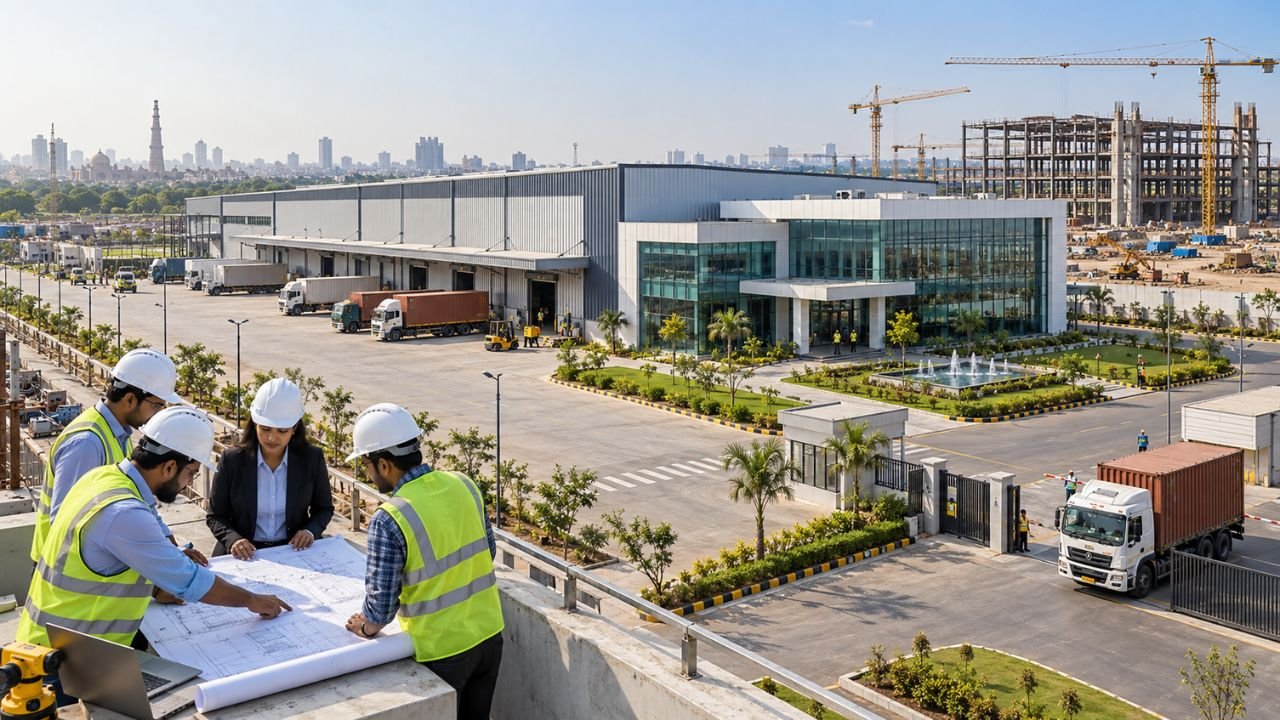
Every civil engineering student and young site engineer in India faces the same challenge: how to turn drawings into realistic numbers. Estimation and Costing Civil Engineering Basics give you that skill. In 2026, with cement prices at ₹340–₹450 per bag, labour shortages pushing daily wages to ₹750–₹1,200, and thousands of projects flowing through GeM and state portals, accurate estimation decides who wins tenders and who loses money.
Estimation means calculating the quantities of materials and labour required from drawings and specifications. Costing means finding the actual rate for each item and arriving at the total project cost. Together they form the backbone of every successful residential, commercial, or infrastructure project. Whether you are preparing for SSC JE, GATE, or simply supervising a G+1 house in Agra, mastering these basics helps you prepare BOQs, control budgets, and avoid 20–40% cost overruns.
This guide explains everything in simple language with real Agra/UP examples, tables, and step-by-step methods. By the end you will confidently prepare preliminary and detailed estimates using IS 1200 rules and current DSR/PWD rates.
What is Estimation and Costing in Civil Engineering?
Estimation is the process of working out the quantities of different items of work from drawings, specifications, and site conditions. It answers “how much material and labour is needed”.
Costing (or rate analysis) is the process of finding the cost per unit of each item by adding material cost, labour cost, plant cost, overheads, and profit. It answers “what will be the total money required”.
Together, estimation and costing civil engineering basics help you:
- Check project feasibility before starting
- Prepare accurate tenders
- Control expenditure during execution
- Arrange funds from banks or clients
In 2026, clients and government departments demand detailed estimates with BOQ in Excel, so these fundamentals are more important than ever.
Before diving into complex formulas, most professionals start with a broad view. You can learn how to estimate construction cost manually to get a quick “thumb rule” figure before starting your detailed takeoff.
Importance and Need for Estimation & Costing Basics in 2026
Accurate estimation and costing directly affect project success in today’s market:
- Tender success — Government and private clients compare your rates with DSR/PWD. A realistic estimate wins more bids.
- Budget control — You can track daily/weekly expenditure and stop overruns early.
- Fund management — Banks release money only against detailed estimates and stage-wise progress.
- Avoid disputes — Clear quantities and rates reduce arguments during final bill settlement.
- Career growth — Students who master these topics clear campus placements and SSC JE exams easily.
With 5–8% inflation and labour shortages in Uttar Pradesh, a small error in estimation can turn a profitable project into a loss-making one.
Choose Your Construction Services
Connect with verified experts for your project. We provide professional
General Contractors, Sub-contractors, Builders, and Material Suppliers.
Our network also includes specialized 3D Rendering Developers and Interior Experts.
Types of Estimates in Civil Engineering
Civil engineers use different types of estimates at different stages:
| Type of Estimate | Purpose | Accuracy | When Used |
| Preliminary / Approximate | Feasibility and rough budget | ±20–30% | Client enquiry, loan application |
| Detailed Estimate | Tendering and execution | ±5–10% | After drawings are final |
| Revised Estimate | When scope changes during work | ±10% | Mid-project variations |
| Annual Repair & Maintenance | Yearly upkeep of buildings | ±10% | Government & society buildings |
A complete estimate also includes:
- Work charged establishment (supervision staff)
- Tools and plant
- Contingencies (usually 3–5%)
- Water and electricity charges
For a small Agra house project, you start with a preliminary estimate using plinth area method and later prepare a detailed estimate for tender.
In 2026, for large-scale or government projects, your detailed estimate becomes a core part of the DPR in construction (Detailed Project Report). This document is essential for securing technical and financial approvals.
Units of Measurement and Rules in Estimation
IS 1200 lays down the standard units and rules:
Common Units
- Earthwork, concrete, brickwork in foundation → Cum (cubic metre)
- Plaster, flooring, brickwork in superstructure → Sqm (square metre)
- Steel reinforcement, pipes → Kg or Rmt (running metre)
- Doors, windows, sanitary fixtures → Nos (numbers)
Important Rules
- Measure net quantities after deductions for openings
- Round off dimensions to nearest 0.01 m
- Separate measurement for work in different conditions (e.g., foundation in rock vs soil)
- Add 5–10% wastage for materials like cement and sand
Always mention the unit clearly in your BOQ to avoid disputes during payment.
For example, if you are calculating for a residential project, knowing the construction cost per sq ft in India for 2026 allows you to cross-check if your detailed item-wise estimate is within the current market average.
Methods of Taking Out Quantities (Quantity Takeoff Basics)
Two main methods are used in building estimation:
- Long Wall – Short Wall Method
Used for simple rectangular buildings.
- Long walls = centre-to-centre length + 2 × wall thickness
- Short walls = centre-to-centre length – 2 × wall thickness
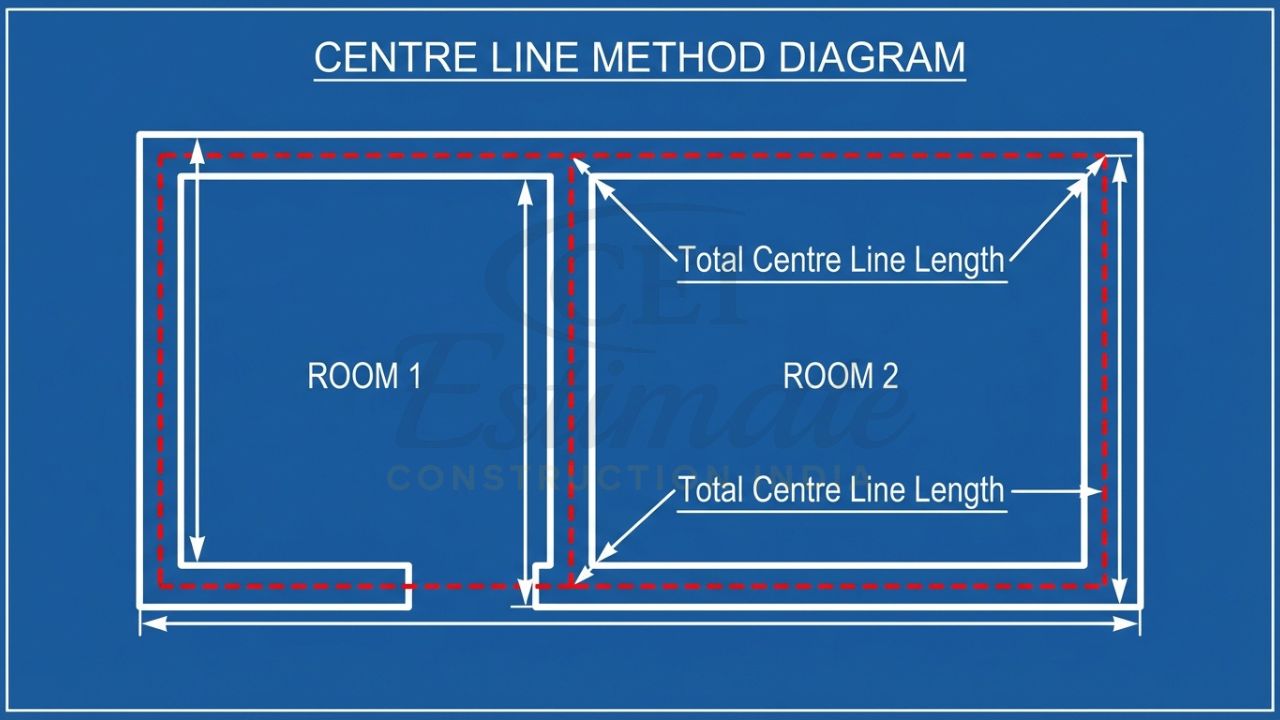
- Centre Line Method
Best for buildings with many cross walls.
Total centre line length = 2 × (length + breadth) – 4 × wall thickness (for one floor)
Multiply by breadth and depth to get volume.
Example for a 10 m × 8 m room with 230 mm walls
Centre line length = 2(10 + 8) – 4×0.23 = 35.08 m
Brickwork volume (230 mm thick, 3 m height) = 35.08 × 0.23 × 3 = 24.2 Cum
Practise both methods on simple house plans before moving to complex structures.
If you are working on a standard residential plan, such as a 3BHK, understanding these methods is the first step to answering the client’s biggest question: “how much does it cost to build a 2000 sq ft house?”
Rate Analysis Basics in Civil Engineering
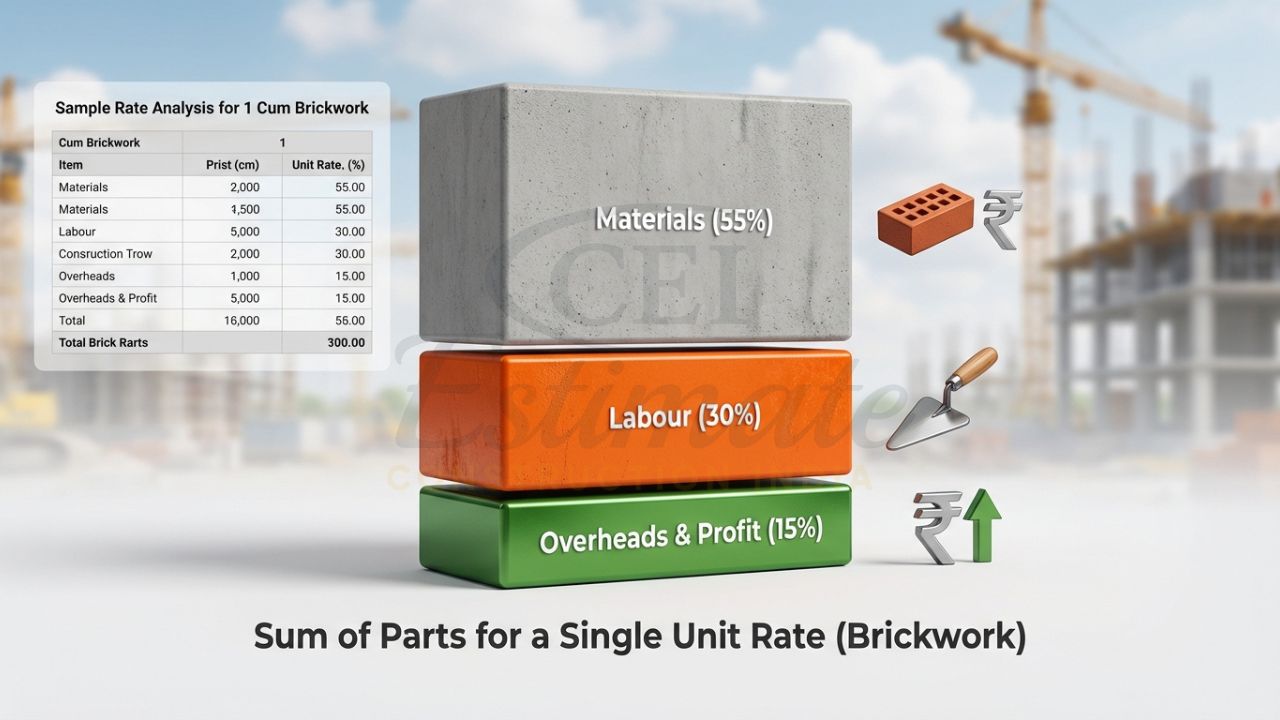
Rate analysis finds the cost of one unit of work by adding:
- Material cost
- Labour cost
- Plant & tool cost
- Overheads (5–10%)
- Contractor’s profit (10–15%)
Sample Rate Analysis for 1 Cum Brickwork in 1:6 mortar (Agra 2026 rates)
| Item | Quantity | Rate (₹) | Amount (₹) |
| Bricks (9″ wall) | 500 Nos | 8.50 | 4,250 |
| Cement (1:6) | 0.22 bag | 400 | 88 |
| Sand | 0.35 m³ | 45/cft | 560 |
| Mason + helper labour | 1.5 days | 1,200/day | 1,800 |
| Total | — | — | 6,698 |
Add 10% contractor profit and 3% contingencies to arrive at final rate ≈ ₹7,500 per Cum.
Always update rates from latest DSR or local market quotations.
Earthwork Estimation Basics
Earthwork is usually the first item in any estimate.
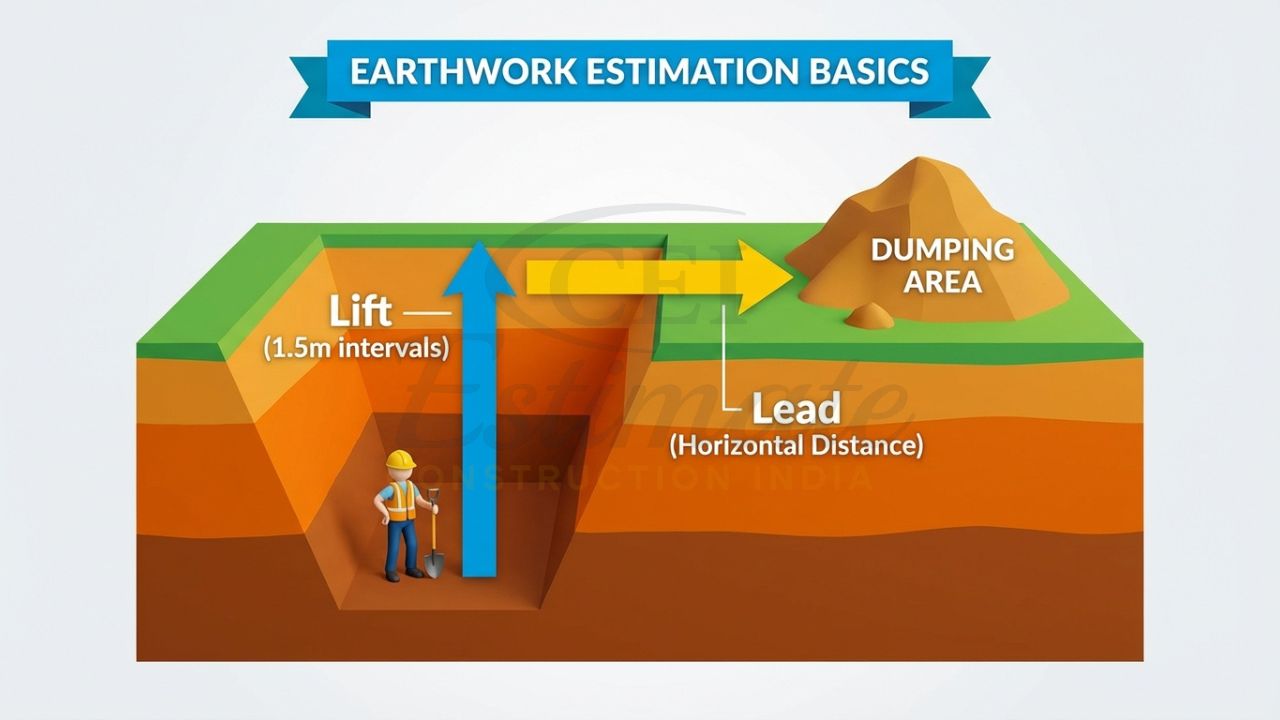
Lead and Lift
- Lead: horizontal distance from excavation to dumping
- Lift: vertical distance (every 1.5 m lift adds extra labour)
Volume Calculation Methods
- Mid-sectional area method (for roads)
- Trapezoidal formula: Volume = (b + d)/2 × L × depth (b = bottom width, d = top width)
Example: Foundation trench 50 m long, 1.2 m wide, 1.5 m deep
Volume = 50 × 1.2 × 1.5 = 90 Cum
Add 10% for irregular sides and 5% for lead & lift charges.
Specifications and Valuation Basics
Specifications describe quality and workmanship:
- Cement: OPC 43/53 grade, ISI marked
- Sand: Zone II, clean, free from clay
- Brickwork: 1:6 cement mortar, English bond
Valuation finds the market value of an existing building. Common methods:
- Cost method (replacement cost minus depreciation)
- Rental method (net rent × year’s purchase)
For students, focus on cost method and depreciation (straight line or sinking fund).
Tendering and Rate Analysis
Once your quantities are ready, you apply rates. This leads to the formal bidding process. Understanding what is a tender in construction is vital for engineers who want to work with government departments or large private developers.
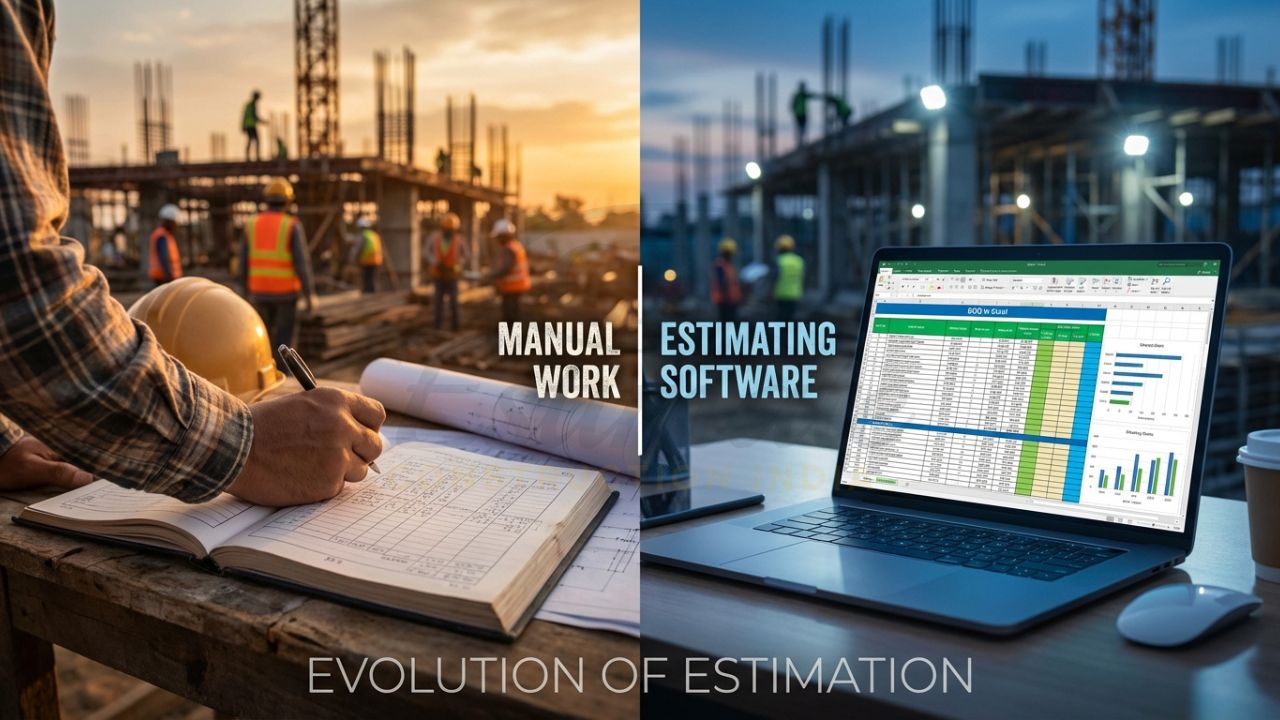
While manual estimation is great for learning basics, modern firms often use technology to speed up the process. Even in international markets, the best construction estimating software in the UK or similar Indian platforms are becoming standard to ensure 100% accuracy.
Common Mistakes in Estimation & Costing for Beginners
- Using wrong units (Sq ft instead of Sqm)
- Forgetting wastage and contingencies
- Taking quantities from carpet area instead of built-up area
- Using last year’s rates without updating
- Missing items like curing, scaffolding, or dewatering
- No separate measurement for different floors or conditions
- Ignoring lead and lift in earthwork
- Mixing labour rates of mason and helper
Always cross-check with a senior or use a standard checklist.
Conclusion
Estimation and Costing Civil Engineering Basics form the foundation of every successful project in India 2026. From preliminary estimates using plinth area method to detailed rate analysis using DSR rates, these skills help you prepare accurate BOQs, win tenders, control costs, and deliver projects profitably.
Start practising with simple house plans, maintain a rate register updated every quarter, and always add proper contingencies. Students who master these basics clear competitive exams easily, while contractors reduce losses and improve margins.
Combine manual methods with [Link: BOQ Format in Excel for Construction] for faster and more professional results. Keep learning, keep estimating accurately, and you will build a strong career in civil engineering.
Ready to get an accurate, customised construction estimate for your project in 2026?
At Construction Estimator India our professional estimating team delivers detailed BOQ and cost reports in just 48 hours.
Construction cost estimation services start at just ₹10,000 INR only.
Contact us today:
📞 Phone / WhatsApp: +91 86306 76890
✉️ Email: info@constructionestimatorindia.com
Don’t overpay or underbid — get your precise 2026 construction cost per sq ft estimate now and win more projects with confidence!
Frequently Asked Questions (FAQs) – Estimation and Costing Civil Engineering Basics
What is the difference between estimation and costing in civil engineering?
Estimation calculates the quantities of materials and labour required from drawings. Costing finds the actual money required by analysing unit rates (material + labour + overheads). Together they form estimation and costing civil engineering basics used for tenders, budgeting, and fund sanction in India 2026.
What are the main types of estimates used in civil engineering projects in India?
The main types are Preliminary (rough budget), Detailed (for tendering), Revised (when scope changes), and Annual Repair estimates. A complete estimate also includes contingencies (3–5%), work charged establishment, and tools & plant. Students must know all types for exams and real projects.
How do you perform rate analysis for items like brickwork in 2026?
Rate analysis adds material cost (bricks + cement + sand), labour cost (mason + helper), and 10–15% profit + overheads. For 1 Cum 230 mm brickwork in Agra 2026 you need 500 bricks, 0.22 bag cement, and 1.5 days labour. Total comes to ₹6,500–7,500 per Cum after adding profit and contingencies.
What are the common methods for taking out quantities in building estimation?
The two popular methods are Long Wall–Short Wall and Centre Line method. Long Wall–Short Wall is simple for rectangular buildings. Centre Line method is faster when there are many cross walls. Both follow IS 1200 rules and give accurate quantities for BOQ preparation.
Why is understanding estimation and costing basics important for civil engineers in 2026?
Accurate estimation helps win tenders on GeM/CPPP, control project costs amid inflation and labour shortages, and prepare bankable documents. Engineers who master estimation and costing civil engineering basics get better placements, avoid disputes, and deliver projects profitably in today’s competitive market.