
- Homepage
- Cement Calculator for Blocks
Cement Calculator for Blocks
Highly Accurate Blocks Material Estimation
🧱 Cement Calculator for Blocks
📊 Block Wall Material Estimation
| Item | Quantity |
|---|---|
| Number of Blocks | |
| Cement Required | |
| Sand Required |
Download Estimate Report
The Cement Calculator for Blocks (also known as Block Masonry Mortar Calculator or Concrete Block / AAC Block Mortar Estimator) is a powerful online tool designed to help builders, contractors, masons, civil engineers, and homeowners accurately estimate the quantity of cement, sand, and water required for mortar in blockwork construction using concrete blocks, solid blocks, hollow blocks, or AAC (Autoclaved Aerated Concrete) / fly ash blocks.
Accurate material estimation is one of the most important steps in modern masonry works, especially with the growing popularity of larger, lighter blocks in India. Using this calculator, you can quickly determine the mortar requirements for block masonry, helping you control project costs, avoid material shortages or excess, and reduce wastage on site.
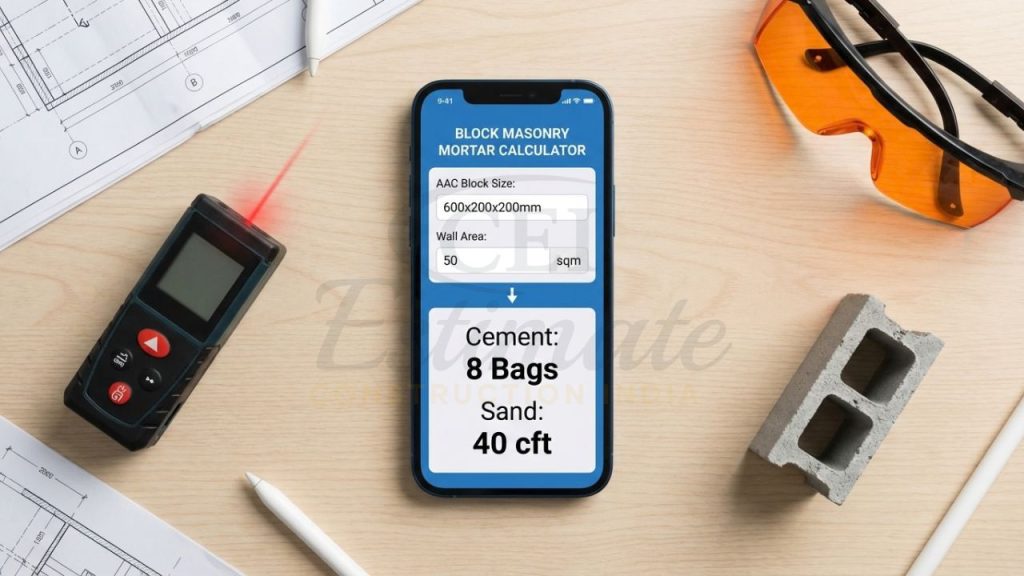
Instead of complicated manual calculations involving block volume deduction, joint thickness, and dry volume adjustments, the block cement calculator provides instant and reliable results based on wall dimensions, block size, mortar joint thickness, mix ratio, and wastage/dry volume allowance.
What is Block Masonry / Block Wall Construction?
Block masonry involves laying precast concrete blocks (solid, hollow, or lightweight AAC) with cement mortar to form strong, durable walls. Blocks are larger than traditional bricks, resulting in fewer joints, faster construction, better thermal insulation (especially AAC), and reduced mortar consumption.
Common block types and sizes in India (2026 standards):
- Concrete hollow/solid blocks: 400 × 200 × 200 mm, 400 × 200 × 150 mm, 400 × 200 × 100 mm (8″, 6″, 4″ thick)
- AAC blocks: 600 × 200 × 100–200 mm (often 625 × 200 mm variants)
- Wall thicknesses: 100 mm (partition), 150 mm (internal), 200 mm (load-bearing/external)
Block walls are used in:
- Residential house walls and partitions
- Commercial building walls
- Compound/boundary walls
- Foundation plinth and basement walls
- Multi-storey structures (with reinforcement where required)
- Lightweight AAC walls for faster, eco-friendly construction
Blockwork uses less mortar than brickwork (typically 10–20% of wall volume vs. 25–35% for bricks), but precise cement and sand calculation is still essential before starting.
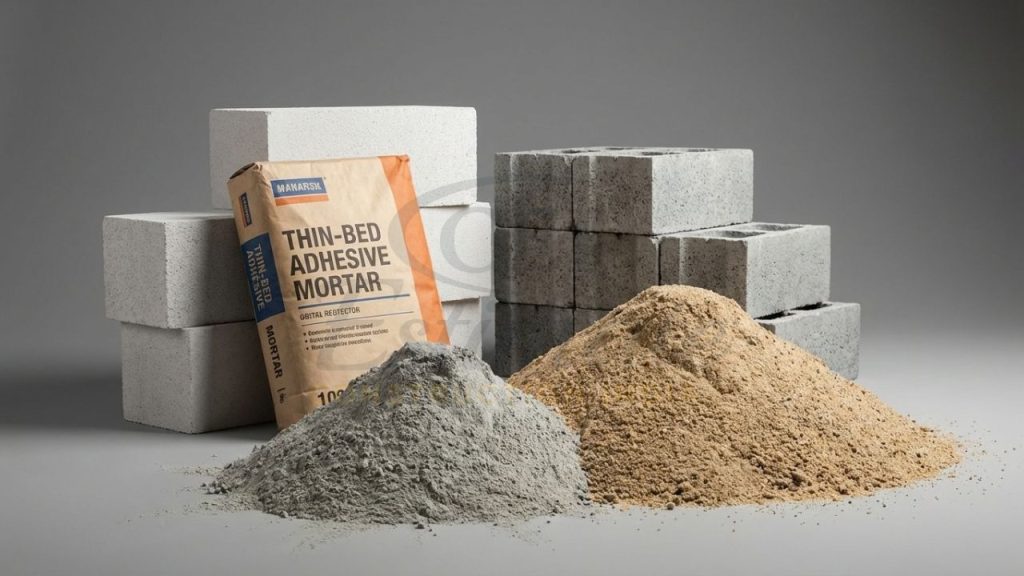
Why Use a Cement Calculator for Blocks?
Manual mortar estimation for blocks can be error-prone due to larger block sizes, variable joint thickness (usually 8–12 mm for concrete blocks, 2–3 mm thin-bed for AAC with special mortar), sand bulking, wastage, and site irregularities. A digital block calculator simplifies the process with instant estimates.
Key Benefits
- Accurate Material Estimation Determines exact quantities of: • Cement (in 50 kg bags and kg) • Sand (in m³, tons, or kg) • Approximate water (in liters) based on wall area/volume, block dimensions, joint thickness, and mix ratio.
- Reduced Material Wastage Precise estimates prevent over-ordering and minimize leftover mortar, especially important with expensive pre-mixed or thin-bed AAC mortars.
- Faster Project Planning Contractors can know requirements immediately before blocklaying begins.
- Cost Control Accurate quantities help manage masonry budgets, negotiate better rates, and compare traditional bricks vs. blocks.
Who Should Use a Blocks Cement Calculator?
This tool is useful for many in the construction industry.
- Builders and Contractors — To estimate mortar for block walls in residential/commercial projects.
- Civil Engineers — For quick BOQ preparation and site planning.
- Architects — To estimate materials during design and specifications.
- Homeowners — To understand requirements for house construction, extensions, or renovations in Delhi/NCR.
- Construction Estimators — To prepare detailed cost estimates and project budgets.
Practical Tips for Block Masonry Work
Even with accurate calculations, proper practices ensure strong, crack-free walls.
- Use first-class blocks (solid/hollow concrete or AAC) from reputable manufacturers.
- Prefer clean, well-graded river sand (Zone II/III) for mortar.
- Common mix ratios in India (CPWD/IS guidelines):
- 1:4 to 1:6 (cement:sand) for concrete block masonry (1:6 common for non-load-bearing)
- Thin-bed mortar (pre-mixed) for AAC blocks (2–3 mm joints, special adhesive)
- Maintain uniform joint thickness: 10 mm for concrete blocks, 2–3 mm for AAC.
- Wet blocks before laying to prevent rapid mortar drying.
- Provide proper curing (wet hessian or ponding) for at least 7 days.
- Add 5–10% extra for wastage, cutting, and irregular surfaces.
- For AAC, use manufacturer-recommended thin-joint mortar to reduce cement usage significantly.
Final Thoughts
A Cement Calculator for Blocks is an essential digital tool for modern, efficient construction using concrete or AAC blocks. By entering wall length, height, thickness, block size (or standard assumptions), cement-sand ratio (like 1:6), joint thickness, and dry volume factor (typically 1.30–1.35), builders can instantly determine the required quantities of cement, sand, and water.
This improves accuracy and efficiency, helps control costs, ensures stronger and more durable walls, reduces rework from shortages, and supports faster, sustainable building practices.
For any blockwork project — whether partition walls, load-bearing structures, or lightweight AAC construction in Delhi — precise mortar estimation is the foundation of solid, long-lasting masonry, and tools like block cement calculators make this process faster, smarter, and more reliable.