When a house starts showing cracks in columns, damp patches on walls, or corroded steel in just 5–8 years, the root cause is very often the wrong cement choice, not just “bad luck” or labour issues. The cement you pick today decides how your foundation will carry load in your soil conditions, how your RCC will resist groundwater and sulfates, and how well your walls and plaster will stay crack-free and leak-proof for decades.
Why Cement Grade & Brand Matter for Long-Lasting House Construction?
For a 1–4 storey house, cement is the backbone of every critical element – foundation, columns, beams, slabs, brickwork, and plaster – so any compromise directly affects structural safety and lifespan. Different cements have different heat of hydration, shrinkage, sulfate resistance and long-term strength gain, which is why grade and brand selection is not a “one-size-fits-all” decision.
If you build in areas with high groundwater, black cotton soil, or sulfate-rich soil (common in parts of UP, MP, Rajasthan, Bihar, Odisha, Chhattisgarh), you need cement with excellent sulfate and chloride resistance like PSC or good-quality PPC. In hot, dry climates, low-heat and low-shrinkage cements reduce thermal and plastic shrinkage cracks in slabs and plaster. Reputed brands also give better quality control, consistent fineness and strength, which means fewer weak pockets and fewer surprises on site.
In short: choosing the right cement type + a reliable brand is the single most important material decision for your house longevity and maintenance cost.
Which Cement Type Is Best for Full House Construction in India?
From a structural and durability point of view in 2026, PSC and PPC (and good Composite cement) are generally better choices for most Indian homes than blindly using OPC 53 everywhere.
Recommended overall strategy
- Use PSC / PPC / Composite for:
- Footings, plinth beams, grade slab, columns, beams, slabs
- Brickwork, blockwork, plaster, floor screeds
- Use OPC 53 only where:
- You need high early strength and fast deshuttering under proper curing and supervision.
- Use OPC 43 for:
- Non-critical RCC and masonry where sulfate risk is low, and you want smoother finishing or quick availability.
PSC vs PPC vs OPC – which is best?
Portland Slag Cement (PSC)
- Excellent resistance to sulfate and chloride attack, ideal for aggressive soils and high groundwater.
- Low heat of hydration, better crack control in mass concrete and thick foundations.
- High long-term strength, particularly beneficial for foundations and RCC in G+1 to G+3 houses.
Portland Pozzolana Cement (PPC)
- Very widely used for house construction; gives good workability, lower shrinkage and better finish for brickwork and plaster.
- Lower heat generation, better resistance to chemical attack than plain OPC, and very economical.
- Excellent for slabs, beams and general RCC when proper curing is done.
Composite Cement (IS 16415)
- Blends clinker with both slag and fly ash; aims to combine PSC + PPC benefits in one cement.
- Good all-round durability, workability and strength; increasingly available from brands like Dalmia and Chettinad.
OPC 43 Grade
- Moderate early strength, commonly used where workability and finishing are important, like general RCC and plaster in low-sulfate areas.
- Acceptable for non-aggressive soils where groundwater is not highly contaminated.
OPC 53 Grade
- High early strength, faster setting and rapid strength gain, useful when shuttering must be removed quickly.
- Higher heat of hydration and shrinkage risk, so not ideal as default cement for entire house unless design and curing are carefully controlled.
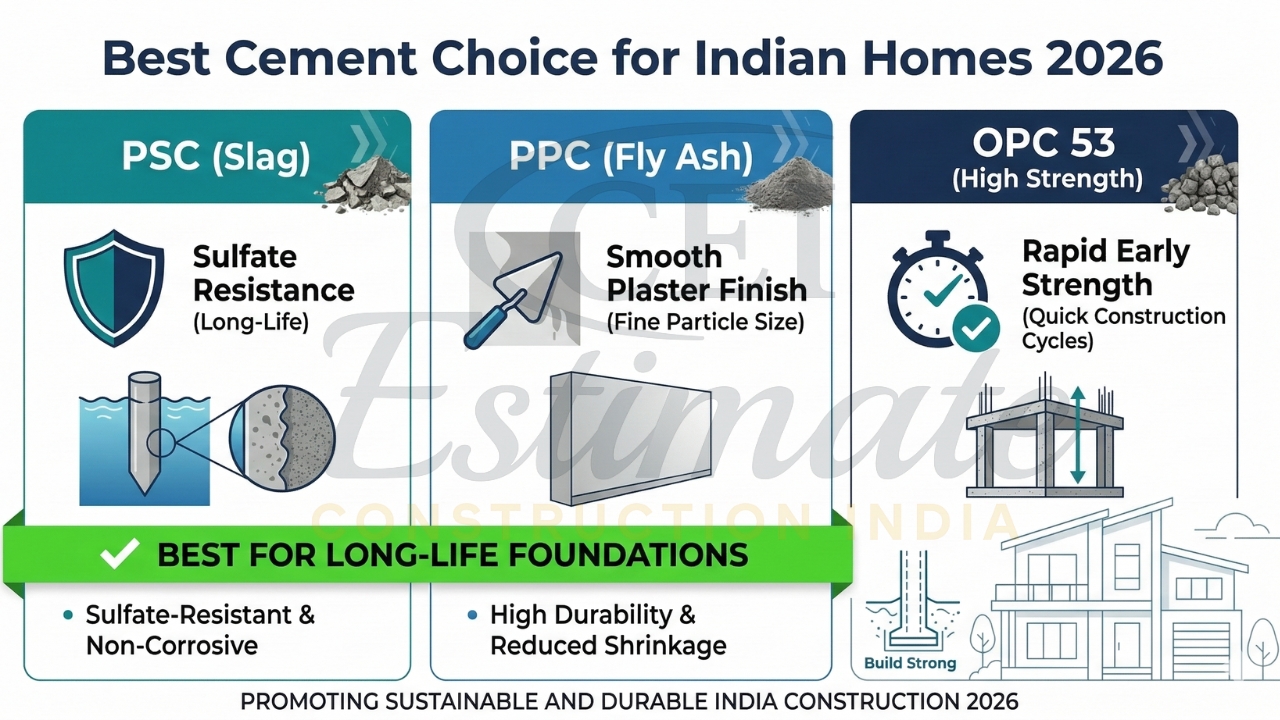
PSC vs PPC vs OPC – Simple Comparison Table
| Cement Type | Best Grade for Home | Sulfate Resistance | Workability | Long-Term Strength | Approx Price (50 kg) – 2026 | Best Region / Soil Type |
| PSC | PSC (IS 455) | Excellent – ideal against sulfates & chlorides | Good to very good | High, strong gain over time | ₹340–₹410 depending on brand & city | High groundwater, coastal, black cotton & sulfate-rich soils (Odisha, Chhattisgarh, AP, Telangana, East/Central belt) |
| PPC | PPC (IS 1489) | High – good for most soils & groundwater | Very good, easy for brickwork & plaster | High long-term, slightly slower early strength | ₹340–₹410 per bag for major brands | All regions; hot climates, normal to moderately aggressive soils – ideal for most Indian homes |
| Composite | IS 16415 | Good overall durability | Good, balanced properties | Good to high, depends on brand | ₹330–₹400 approx. | Central/North India, mixed soil conditions, where Composite is easily available |
| OPC 43 | 43 Grade | Moderate, acceptable in low-sulfate soils | Good, smooth finish | Good, but lower durability vs PPC/PSC in aggressive conditions | ₹360–₹430 depending on brand and market | Low-sulfate soils, normal groundwater, interior regions where durability exposure is moderate |
| OPC 53 | 53 Grade | Moderate, needs stronger design & curing control | Medium, faster setting | Very high early strength; long-term good but crack risk higher | ₹370–₹450 per bag (premium range) | Only for fast-track RCC in low-sulfate soils with good curing & supervision |
Why PSC/PPC combo is #1 recommendation: for most Indian plots (Tier-2/3 cities and rural areas with mixed soil and variable groundwater), a combination of PSC for foundations + critical RCC and PPC for superstructure RCC, brickwork and plaster gives the best balance of durability, crack resistance and cost.

Top 10 Best Cement Brands for Home Construction in India 2026
Below are the most widely trusted house-construction brands many contractors and homeowners use in North, East, Central and West India in 2026. Prices vary by state and dealer, but typical PPC/PSC bag rates fall between ₹340–₹430 per 50 kg in March 2026.
- UltraTech Cement (PPC & Premium PSC/Composite)
- Pros: Very consistent quality, good PPC and Premium variants for RCC, brickwork and plaster; good workability and long-term durability.
- Price range 2026: ₹380–₹450 per 50 kg depending on region & variant.
- Regional strength: Strong presence pan-India, especially in North, West and Central regions.
- Feedback: Contractors like its predictable strength and finish; homeowners see fewer cracks and seepage complaints when mixed and cured properly.
- ACC Cement (Suraksha / PPC / PSC)
- Pros: ACC Suraksha and PSC/PPC grades known for reliable performance in RCC and plaster; good sulfate resistance when using PSC in aggressive soils.
- Price range: Around ₹370–₹440 per bag in most markets.
- Regional strength: Widely available across North, East and Central India through strong dealer network.
- Feedback: Many small builders appreciate steady quality and fewer variations batch-to-batch.
- Ambuja Cement (Plus, Roof Special, PSC/PPC)
- Pros: Ambuja Plus / Roof Special are popular for slab and roof RCC due to good cohesiveness and finish; PSC/PPC give strong durability and crack control.
- Price range: Typically ₹380–₹450 per bag for retail PPC/PSC grades.
- Regional strength: Strong in North, West, and some parts of East India.
- Feedback: Homeowners often report smoother plaster finish and fewer hairline cracks when curing is done properly.
- JK Lakshmi / JK Cement (PPC / PSC / Composite)
- Pros: JK brands offer good PPC and PSC, with composite options in some markets; good workability and strength for G+1 to G+3 homes.
- Price range: Around ₹360–₹430 per bag for PPC/PSC.
- Regional strength: Strong in Rajasthan, Gujarat, North and Central India.
- Feedback: Contractors like its easy mixing and pumpability in RCC, and good finish in plaster.
- Dalmia Cement (DSP PSC / Composite / PPC)
- Pros: Dalmia DSP PSC is known for high sulfate and chloride resistance, very suitable for high groundwater and aggressive soils; Composite cement is strong all-rounder.
- Price range: Typically ₹360–₹430 per bag.
- Regional strength: Strong in East, North-East, and parts of Central and South India.
- Feedback: Good reputation for durability; many engineers prefer it for foundations in coastal/river-belt districts.
- Wonder Cement (PPC)
- Pros: Popular PPC with good workability and finish; very suitable for brickwork and plaster, and general RCC in North-West regions.
- Price range: Roughly ₹350–₹420 per bag.
- Regional strength: Strong in Rajasthan and neighbouring states of North-West India.
- Feedback: Masons like its smoothness and reduced shrinkage cracks in plaster when curing is adequate.
- Shree Cement / Bangur Cement (PPC)
- Pros: PPC with good performance for house building; popular for RCC, masonry and plaster where cost-effectiveness is important.
- Price range: About ₹340–₹410 per bag in many North and East markets.
- Regional strength: Very strong in North and East India (Rajasthan, UP, Bihar, Odisha, Jharkhand).
- Feedback: Seen as value-for-money option with reliable quality when purchased from authorised dealers.
- HeidelbergCement (Mycem PSC, Penna PSC/PPC)
- Pros: Mycem PSC and Penna PSC provide good sulfate resistance and durability, suitable for foundations and RCC in aggressive conditions.
- Price range: Around ₹350–₹420 per bag for PSC/PPC grades.
- Regional strength: Mycem – strong in Central & North India; Penna – strong in South and parts of East.
- Feedback: Professional contractors often rate its mix consistency and long-term performance positively.
- India Cements / Coromandel King (PPC / PSC)
- Pros: Coromandel King PPC/PSC used widely in South and East India; PSC suitable for foundations and RCC in moisture-prone soils.
- Price range: Typically ₹340–₹410 per bag.
- Regional strength: Strong presence in South India and some Eastern states.
- Feedback: Trusted regional brand; many small builders use it as standard choice for homes.
- Birla Corporation / MP Birla Perfect Plus (PSC / PPC)
- Pros: Perfect Plus and other PSC/PPC variants emphasise durability and sulfate resistance; good option in areas with problematic groundwater.
- Price range: Around ₹350–₹420 per bag in most markets.
- Regional strength: Strong in Central, East and North India.
- Feedback: Good market image for durable, crack-resistant performance in well-executed houses.
Simple Brand Comparison Table (for Homeowners)
| Brand (Group) | Best Grade for Home | Sulfate Resistance | Workability | Long-Term Strength | Approx Price (50 kg) 2026 | Best Region / Soil Type |
| UltraTech | PPC / Premium PSC | High with PSC/PPC | Very good for RCC & plaster | High, reliable | ₹380–₹450 | Pan-India, all soils; PSC for aggressive groundwater |
| ACC | Suraksha PPC / PSC | High with PSC | Good | High | ₹370–₹440 | North/East/Central India, normal to aggressive soils |
| Ambuja | Plus / Roof Special PPC, PSC | High with PSC, good with PPC | Very good finish | High | ₹380–₹450 | North/West; slabs & roofs, mixed soils |
| JK (Lakshmi/JK) | PPC / PSC / Composite | Good to high | Good | High for RCC | ₹360–₹430 | Rajasthan, North & Central India |
| Dalmia | DSP PSC / Composite | Excellent for sulfates & chlorides | Good | High | ₹360–₹430 | East, NE, coastal and high groundwater soils |
| Wonder | PPC | Good | Very good for plaster | High with proper curing | ₹350–₹420 | Rajasthan & nearby, normal to moderate soils |
| Shree/Bangur | PPC | Good | Good | High value-for-money | ₹340–₹410 | North & East, including UP, Bihar, Odisha |
| Heidelberg/Mycem/Penna | PSC/PPC | High with PSC | Good | High | ₹350–₹420 | Central/North (Mycem), South/East (Penna) |
| India Cements / Coromandel King | PPC / PSC | Good to high | Good | High | ₹340–₹410 | South & East India, varied soils |
| Birla Corp / MP Birla Perfect Plus | PSC/PPC | High with PSC | Good | High | ₹350–₹420 | Central, East, North with moderate to aggressive soils |
How Much Cement Do You Need for a Typical 1000 sq ft House?
Quantities vary with design, soil, number of storeys and wall thickness, but for a typical 1000 sq ft, 2–3 BHK G+1 house, you can use the following rough guide for planning (M20–M25 RCC, M15–M20 masonry/lean mixes).

Approximate Cement Consumption for 1000 sq ft G+1 House
| Work Item | Typical Grade & Use | Approx Cement (50 kg bags)* |
| Foundations & Footings (PCC + RCC) | M20–M25 with PSC/PPC (or PSC Composite mix) | 80–110 bags |
| Plinth beam & ground slab | M20–M25 RCC | 40–60 bags |
| Columns & Beams (G+1) | M20–M25 RCC (PPC/PSC; OPC 53 only if fast track) | 70–100 bags |
| Roof Slab (one floor) | M20–M25 RCC | 50–70 bags |
| Staircase | M20 RCC | 15–20 bags |
| Brickwork / Blockwork | M7.5–M10 mortar (1:6 / 1:5) PPC/Composite | 40–60 bags |
| Internal & External Plaster | 1:4 / 1:5 PPC/OPC43 | 40–55 bags |
| Misc. (lintels, chajjas, repairs) | Various | 15–25 bags |
| Total (Planning Range) | 350–450 bags |
*These are planning ranges, not a site-specific BOQ; exact quantities depend on structural design, wall thickness, room layout and soil conditions.
For an accurate cement quantity estimate based on your plot size, soil report, number of floors and local rates, WhatsApp +91 8630676890 and get a free full-house BOQ and budget.
Practical Tips for Using the Best Cement in House Construction
- Choose the right mix grades:
- Use M20–M25 for foundations, columns, beams and slabs, and M15–M20 for brickwork concrete or levelling layers.
- Prefer PSC/PPC for durability:
- In most Indian soil and climate conditions, use PSC or PPC as your primary cement for RCC and masonry, especially where groundwater or sulfate risk exists.
- Use OPC 53 only when necessary:
- Reserve OPC 53 for specific high early-strength needs (like fast deshuttering of columns/beams) in low-sulfate soils and only under strict curing and technical supervision.
- Control water–cement ratio (w/c):
- Aim for 0.45–0.50 w/c for RCC; do not make “soupy” concrete just to make pouring easy, as it weakens strength and increases cracks.
- Use clean aggregates and sand:
- Ensure coarse aggregates and sand are free from mud, organic matter and excessive silt to avoid reduced bond and long-term durability issues.
- Mixing consistency:
- Maintain consistent batching (same pan/bucket measure) and mixing time so that every batch of concrete or mortar has similar strength and workability.
- Avoid cold joints:
- Plan RCC casting so that one beam–slab–column set is poured without long gaps; cold joints create weak planes and leakage points.
- Curing is non-negotiable:
- Cure RCC and plaster continuously for 14–21 days (at least 10 days minimum) using ponding, jute bags or continuous sprinkling, especially in hot, dry climates.
- Use superplasticizer, not extra water:
- If you need higher workability (for congested reinforcement or pumping), add a good superplasticizer as per manufacturer instructions instead of adding more water.
- Protect fresh concrete from heat & rain:
- In peak summer and heavy rain, protect fresh concrete with coverings to avoid rapid drying, shrinkage or washout of cement paste.
- Store cement properly on site:
- Keep bags on wooden pallets, at least 150 mm above ground and away from walls; cover with plastic to avoid moisture and lumping.
- Test cubes for important RCC:
- For bigger houses (G+2/G+3) or poor soil, consider casting concrete cubes and testing compressive strength at 7 and 28 days to verify mix performance.
For a site-wise cement + mix design recommendation for your plot and city, WhatsApp +91 8630676890 with your location and house plan.
Need Accurate BOQ & Full House Construction Budget?
If you are confused about “How many bags will my house actually need?” or “What will be my total RCC + brickwork + plaster cement cost in 2026?”, it’s best to get a customised BOQ instead of guessing.
Step-by-step process to get your free estimate
- WhatsApp your details
- Send a message to +91 8630676890 with your:
- Plot size (e.g. 30×40, 25×50)
- City/village & state
- Planned floors (G, G+1, G+2, G+3)
- Send a message to +91 8630676890 with your:
- Share any basic drawings
- If you have a rough plan, old drawing, or architect sketch (even a photo), share it on WhatsApp for better accuracy.
- Soil & groundwater info
- Tell us if your plot has high groundwater, black cotton soil, nearby drain/nala, or visible salt deposits; this helps choose between PSC/PPC/Composite and OPC.
- Brand & budget preference
- Mention if you prefer specific brands (like UltraTech, ACC, Ambuja, Shree, Dalmia) or want a best value mix of Tier-1 and regional brands.
- Get your BOQ & cement quantity
- You’ll receive a cement quantity estimate (bags), recommended cement types/grades, and an approximate construction budget for your 1000–2500 sq ft home based on 2026 rates.
- Clarify all doubts on call/WhatsApp
- Ask your questions about RCC grades, brand choices, curing, or mix ratios – we’ll explain in simple, contractor-friendly language.

FAQ – Best Cement for Home Construction in India (2026)
- Which cement is best for full house construction in India in 2026?
For most 1–4 storey houses, a combination of PSC (for foundations & aggressive soils) and PPC (for RCC, brickwork and plaster) from a reputed brand (UltraTech, ACC, Ambuja, Dalmia, Shree, etc.) is usually the best balance of durability, crack resistance and cost. - Is OPC 53 better than PPC for my home?
OPC 53 gives higher early strength and faster setting, but it generates more heat and can increase cracking risk if curing is not perfect; PPC gives better durability, lower heat and workability, making it safer as default choice for most homes. - When should I use OPC 53 grade cement?
Use OPC 53 only when you need fast deshuttering of columns/beams or rapid early strength in controlled conditions, and only in low-sulfate soils with strict curing and good site supervision. - Is PSC cement good for house slabs and columns?
Yes, PSC is very good for RCC in foundations, columns, beams and slabs, especially where groundwater is high or soil is aggressive, because of its excellent sulfate and chloride resistance and low heat of hydration. - Which grade of concrete should I use for foundation and slabs?
For typical G+1 to G+3 houses, M20–M25 grade concrete is generally used for foundations, columns, beams and slabs, while lower grades like M15–M20 are used for non-structural concrete and levelling. - How many cement bags are required for a 1000 sq ft house?
Depending on design and number of floors, a 1000 sq ft G+1 house usually needs around 350–450 bags of cement for RCC, brickwork, plaster and miscellaneous works. For a more accurate number, share your plan on WhatsApp +91 8630676890. - What is the cement price per bag in India in 2026?
In March 2026, most PPC/PSC bags from major brands are in the ₹340–₹410 range, while OPC 43/53 generally falls between ₹360–₹430 per 50 kg bag, varying by brand and city. - Does brand really matter, or can I buy any cheap cement?
Brand matters because reputed brands control clinker quality, fineness and strength more tightly, which gives more consistent concrete and reduces risk of weak pockets and early failures. Cheap or unknown brands may save a few rupees per bag but can cost lakhs in repairs later. - Which cement is best for plastering and brickwork?
PPC is generally preferred for plastering and brickwork because it offers good workability, smooth finish and reduced shrinkage cracks compared to plain OPC. - Can I mix different cement brands on the same site?
It is better to stick to one brand and type for each structural element to maintain uniformity; if you must mix due to availability, avoid mixing brands within the same structural pour and maintain consistent type (PPC with PPC, PSC with PSC).
Conclusion – Build Once, Build Strong: Choose the Right Cement
If you are building your dream house in a Tier-2/3 city or village – whether in Uttar Pradesh, Delhi NCR, Uttarakhand, Rajasthan, MP, Bihar, Punjab, Haryana, Jharkhand, Chhattisgarh, Odisha, AP, Telangana or elsewhere – the smartest decision is to choose PSC/PPC/Composite from a trusted brand and use OPC 53 only where really needed under proper curing. Combine this with correct mix design (M20–M25 for RCC), low water–cement ratio, good aggregates and disciplined curing, and your house can stay strong, crack-resistant and leak-free for decades.
To avoid over- or under-buying and to match the cement type to your soil, groundwater and structural design, get a customised BOQ and cement quantity estimate before you start.
WhatsApp now on +91 8630676890 for:
- Free full-house BOQ (foundation to finishing)
- Exact cement quantity calculation for your plan
- Complete home construction budget estimate as per 2026 rates in your city
Build it once. Build it strong.
Message +91 8630676890 on WhatsApp today and get your free expert cement and BOQ guidance before you place your first order.