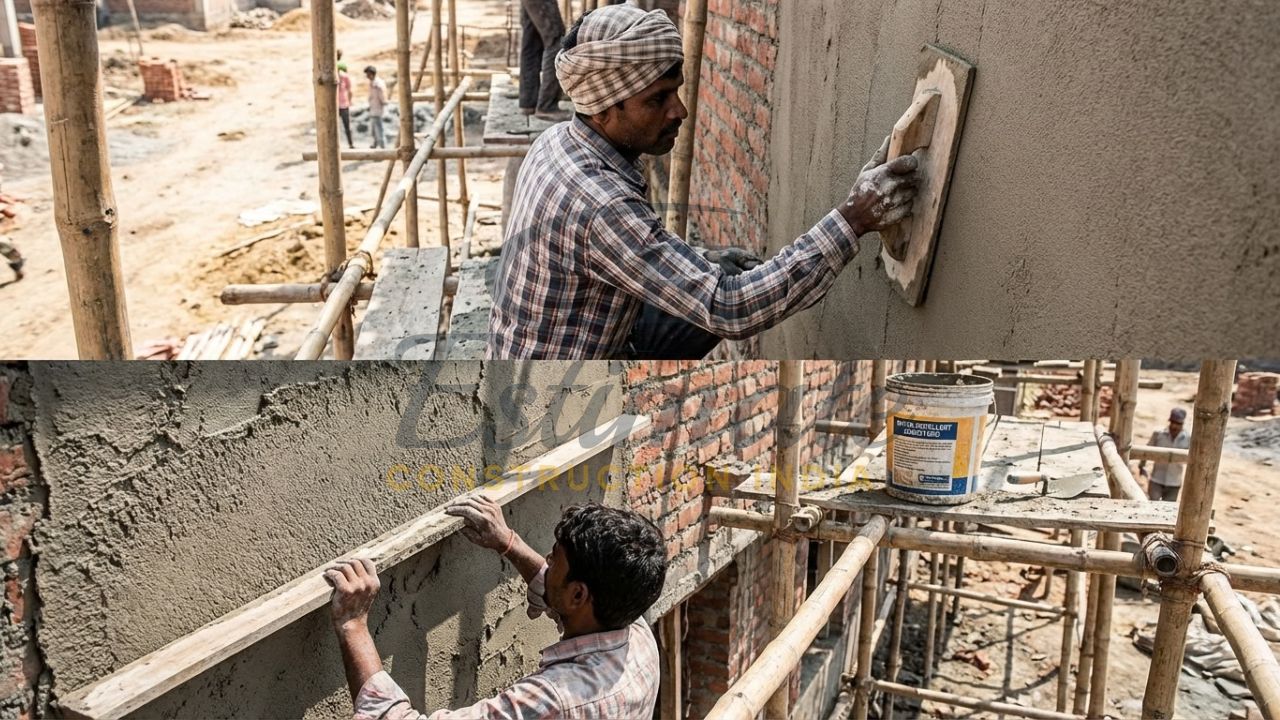
Exterior plaster is your first line of defence against rain, heat, UV and pollution, yet many houses start showing cracks, damp patches and peeling paint within just 1–2 monsoons because the wrong cement type was used or the mix and curing were not controlled properly.
Why Cement Choice Is Extra Important for Exterior Wall Plaster?
Interior plaster is mostly cosmetic and protected from direct rain and harsh sun, but exterior plaster is always exposed to wet–dry and hot–cold cycles. That means the cement must handle continuous expansion–contraction without developing shrinkage and thermal cracks.
For exterior walls, the cement must give:
- High resistance to sulfates and chlorides (groundwater, contaminated soil, polluted rain).
- Low permeability and good water repellency to reduce seepage and dampness inside rooms.
- Low heat of hydration and low shrinkage so that micro-cracks do not open up in the first few weeks.
- Strong bonding with brick/block/concrete and enough breathability so that trapped vapour can escape instead of pushing paint out.
That is why the same OPC 53 cement that performs well in RCC beams and slabs can actually become a problem in exterior plaster due to higher heat and shrinkage.
Suggested image: “Close-up of cracked exterior plaster on Indian house due to wrong cement choice”
Which Cement Type Is Best for Exterior Plaster in India?
For most Indian climates in 2026, PSC and good quality PPC / composite cement clearly outperform plain OPC for exterior plaster.
- PSC (Portland Slag Cement) – excellent sulfate and chloride resistance, very low permeability, low heat of hydration, best for rain-prone and humid areas.
- PPC (Portland Pozzolana Cement) – very good workability, lower heat, low shrinkage, economical and widely available; great second choice.
- Composite Cement (IS 16415) – blends multiple mineral additives (slag + fly ash) to give balanced workability, durability and strength for external walls.
- Special waterproof PPC/PSC variants – factory-added water-repellent additives for better resistance against rain penetration.
- OPC 53 – fast strength gain but high heat and shrinkage; avoid for exterior plaster to reduce crack risk.
- OPC 43 – can be used only in very dry, low-exposure areas when PSC/PPC not available; still not the first preference.
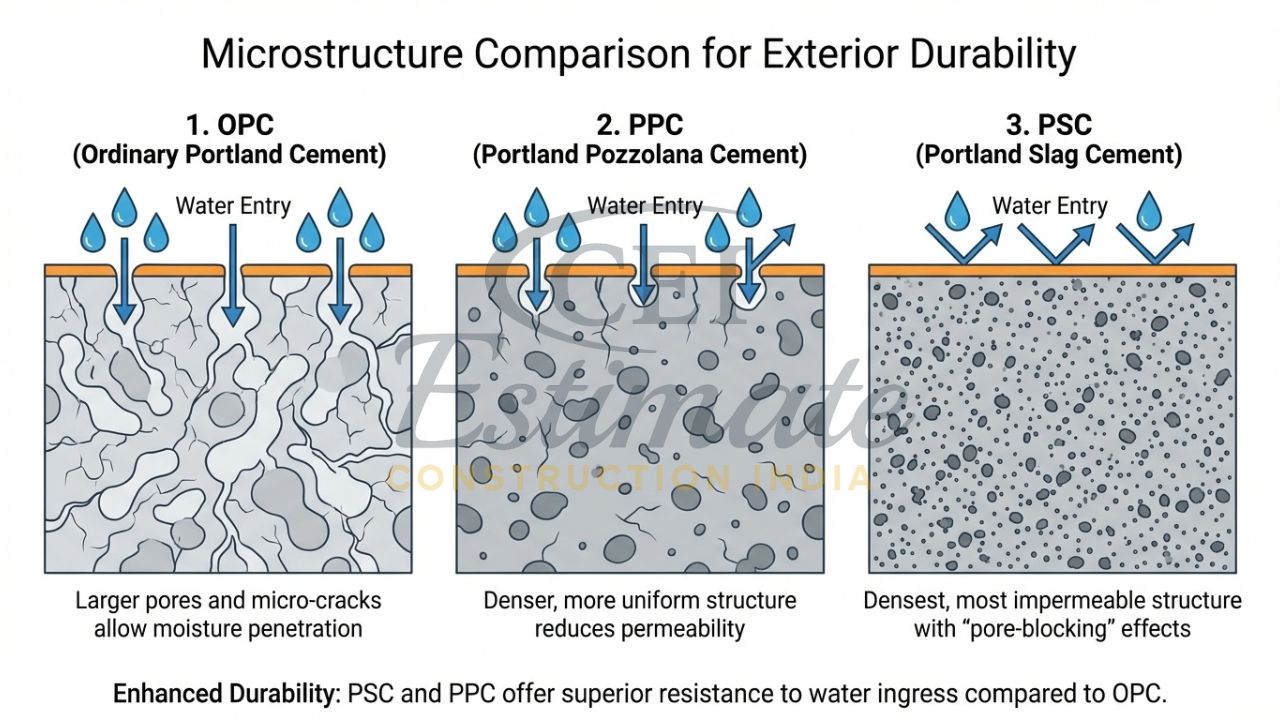
PSC vs PPC vs OPC for Exterior Plaster – Quick Comparison
| Cement Type | Heat & Shrinkage | Water Permeability | Chemical Resistance (sulfate/chloride) | Workability for Plaster | Exterior Crack Risk | Typical Use Recommendation 2026 |
| PSC | Very low (cool) | Very low (dense microstructure) | Excellent – best among three | Smooth, slightly slower set | Very low | No.1 choice for exterior plaster, especially rain-prone / coastal / high-moisture zones |
| PPC | Low | Low | Very good | Very good, easy to spread | Low | Very good choice for most exterior walls in moderate exposure, economical |
| OPC 43 | Medium | Medium | Moderate | OK, sets faster | Medium | Use only where climate is dry and work needs speed; not preferred |
| OPC 53 | High (hot) | Higher | Lower than PPC/PSC | Stiffer, less forgiving | High | Avoid for exterior plaster; more cracks, more maintenance |
Bottom line: For small-medium contractors and homeowners in North & Central India, PSC or a good PPC / composite cement – preferably a water-repellent variant – is usually the best and safest long-term option for exterior walls.
Suggested image: “Best cement type comparison chart for exterior plaster – PSC vs PPC vs OPC 2026”
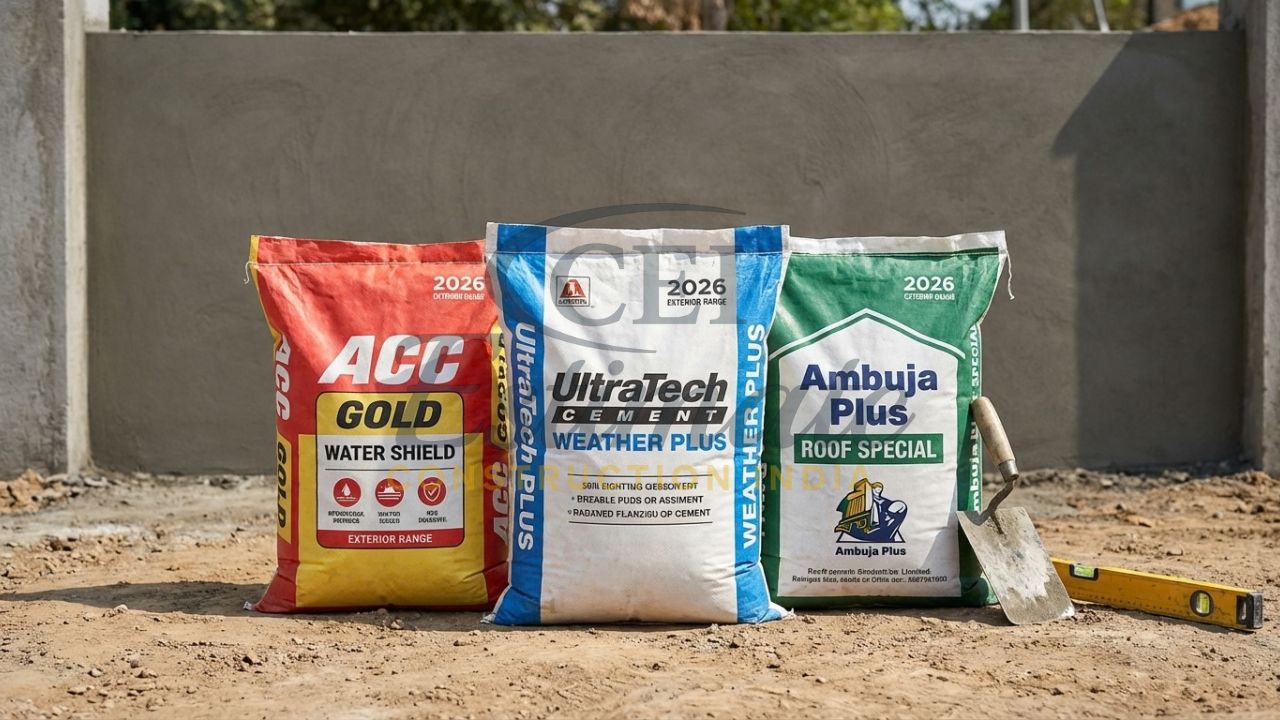
Top 10 Best Cement Brands for Exterior Walls in India 2026
Below are 10 highly trusted Indian brands/variants commonly used for durable exterior plaster in 2026, with typical retail price bands. Actual rates vary by state, transport and dealer, so always confirm with your local supplier.
Overall 2026 benchmark: PPC and PSC cements for house construction usually retail around ₹330–₹410 per 50 kg bag depending on brand and location.
1. UltraTech Premium / UltraTech Weather Plus
- Cement type: PPC / PSC / composite range depending on region; Weather Plus and Premium are positioned as durable, moisture-resistant cements for housing.
- Why good for exterior: Good workability, denser microstructure, better resistance to moisture and aggressive agents than plain OPC.
- Water repellency & cracks: Lower permeability and lower heat help reduce seepage and hairline cracking on facades.
- Approx. 2026 price (50 kg): ₹390–₹460 depending on state and variant; 2025 data shows Premium, Weather Plus and PSC around ₹395–₹415 per bag in many markets.
- Regional strength: Very strong in Delhi NCR, UP, Rajasthan, MP, Chhattisgarh, Andhra, Telangana – easy to source even in semi-urban and many rural markets.
- Mason feedback: Easy spreading, consistent colour and finish, fewer shrinkage cracks when curing is done properly.
2. ACC Gold Water Shield (Water-Repellent PPC)
- Cement type: PPC with water-repellent properties, marketed specially for damp resistance and longer-life plaster/brickwork.
- Why good for exterior: Factory-added hydrophobic additives improve resistance to water ingress, ideal for external walls and parapets.
- Water repellency & cracks: Very good for monsoon-driven seepage; PPC base keeps heat of hydration low, reducing surface cracks.
- Approx. 2026 price (50 kg): Indicative ₹360–₹440; recent market listings show ACC Gold Water Shield around the mid ₹350–₹380 band in several locations.
- Regional strength: Strong presence in Bihar, Jharkhand, Odisha, Chhattisgarh, parts of UP and MP.
- Mason feedback: Popular for “damp-proof plaster” on boundary walls and terraces; feels smooth to work with.
3. Ambuja Plus Roof Special (Water-Repellent PPC)
- Cement type: PPC with enhanced water-resisting properties and workability, marketed for roofs and external elements.
- Why good for exterior: Superior cohesion and fineness help achieve tight, dense plaster which resists water penetration.
- Water repellency & cracks: Hydrophobic features plus low heat pozzolana base help minimise efflorescence and hairline cracks.
- Approx. 2026 price (50 kg): ₹370–₹450, aligned with premium PPC segment in many markets.
- Regional strength: Strong in North & West India – Rajasthan, Gujarat, Haryana, Punjab, Delhi NCR, parts of UP.
- Mason feedback: Gives smooth, neat finish which takes putty and paint very well; good for villas and elevation walls.
4. Dalmia DSP Cement / Dalmia PSC
- Cement type: PSC and blended cements with strong slag content; tuned for durability and less permeability.
- Why good for exterior: Slag-based PSC gives excellent sulfate and chloride resistance, ideal for coastal/humid belts and groundwater-affected areas.
- Water repellency & cracks: Very low heat and dense paste reduce micro-cracking and long-term seepage.
- Approx. 2026 price (50 kg): ₹360–₹430 depending on PSC vs DSP premium positioning.
- Regional strength: Strong in East & South – Odisha, Andhra Pradesh, Telangana, Tamil Nadu, parts of Bihar and Jharkhand.
- Mason feedback: Slightly slower set but very “solid” feel after curing; good for sea-facing or high-rainfall houses.
5. JK Lakshmi PSC / JK Super PSC
- Cement type: PSC with focus on long-term durability and smoother finish for plaster.
- Why good for exterior: High slag content protects against sulfate attack and reduces permeability, suitable for aggressive soils and polluted urban air.
- Water repellency & cracks: Low heat of hydration keeps plaster cool in hot climates, helping reduce thermal and shrinkage cracks.
- Approx. 2026 price (50 kg): ₹350–₹420 in many Tier-2/3 city markets.
- Regional strength: Strong in Rajasthan, Gujarat, Delhi NCR, Western UP, parts of MP and Haryana.
- Mason feedback: Feels creamy in plaster; many contractors prefer it for elevation and compound wall work.
6. Wonder PSC / Wonder Weather Shield
- Cement type: PSC / blended cements marketed for weather and moisture resistance.
- Why good for exterior: Combines slag benefits with tailored fineness to obtain dense, durable plaster surfaces.
- Water repellency & cracks: Performs well under alternate dry–wet cycles; fewer surface cracks when proper curing is done.
- Approx. 2026 price (50 kg): Roughly ₹340–₹410 based on similar PSC/PPC categories in semi-urban North & West India.
- Regional strength: Good coverage in Rajasthan, Gujarat, MP, parts of UP and Haryana.
- Mason feedback: Seen as a good value-for-money PSC option for exterior facades and parapet walls.
7. Shree / Bangur PSC
- Cement type: PSC and blended cements with strong foothold in Northern and Western India.
- Why good for exterior: PSC gives extra durability against moisture, sulfates and chlorides – important for foundations and external plaster.
- Water repellency & cracks: Low heat lowers crack risk; dense paste reduces seepage issues in upper floors.
- Approx. 2026 price (50 kg): Typically ₹340–₹410 in many markets, competing with other large brands.
- Regional strength: Strong in Rajasthan, Gujarat, Delhi NCR, UP, Haryana, Punjab, MP.
- Mason feedback: Reliable, easy availability, preferred for large exterior plastering jobs where consistency matters.
8. Heidelberg (Mycem PSC, Penna PSC)
- Cement type: PSC from Heidelberg’s Mycem plus PSC from Penna; both focus on durability and workability.
- Why good for exterior: Suitable for walls exposed to continuous rain and pollutants; PSC structure resists chemical attack and reduces permeability.
- Water repellency & cracks: Low-heat hydration translates to fewer thermal cracks on sunny elevations.
- Approx. 2026 price (50 kg): Usually ₹340–₹410, aligned with mainstream PSC pricing.
- Regional strength: Mycem strong in Central & North India; Penna strong in Andhra, Telangana and neighbouring states.
- Mason feedback: Recognised among engineers for long-term durability; slightly slower set but “safer” for exteriors.
9. Birla Corporation / MP Birla Weather Plus
- Cement type: PPC / PSC and weather-focused variants like Weather Plus.
- Why good for exterior: Designed to handle moisture ingress and thermal cycles; good for plaster on external walls and balconies.
- Water repellency & cracks: Blended design and carefully controlled fineness improve crack resistance versus typical OPC.
- Approx. 2026 price (50 kg): Around ₹350–₹430 depending on region and exact variant.
- Regional strength: Strong in MP, UP, Bihar, Rajasthan, Chhattisgarh.
- Mason feedback: Good finishing characteristics, less pinholes and honeycombing in plaster.
10. Coromandel King PSC / India Cements PSC
- Cement type: PSC and blended cements manufactured by India Cements.
- Why good for exterior: PSC structure offers very good resistance to chlorides and sulfates; suitable for coastal belts and high-rainfall areas.
- Water repellency & cracks: Slower heat release lowers surface stresses, reducing risk of map cracking.
- Approx. 2026 price (50 kg): Typically ₹340–₹410 in South and East India retail markets.
- Regional strength: Popular in Andhra Pradesh, Telangana, Tamil Nadu, parts of Odisha and Karnataka.
- Mason feedback: Trusted brand presence; often specified by engineers for structures facing weather.
Suggested image: “Best cement brands for exterior plaster comparison chart 2026 – UltraTech, ACC, Ambuja, Dalmia, JK, Wonder, Shree, Mycem, Birla, Coromandel”
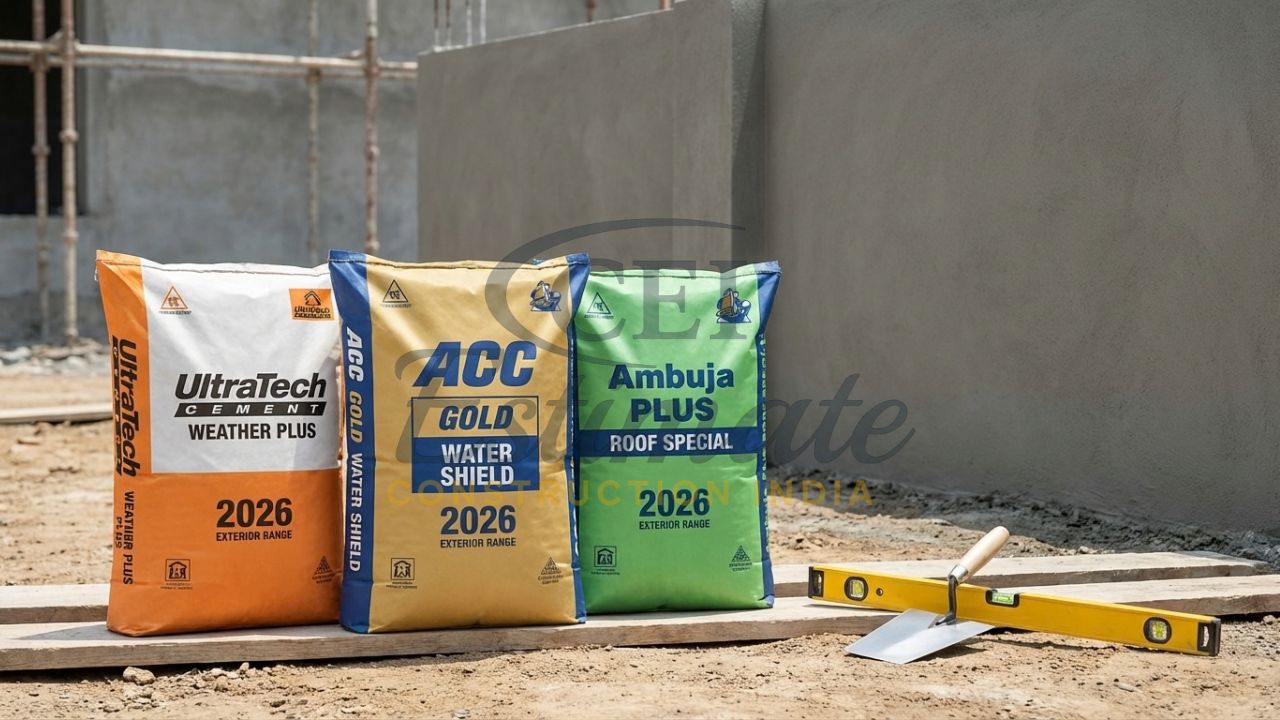
Simple Comparison Table – Top Exterior Plaster Cements (Indicative)
| Brand / Variant | Cement Type | Water Repellency* | Crack Resistance* | Durability (Rain/UV)* | Approx Price 2026 (50 kg) | Best Region / Exposure (example) |
| UltraTech Premium / Weather Plus | PPC / PSC / composite | High (denser mix) | High | High | ₹390–₹460 | All-India, especially NCR, UP, Rajasthan – general exterior plaster |
| ACC Gold Water Shield | PPC (water-repellent) | Very high | High | High | ₹360–₹440 | Rain-prone Bihar, Jharkhand, Odisha, Chhattisgarh |
| Ambuja Plus Roof Special | PPC (water-repellent) | Very high | High | High | ₹370–₹450 | North & West India, terraces and external facades |
| Dalmia DSP / Dalmia PSC | PSC | High | Very high | Very high | ₹360–₹430 | Coastal / high-moisture – Odisha, AP, Telangana |
| JK Lakshmi PSC / JK Super PSC | PSC | High | Very high | Very high | ₹350–₹420 | Rajasthan, Gujarat, NCR, Western UP |
| Wonder PSC / Weather Shield | PSC / blended | High | High | High | ₹340–₹410 | Rajasthan, Gujarat, MP – value segment exterior |
| Shree / Bangur PSC | PSC | High | High | High | ₹340–₹410 | Rajasthan, Gujarat, NCR, UP, Haryana |
| Mycem PSC / Penna PSC | PSC | High | Very high | Very high | ₹340–₹410 | Central & South India, rain-exposed walls |
| MP Birla Weather Plus | PPC / PSC | High | High | High | ₹350–₹430 | MP, UP, Bihar, Chhattisgarh external walls |
| Coromandel King / India Cements PSC | PSC | High | Very high | Very high | ₹340–₹410 | Coastal & high-rain South and East India |
*Water repellency, crack resistance and durability are indicative qualitative ratings for exterior plaster use, based on cement type behaviour (PSC/PPC vs OPC) and product positioning.
How Much Cement Do You Need for Exterior Plastering?
For a typical exterior plaster thickness of 12–18 mm, cement consumption usually falls around 0.16–0.22 bags per sq m when using a richer 1:4 cement:sand mix. Actual usage depends on surface evenness and wastage on site.
Below is a simple guide (assuming 1:4 mix and 14–16 mm average thickness):
| Plaster Area (sq m) | Approx. Thickness | Estimated Cement Bags* |
| 10 sq m | 12–14 mm | 2 bags (1.6–2.0 bags) |
| 50 sq m | 14–16 mm | 9–11 bags |
| 100 sq m | 14–16 mm | 16–22 bags |
| 200 sq m | 14–16 mm | 32–44 bags |
| 500 sq m | 14–16 mm | 80–110 bags |
*Numbers are indicative based on typical consumption of 0.16–0.22 bags per sq m for 12–18 mm plaster; always refine using actual site measurements.
If you want an accurate quantity as per your house drawings, WhatsApp your plan to +91 8630676890 and we will prepare a plaster material estimate and full BOQ.
Suggested image: “Indian mason measuring exterior wall area for plaster quantity calculation”
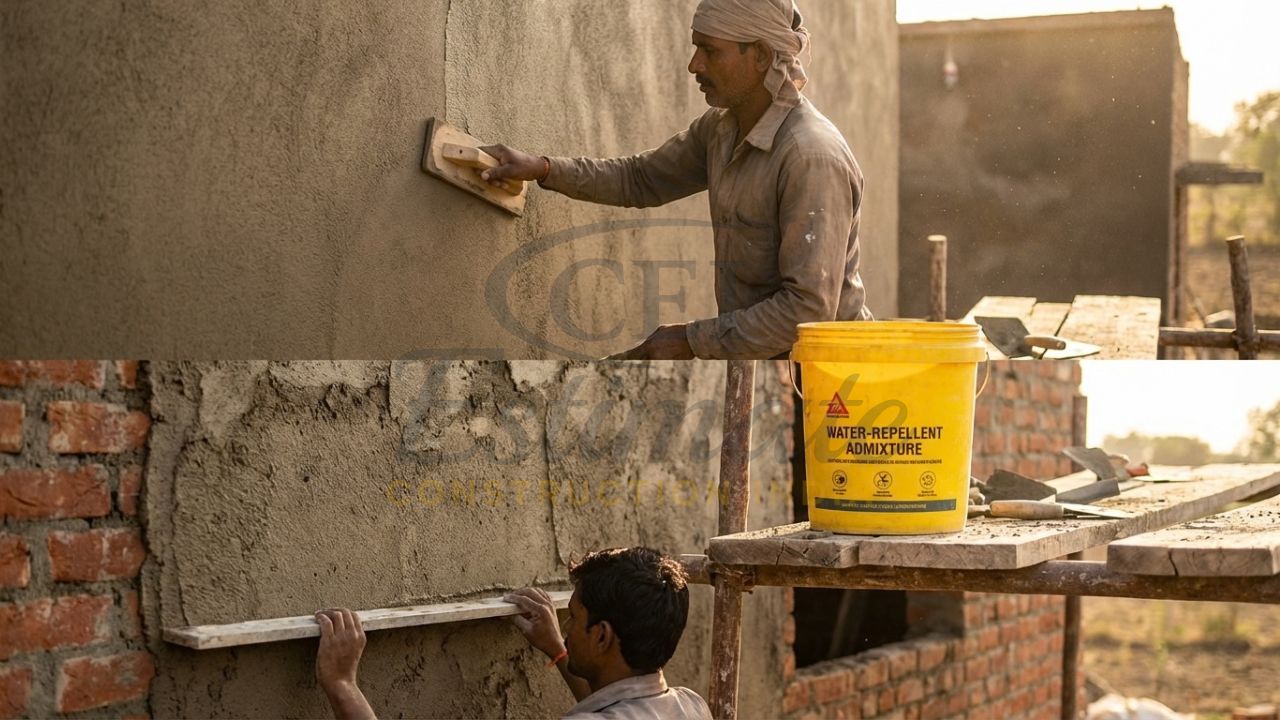
Practical Tips for Crack-Free, Weather-Resistant Exterior Plaster
Follow these site-friendly tips to get the full benefit from the best cement:
- Choose the right cement type
Prefer PSC or good PPC/composite cement (or water-repellent PPC) for exterior walls; avoid OPC 53 for plaster. PSC is especially useful in rain-prone / coastal belts. - Use a richer plaster mix
For external walls, use a 1:4 cement:sand ratio (1 part cement, 4 parts clean sand). This gives stronger, denser plaster that resists rain and impacts better than lean mixes. - Control the water–cement ratio
Keep water–cement ratio around 0.45–0.50; the mix should be workable but not soupy. Too much water is a common reason for weak, permeable plaster and early cracks. - Add waterproofing compound / plasticizer
Mix a good quality integral waterproofing compound or plasticizer as per manufacturer’s dosage. This improves workability, reduces water requirement and further cuts down seepage paths. - Use clean, well-graded sand
Prefer clean river sand or good quality crushed sand with proper grading. Avoid very fine or clayey sand – it increases shrinkage and reduces strength. - Prepare the background surface properly
- Roughen smooth RCC surfaces (hack, bush hammer or use bonding agent).
- Dampen the wall before plastering so that brick/block does not suck water from the fresh mortar.
- Adopt two-coat plaster system
Apply two coats on exteriors wherever possible:- First (base) coat: 12–15 mm to level and cover joints.
- Second (finish) coat: 8–10 mm with slightly richer and finer mix for surface finish.
- Avoid plastering in extreme sun or high wind
Direct hot sun and strong wind suck moisture out too fast and cause plastic shrinkage cracks. Try to plaster in the morning / late afternoon and provide shade/netting where needed. - Cure thoroughly for 10–14 days
Start curing after initial set and continue for at least 10–14 days for PSC/PPC-based plaster. Continuous light curing (sprinkling or wet hessian) is better than sudden flooding. - Treat vulnerable details carefully
Pay extra attention to:- Parapet tops, sunshades, window jambs, balcony edges.
- Provide drip courses and small slopes to throw water away.
- Keep expansion joints and breaks in mind
For very long walls and compound walls, provide control/expansion joints as per engineer’s guidance to reduce random cracking. - Coordinate with paint/putty schedule
Let plaster dry and cure fully before applying putty and paint. Rushing directly to painting on green plaster traps moisture and causes peeling and bubbles.
Suggested image: “Indian mason applying two-coat exterior plaster with proper curing”
If you want site-specific guidance for mix, sand selection and curing schedule for your location, WhatsApp your query and photos to +91 8630676890 and get expert advice.
Need Accurate Exterior Plaster Material Estimate & Full Budget?
If you are a contractor, mason or homeowner, we can help you avoid both shortage and over-buying of cement, sand and other materials.
Step-by-step process (simple WhatsApp workflow):
- Send your drawings / photos
WhatsApp your house plan, elevations or site photos to +91 8630676890. - Share basic details
Mention:- Plot size and number of floors.
- Whether it is new construction or renovation.
- Which state / district your site is located in.
- We calculate exact plaster quantities
We estimate exterior wall area, plaster thickness, and calculate cement, sand, waterproofing compound and scaffolding area as needed. - You get a clear BOQ and budget
You receive:- Cement and sand quantity for external plaster.
- Item-wise BOQ for plaster work.
- Approximate total plaster cost as per your local cement and sand rate.
- Optional: full house construction budget
If you like, we also prepare a complete construction budget – foundation to finishing – based on your city and target quality.
Just WhatsApp “Exterior Plaster Estimate” to +91 8630676890 and we’ll guide you step by step.
CTA – Get Your Exterior Plaster Estimate (Use This Box Prominently)
Planning exterior plaster for your house, villa or project?
- Want to know how many cement bags you actually need?
- Confused between PSC, PPC, OPC and waterproof brands?
- Need BOQ + full construction budget for your site?
👉 WhatsApp now on +91 8630676890 for a exterior plaster material quantity calculation, brand suggestion and complete BOQ.
Place this CTA box near the top, middle and end of the page to capture leads from contractors and homeowners.
FAQ – Best Cement for Exterior Plaster in India 2026
- Which cement is best for exterior wall plaster in India 2026?
For most house projects, PSC or good quality PPC / composite cement is best because of their low heat, low permeability and high chemical resistance. In very aggressive or coastal environments, PSC has a clear edge. - Is OPC 53 good for exterior plaster?
No, OPC 53 is not recommended for exterior plaster because it releases more heat and shrinks more, which increases the risk of surface cracks and long-term seepage. - Can I use OPC 43 grade for exterior plaster?
You can use OPC 43 only in relatively dry, low-exposure areas and when PSC/PPC is not easily available, but PSC/PPC are still better for durability. - Are water-repellent PPC cements like ACC Gold Water Shield and Ambuja Plus worth the extra cost?
Yes, for rain-prone states (Bihar, Jharkhand, Odisha, coastal Andhra/Telangana), water-repellent PPC gives extra protection against dampness and reduces repainting costs, so it usually pays back over time. - What is the ideal cement:sand ratio for exterior plaster?
Use a 1:4 mix (one part cement, four parts sand) for most exterior surfaces and critical elements like parapets and boundary walls. - How many days should I cure exterior plaster?
For PSC/PPC-based plaster, plan 10–14 days of continuous curing for best crack resistance and long-term strength. - How many cement bags do I need for 1,000 sq ft (about 93 sq m) of exterior plaster?
For 14–16 mm thick plaster at 0.16–0.22 bags per sq m, you may need roughly 15–20 bags for 93 sq m, depending on wastage and unevenness. For a precise figure, share your plan on WhatsApp. - Which brand is better – UltraTech or ACC or Ambuja for exterior plaster?
All three have strong PSC/PPC or water-repellent variants; the best choice depends on your state, availability, budget and exposure. In many markets, UltraTech Premium/Weather Plus, ACC Gold Water Shield and Ambuja Plus Roof Special are safe, proven exterior options. - Does using waterproofing compound remove the need for good cement?
No, waterproofing compound only assists. You must still select the right cement type (PSC/PPC), correct mix and proper curing; otherwise, compounds cannot fully compensate for poor base plaster. - Can I get a combined BOQ for brickwork plus exterior plaster?
Yes, if you share your drawing and basic specs, we can create a combined BOQ for brickwork, plaster and even RCC as part of a complete house construction budget. Just WhatsApp your plan to +91 8630676890.
Conclusion – Choose the Right Cement, Save Your Exterior Walls
If you are building or renovating in Delhi NCR, UP, Uttarakhand, Rajasthan, MP, Bihar, Punjab, Haryana, Jharkhand, Chhattisgarh, Odisha, Andhra Pradesh or Telangana, choosing the right PSC or PPC-based cement and following good site practices will decide whether your walls stay crack-free and leak-free for the next 10–15 years. PSC or water-repellent PPC (UltraTech Premium/Weather Plus, ACC Gold Water Shield, Ambuja Plus Roof Special, Dalmia PSC, JK PSC and similar) usually give the best balance of cost, durability and finish for exterior plaster in 2026.
To avoid guesswork and wastage, WhatsApp your house plan or site photos to +91 8630676890 now and get a exterior plaster material quantity calculation, detailed BOQ and complete house construction budget estimate tailored to your location.
Suggested image: “Crack-free exterior plaster using PSC cement on Indian independent house after monsoon”