If you’re a civil engineering student, a fresh diploma holder, a junior site supervisor, or even a small contractor starting out in Agra, Delhi, or any part of Uttar Pradesh, you’ve probably felt overwhelmed by the flood of technical jargon on construction sites. In 2026, India’s construction boom — driven by National Infrastructure Pipeline (NIP) projects, PMAY housing schemes, expressways, metro expansions, and data centres — has made accurate communication more important than ever. Misunderstanding even one term can lead to costly mistakes, rejected work, payment delays, or safety issues.
Basic Civil Engineering Terms Explained in simple language helps bridge that gap. Whether you’re reading a drawing in Mumbai, supervising RCC column casting in Lucknow, or preparing a BOQ for a villa project in Agra, knowing these civil engineering terms for beginners builds confidence, improves site coordination, and helps you speak the same language as senior engineers, architects, and clients. This guide covers the most common construction terms India uses in 2026 — explained plainly with real Indian site context.
Why Learn Basic Civil Engineering Terms in 2026?
Mastering basic civil engineering glossary terms offers real advantages in today’s fast-moving Indian market:
- Better job interviews & campus placements — Interviewers frequently ask definitions of footing, slump test, DPC, or bar bending schedule.
- Improved site supervision — Clear instructions reduce rework and help you catch mistakes early.
- Accurate estimation & bidding — Understanding BOQ, BBS, and variation clauses helps you prepare realistic tenders and win more profitable contracts.
- Safer & faster execution — Knowing terms like cover, curing period, and expansion joint prevents structural issues.
- Professional growth — From junior engineer to site in-charge, vocabulary is your ticket to credibility.
In 2026, with labour shortages and tight schedules, contractors and engineers who communicate precisely save time and money.
Core Structural & Building Terms Explained
Here are the foundational civil engineering definitions every beginner should know:
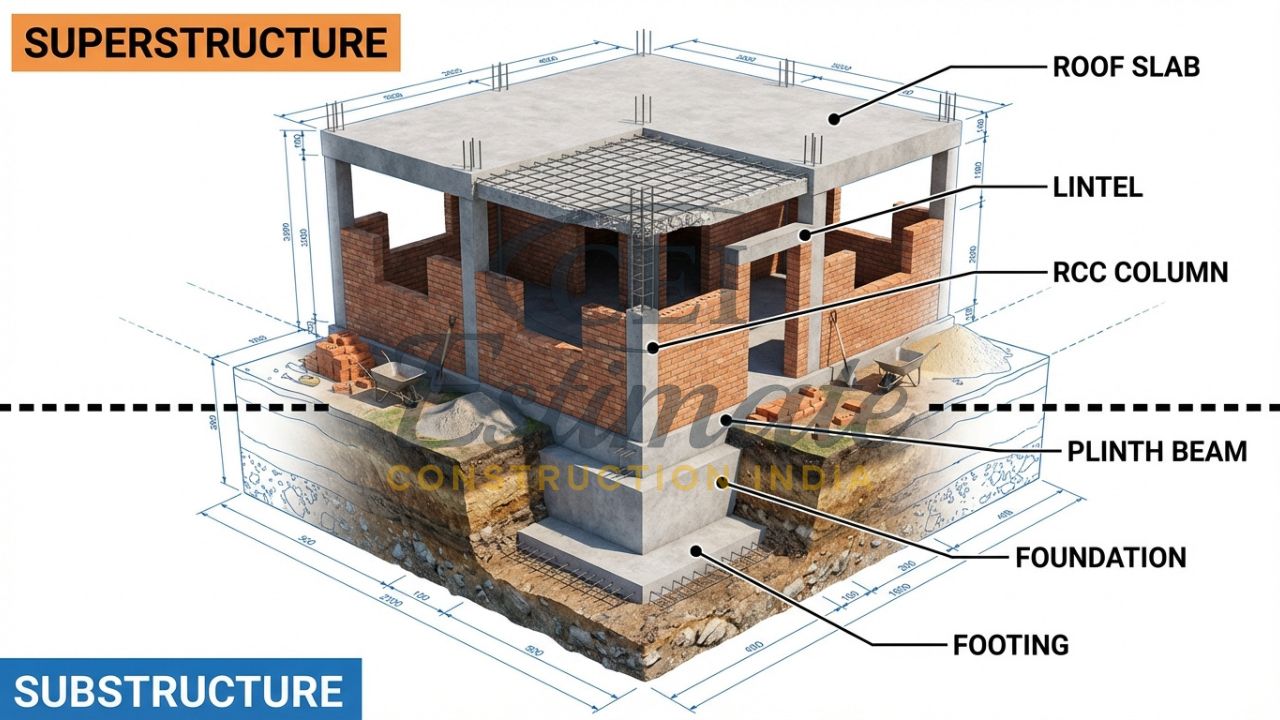
- Foundation — The lowest part of the structure that transfers load to the soil. In Uttar Pradesh, most houses use isolated footings or raft foundations due to varying soil strata.
- Footing — Widened base of column or wall that spreads load. Common sizes in residential projects: 1.2 m × 1.2 m for single-storey houses in Agra.
- Plinth — The portion between foundation top and ground floor level (usually 450–600 mm above ground to prevent dampness).
- Beam — Horizontal RCC member that carries slab load and transfers it to columns. Main beams run along longer spans.
- Column — Vertical RCC member that carries compressive load from beams/slabs to foundation. Typical residential column size: 230×300 mm or 300×300 mm.
- Slab — Horizontal RCC plate forming floors/roofs. One-way (load in one direction) and two-way slabs are common in Indian homes.
- Lintel — Small beam over doors/windows to support wall load above opening.
- Superstructure — Everything above plinth level (walls, columns, beams, slabs).
- Substructure — Everything below plinth level (foundation, plinth beams).
- RCC (Reinforced Cement Concrete) — Concrete with steel bars for tensile strength — backbone of modern Indian construction (governed by IS 456:2000).
- Formwork / Shuttering — Temporary mould for fresh concrete (wooden, steel, or aluminium). Good shuttering prevents honeycombing.
- Scaffolding — Temporary platform for masons to work at height. Bamboo + GI pipe is still widely used in smaller sites.
Choose Your Construction Services
Connect with verified experts for your project. We provide professional
General Contractors, Sub-contractors, Builders, and Material Suppliers.
Our network also includes specialized 3D Rendering Developers and Interior Experts.
Foundation & Soil Related Terms
Strong foundations prevent settlement and cracks — key in areas like Agra with black cotton soil or sandy strata.
- Bearing Capacity — Maximum load soil can safely carry per unit area (safe bearing capacity typically 100–250 kN/m² in UP plains).
- Settlement — Gradual sinking of foundation due to soil compression. Differential settlement causes cracks.
- Raft Foundation — Continuous slab foundation used when soil is weak or columns are closely spaced.
- Pile Foundation — Deep foundation transferring load to hard strata (common in high-rises or riverbank projects).
- Soil Compaction — Mechanical process to increase soil density using rollers/vibrators before backfilling.
- Backfill — Soil placed back in excavated area after foundation work (compacted in layers).
- Excavation — Removal of earth to form foundation pit (measured in cubic metres).
- Strata — Different soil layers revealed during trial pit or bore log.
- Groundwater Table (GWT) — Level below which soil is saturated — affects foundation depth and dewatering needs.

Concrete & Material Terms
Concrete dominates Indian residential and commercial construction.
- Aggregate — Inert granular material (sand + gravel/stone) making up 70–80% of concrete volume.
- Admixture — Chemical added to improve workability, setting time, or strength (e.g., superplasticizer, retarder).
- Curing — Keeping concrete moist for 7–14 days to achieve design strength. Ponding or wet gunny bags are common in India.
- Grade of Concrete — Strength indicator (M20 = 20 N/mm² compressive strength at 28 days). M20/M25 most used for residential RCC.
- Rebar — Steel reinforcement bars (TMT Fe500/Fe550 common in 2026).
- Cover — Minimum concrete thickness over rebar to protect from corrosion (25–40 mm depending on exposure).
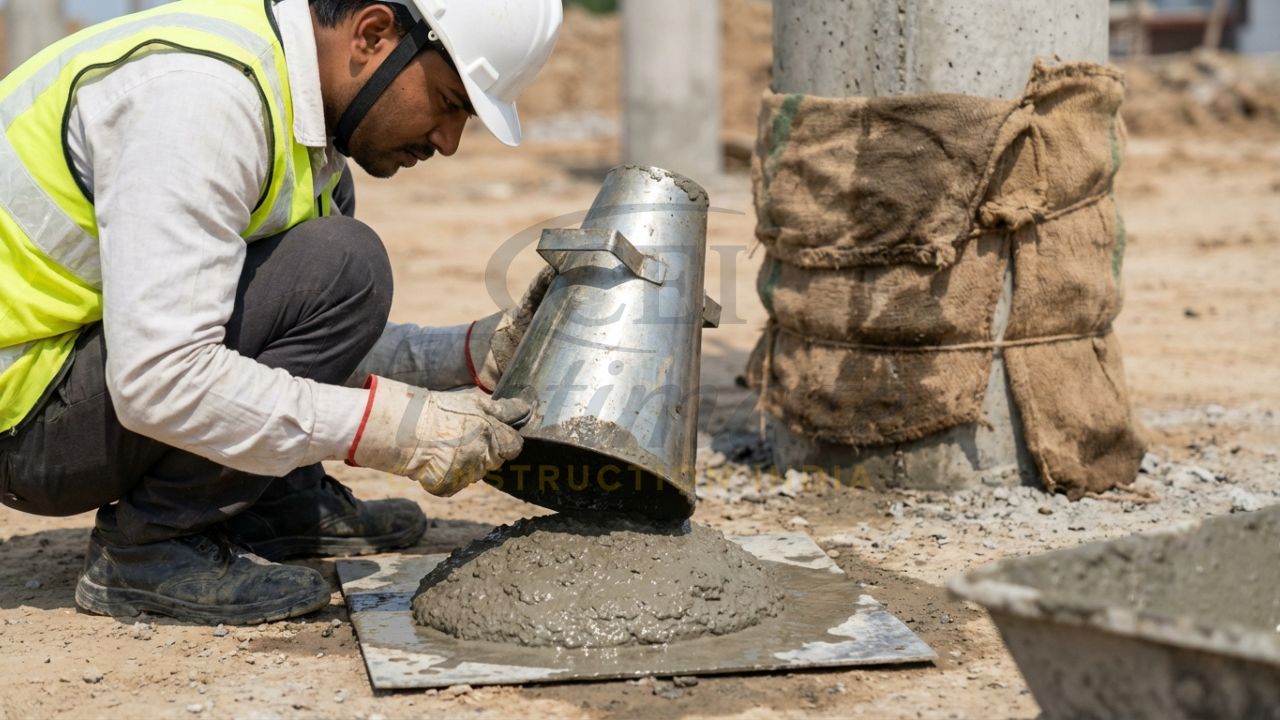
- Slump Test — Measures workability of fresh concrete (75–150 mm typical for RCC).
- Compressive Strength — Maximum load concrete can withstand before crushing (tested on cubes).
- IS Code — Indian Standard specifications (e.g., IS 456 for RCC, IS 383 for aggregates).
Surveying & Leveling Terms
Accurate levels and alignments prevent costly errors.
- Benchmark (BM) — Fixed reference point with known reduced level.
- Reduced Level (RL) — Height of a point above or below a datum.
- Chainage — Distance along centreline of road/alignment (marked every 10 m or 20 m).
- Contour — Imaginary line joining points of equal elevation.
- Backsight / Foresight — Readings taken on staff to transfer levels.
- Levelling Instrument — Dumpy level or auto level used for height differences.
- Theodolite — Angle-measuring instrument for horizontal/vertical angles.
- Total Station — Electronic theodolite + EDM for precise coordinates and distances (widely used on large sites in 2026).

Site & Construction Management Terms
These terms appear daily on Indian construction sites.
- BOQ (Bill of Quantities) — Detailed list of materials, labour, and rates for tendering.
- DPR (Daily Progress Report) — Daily record of work done, labour, material used.
- Bar Bending Schedule (BBS) — Table showing cutting length, shape, and number of rebar pieces.
- Shuttering / Deshuttering — Fixing and removal of formwork.
- Curing Period — Minimum time concrete must be kept moist (7 days minimum for OPC).
- Plastering — Applying cement mortar layer on walls (12–15 mm internal, 18–20 mm external).
- Pointing — Finishing mortar joints in brickwork.
- DPC (Damp Proof Course) — Waterproof layer at plinth level to stop rising dampness.
- Expansion Joint — Gap filled with compressible material to allow thermal movement.

Common Indian Site Terms & Acronyms
Every site in India uses these daily:
- DSR — Delhi Schedule of Rates (reference for government works across many states).
- PWD Rates — Public Works Department approved rates used for estimation.
- CPWD — Central Public Works Department — sets standards for central government projects.
- Tender — Formal offer to execute work at quoted price.
- L1 Bidder — Lowest responsive bidder who usually wins government contracts.
- Variation — Change in scope/quantity during execution.
- Extra Item — Work not included in original BOQ but required later.
- As-Built Drawing — Final drawings showing actual constructed work.
Conclusion
Mastering Basic Civil Engineering Terms Explained in this guide gives you a strong foundation — whether you’re a student preparing for interviews, a site supervisor coordinating masons, or a contractor bidding on projects in Agra, Delhi, or beyond. In 2026’s booming Indian construction market, clear communication reduces mistakes, improves quality, speeds up execution, and helps you win more tenders through accurate BOQs and confident discussions.
Start using these terms daily on-site, refer to drawings, ask questions, and keep a pocket notebook. Combine this vocabulary with practical experience and tools like Construction Cost Per Sq Ft in India 2026, and you’ll build stronger structures — and a stronger career.
Ready to get an accurate, customised construction estimate for your project in 2026?
At Construction Estimator India our professional estimating team delivers detailed BOQ and cost reports in just 48 hours.
Construction cost estimation services start at just ₹10,000 INR only.
Contact us today:
📞 Phone / WhatsApp: +91 86306 76890
✉️ Email: info@constructionestimatorindia.com
Don’t overpay or underbid — get your precise 2026 construction cost per sq ft estimate now and win more projects with confidence!
Frequently Asked Questions (FAQs) on Basic Civil Engineering Terms
What are the most important basic civil engineering terms for beginners in India?
For beginners in India, focus on structural terms (foundation, footing, plinth, beam, column, slab, RCC), concrete terms (M20/M25 grade, curing, slump test, cover), and site management terms (BOQ, BBS, DPC, DSR). These appear daily on residential and commercial sites across Uttar Pradesh and other states. Mastering this basic civil engineering glossary helps you understand drawings, give instructions clearly, and avoid costly errors right from day one.
How do terms like RCC and M20 grade concrete differ in practical site use?
RCC (Reinforced Cement Concrete) refers to concrete strengthened with steel bars for tensile strength — used for beams, columns, slabs in almost every Indian house. M20 grade means concrete designed to achieve 20 N/mm² compressive strength at 28 days (common for residential columns/slabs). On-site, you select M20 for normal loads and M25 for heavier structures or seismic zones. Proper curing and cover ensure RCC reaches its full strength as per IS 456.
Why is understanding BOQ and bar bending schedule crucial for contractors?
BOQ lists every material and labour item with quantities and rates — it’s the backbone of tendering and payment. BBS details exact cutting length, shape, and number of rebar pieces needed for each member. Accurate BOQ and BBS prevent material wastage, help calculate steel tonnage precisely, and avoid disputes during billing. In 2026, contractors who prepare error-free BOQs win more bids and maintain healthy cash flow.
What is the difference between plinth level and slab level in house construction?
Plinth level is the top of the plinth beam or DPC layer — usually 450–600 mm above ground to protect against dampness and termites. Slab level refers to the finished floor level of any storey (ground floor slab, first floor slab, etc.). In typical Indian homes, ground floor slab is cast at or slightly above plinth level. Knowing this difference helps supervisors set correct levels and avoid height mismatches.
Which civil engineering terms help in winning more tenders in India 2026?
Terms like BOQ, BBS, DSR, PWD rates, variation, extra item, L1 bidder, and as-built drawing are critical in tender preparation and execution. Understanding these shows clients and government departments that you can manage scope changes, control costs, and deliver compliant work. Combined with accurate estimation and risk assessment, strong command of these civil engineering vocabulary 2026 terms improves your tender success rate and profitability.