
Ramesh, a skilled mason working on a high-rise project in Meerut, Uttar Pradesh, had always been meticulous about his work. However, during a sudden monsoon downpour in early 2026, a structural scaffold slip caused him to fall twelve feet onto a pile of reinforcement bars, resulting in severe spinal injuries. For his contractor, Sanjay, the tragedy was compounded by the realization that he had neglected the essential workers’ comp requirements for construction businesses. Within days, Sanjay faced a flurry of legal notices, a ₹15 lakh compensation claim, and an immediate “Stop Work” order from local labor authorities that paralyzed his project. This scenario is a stark reminder that in the high-stakes Indian infrastructure landscape, safeguarding your workforce is not just a moral duty but a critical pillar of project management.
Workers’ Compensation (often referred to as Workmen Compensation Insurance) is one of the most vital and legally mandated protections for any construction firm operating in India. Due to the inherent risks of site work—ranging from falls and electrocution to material collapses—the law demands that you provide a financial safety net for your laborers. This article serves as a comprehensive, up-to-date 2026 guide on the mandatory legal requirements under the Employees’ Compensation Act 1923 and the Building and Other Construction Workers (BOCW) Act 1996. We will explore who must comply, the benefits provided, typical costs, and, most importantly, how construction estimators can accurately factor these expenses into a professional Bill of Quantities (BOQ). By the end of this guide, you will have a clear roadmap to navigate compliance, protect your cash flow, and ensure your business remains resilient against unforeseen site accidents.
What is Workers’ Compensation Insurance and Why is it Mandatory for Construction Businesses?
Workers’ compensation is a specialized form of insurance designed to cover the legal liability of an employer to pay compensation to employees for bodily injury, disability, or death occurring “out of and in the course of employment.” In the construction sector, where the workspace is dynamic and exposed to the elements, the accident rate is significantly higher than in controlled factory environments. In North India, extreme weather—from 48°C heatwaves to torrential rains—further amplifies these site hazards.
The primary reason this insurance is mandatory is to prevent a single mishap from resulting in generational poverty for a worker’s family or sudden bankruptcy for a contractor. For a business owner, a Workmen Compensation Insurance (WCI) policy acts as a “risk transfer” mechanism. Instead of paying a multi-lakh compensation payout out-of-pocket, the financial burden shifts to a professional insurer. In 2026, as infrastructure pushes into tier-2 cities like Meerut and Ghaziabad, maintaining these workers’ comp requirements for construction businesses is your ultimate shield against litigation and financial instability.
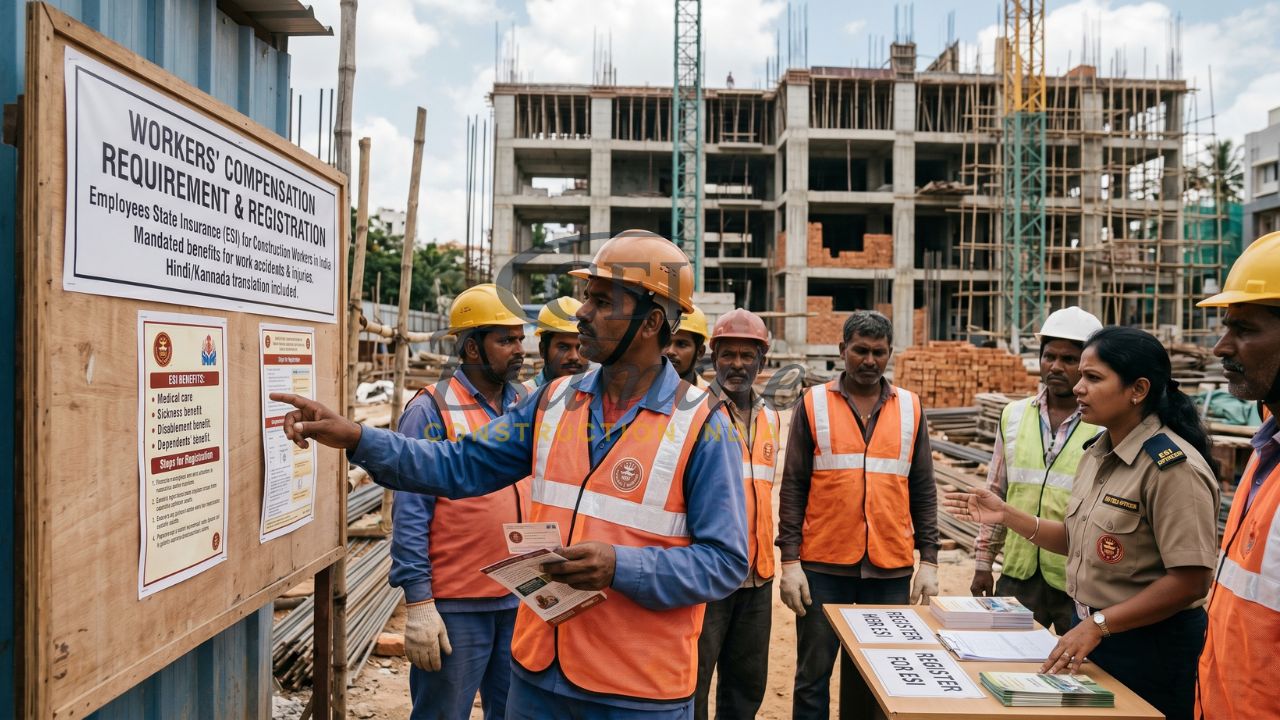
Legal Framework – Key Laws Governing Workers’ Comp in Construction
Navigating the legal landscape of Indian construction requires a firm grasp of two primary statutes that dictate how you must protect your workforce:
1. The Employees’ Compensation Act, 1923
This is the cornerstone of labor law in India. It establishes that an employer is legally liable to pay compensation regardless of whether the accident was the worker’s fault or an “act of God.” The law mandates payouts for death, permanent total disability (PTD), permanent partial disability (PPD), and temporary disability.
2. The BOCW Act 1996 and Labor Welfare Cess
The Building and Other Construction Workers Act focuses on the broader welfare of laborers. It requires every construction establishment to register with the state’s BOCW Welfare Board. A critical component of this act is the payment of a labor welfare cess—typically 1% of the total project cost—which funds state-level insurance, medical aid, and maternity benefits for registered workers.
3. Code on Social Security 2020
In 2026, the implementation of the Code on Social Security 2020 has further strengthened these protections by expanding the definition of workers and digitizing the registration process. It aims to provide universal social security to both organized and unorganized construction workers, making digital muster rolls and transparent wage records a standard compliance requirement.
Who Needs to Comply with Workers’ Comp Requirements?
A common misconception among small builders is that these requirements only apply to large firms. In reality, the workmen compensation insurance requirements for construction in India apply to almost every entity in the building process:
- Main Contractors: You are the primary party responsible for ensuring every worker on your site is insured, even if you utilize multiple subcontractors.
- Sub-contractors: Even if you only provide labor for a specific phase (like masonry or electrical), you must ensure your specific workforce is covered under a valid WCI policy.
- Small Businesses and Independent Builders: If you employ even a few helpers for a small residential project in a tier-2 city, you are legally an “employer” and must comply with the 1923 Act.
- Principal Employers/Developers: Under the “Principal Employer” clause, the property owner or developer can be held liable if the contractor fails to provide insurance.
- Self-Employed Persons with Helpers: Even individual homeowners hiring daily-wage labor for a home build should consider WCI to protect themselves from legal liability.
Specific Workers’ Compensation Requirements for Construction Businesses
Fulfilling the workers’ comp requirements for construction businesses involves more than just buying a policy. It requires a structured approach to compliance. Use this detailed checklist for your 2026 projects:
| Requirement Type | Description & 2026 Standards |
|---|---|
| Minimum Coverage | Payouts are calculated using a statutory formula based on the worker’s age and monthly wages. |
| BOCW Registration | Every worker must be registered with the State Labor Department to access welfare board benefits. |
| Labor Welfare Cess | A mandatory 1% of the project’s civil cost must be deposited with the state government. |
| Record Maintenance | Muster rolls, wage slips, and accident logs must be maintained digitally for inspection. |
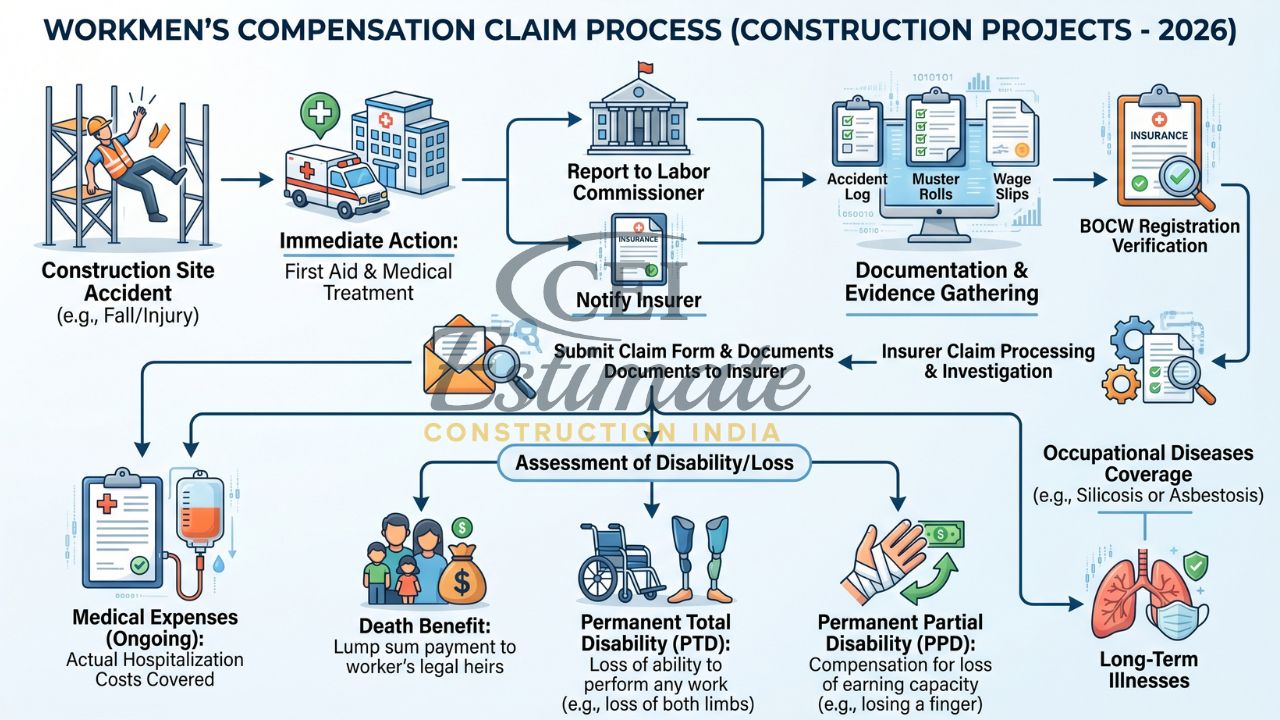
| Timely Reporting | Site accidents must be reported to the Labor Commissioner and the insurer within 24–48 hours. |
| Medical Expenses | The policy must include riders to cover actual hospitalization costs resulting from site injuries. |
Key Benefits to be Provided:
- Death Benefit: A lump sum payment to the worker’s legal heirs.
- Permanent Total Disability (PTD): Paid if the worker loses the ability to perform any work (e.g., loss of both limbs).
- Permanent Partial Disability (PPD): Compensation for loss of earning capacity due to partial injuries like losing a finger.
- Occupational Diseases: Coverage for long-term illnesses like silicosis or asbestosis.
How to Obtain Workers’ Compensation Insurance for Your Construction Business?
Securing a policy is a straightforward process if you follow these actionable steps:
- Assess Your Wage Bill: Calculate the total number of workers and their average monthly wages. The sum insured is often based on the estimated annual wage bill for the project duration.
- Choose the Right Coverage: Decide between a standalone Workmen Compensation Insurance (WCI) policy or integrating it as a rider within a Contractors’ All Risk (CAR) policy.
- Select a Reputable Insurer: Compare quotes from top-tier providers like New India Assurance, ICICI Lombard, or HDFC Ergo. Ensure they have a high claim settlement ratio in the engineering/construction sector.
- Add Subcontractors: Explicitly mention if your policy covers subcontractors’ laborers or if you require them to provide their own certificates.
- Include Occupational Disease Cover: In 2026, adding this rider is essential for projects involving extensive dust, chemicals, or demolition.
Cost of Workers’ Compensation for Construction Businesses in 2026
Budgeting for the cost of workers comp for construction business 2026 is vital for maintaining your profit margins. Unlike other insurances, WCI premiums are not based on the project value but on the risk class of the work and the total wage bill.
- Standard Rates: Premiums typically range from 0.5% to 2% of the total labor wage bill.
- Risk Factors: Workers involved in high-rise construction, heavy machinery operation, or deep excavations attract higher premiums than those in painting or finishing roles.
- Location Impact: Projects in high-risk seismic zones (like Delhi-NCR’s Zone IV/V) may see slightly higher base rates.
- Safety Record: Contractors who maintain zero-accident sites over several years can often negotiate lower “no-claim” renewal rates.
For a project in Noida with an estimated annual labor payroll of ₹50 lakhs, the insurance premium would likely range between ₹25,000 and ₹1,00,000.
Penalties for Non-Compliance with Workers’ Comp Requirements
Ignoring these mandates is a recipe for disaster. In 2026, the government has tightened enforcement to protect the migrant workforce. The consequences of non-compliance include:
- Hefty Fines: Penalties can exceed ₹50,000 per violation of the BOCW Act.
- Interest on Compensation: If a claim is delayed, courts often order the employer to pay 12% annual interest on the compensation amount to the worker’s family.
- Imprisonment: In cases of gross negligence leading to a fatality, directors and principal contractors can face criminal charges and jail time.
- Project Shutdowns: Labor commissioners have the authority to issue “Stop Work” notices, which can delay a project for months and lead to massive RERA-mandated penalties.
- Blacklisting: Your firm may be permanently barred from bidding on government tenders or securing work from large corporate developers.
Best Practices for Construction Businesses
To manage your workers’ comp requirements for construction businesses effectively, adopt these proactive strategies:
- Regular Safety Audits: Conduct weekly site inspections to identify hazards like loose scaffolding or exposed wiring. A safe site leads to fewer claims and lower long-term premiums.
- Digital Documentation: Use project management software to maintain real-time muster rolls and wage payments. This ensures that if an accident happens, your documentation for the insurance claim is ready.
- Worker Training: Provide mandatory safety briefings in local languages for every new laborer.
- Check Subcontractor Compliance: Never allow a subcontractor to start work without verifying their WCI certificate or adding their labor to your master policy.
- Enroll in PMSBY: For just ₹20 per year, help your workers link their bank accounts to the Pradhan Mantri Suraksha Bima Yojana for an extra ₹2 lakh accidental cover.
How Estimators Should Include Workers’ Comp Costs in BOQ?
At Construction Estimator India, we emphasize that insurance is a “non-negotiable” soft cost. To ensure your project remains profitable, follow these steps during the estimation phase:
- Line Item Entry: List “Worker Insurance & Statutory Compliance” as a distinct row in your Bill of Quantities (BOQ).
- Separate the Cess: Always include a separate 1% line item for the BOCW Labor Welfare Cess based on the total civil cost.
- Use Realistic Percentages: Use a rate of 1% to 1.5% of the estimated labor component to calculate the WCI premium.
- Factor in Project Duration: Ensure the premium covers the entire period from groundbreaking to handover, including any maintenance phases.
Conclusion
Understanding and fulfilling the workers’ comp requirements for construction businesses is the hallmark of a professional contractor in 2026. From the mandatory legal mandates of the Employees’ Compensation Act to the social welfare benefits of the BOCW Act, these protections form the invisible foundation of a sustainable business. By prioritizing worker safety and accurate cost estimation, you protect your firm from bankruptcy-level liabilities and ensure that the men and women who build our future are not left behind.
Don’t leave your project’s solvency to chance. Ensure your workforce is fully protected and your project costs are calculated with precision. Contact Construction Estimator India today for professional BOQ and construction cost estimation services that account for every insurance and compliance cost, ensuring your projects are both safe and profitable.
FAQ Section
What are the workers’ comp requirements for construction businesses in India?
The primary requirements include having a valid Workmen Compensation Insurance (WCI) policy under the Employees’ Compensation Act 1923, registering workers with the state BOCW Welfare Board, and paying a 1% labor welfare cess.
Is workmen compensation insurance mandatory for all contractors?
Yes, it is a statutory requirement for any employer hiring labor for hazardous work like construction. This applies to main contractors, subcontractors, and small builders.
How much does workers’ compensation insurance cost for construction?
In 2026, the premium typically ranges from 0.5% to 2% of the total labor wage bill, depending on the risk class of the work (e.g., higher for high-rise projects).
What benefits are provided under workers’ compensation?
It provides financial compensation for accidental death, permanent total disability, permanent partial disability, temporary disability, and associated medical expenses.
Do sub-contractors need separate workers’ comp coverage?
Yes, subcontractors are responsible for their own labor force. However, the “Principal Employer” is often held liable if the subcontractor fails to provide coverage.
What is the BOCW cess and who pays it?
The Building and Other Construction Workers (BOCW) cess is a 1% tax on the total project cost. It is usually paid by the project owner or developer to the state welfare board.
What are the penalties for not having workers’ compensation?
Penalties include fines exceeding ₹50,000, 12% interest on delayed compensation, project “Stop Work” orders, and potential imprisonment for gross negligence.
How to include workers’ comp cost in BOQ?
It should be listed as a separate line item under “Preliminaries” or “Statutory Requirements,” calculated as a percentage of the labor wage bill or the total project cost.
Can small construction businesses buy affordable workers’ comp?
Yes, most insurers offer budget-friendly WCI policies for small teams. Combining these with government schemes like PMSBY (₹20/year) provides a robust, low-cost safety net.How often do I need to renew workers’ compensation policy?
Most project-specific policies last for the duration of the construction contract. However, for ongoing firms, an annual “muster-roll” based policy should be renewed every year.