
- Homepage
- How to Choose the Best Quality Cement for Stair Construction in India
How to Choose the Best Quality Cement for Stair Construction in India – Expert Guide 2026
Highly Accurate Cement and Other Material Estimation
Staircases are one of the most heavily used and structurally demanding elements in any Indian home or building. Every day they endure thousands of foot impacts, point loads from furniture movement, constant abrasion on treads, and exposure to moisture, dust, and temperature fluctuations. A single wrong decision in cement selection can result in surface cracks, spalling on risers, uneven treads, hollow sounds underfoot, or even structural weakening over time — issues that are expensive and disruptive to repair.
In 2026 India, with skyrocketing real-estate prices and increasing awareness of long-term building quality, homeowners and builders in Delhi, Agra, Noida, Gurgaon, Mumbai, Bangalore, and other cities can no longer afford to treat cement choice casually. Poor-quality or mismatched cement often leads to shrinkage cracks in the waist slab, poor finishing on steps, or accelerated wear in high-traffic staircases.
The good news? Choosing the best quality cement for staircase construction is straightforward when you understand the right grades, types, and brands. This expert guide explains exactly how to choose cement for stairs so your RCC staircase remains strong, crack-resistant, safe, and visually flawless for decades. You’ll learn the role of cement in stair construction, suitable grades and types, key selection factors, top brands trusted in 2026, common pitfalls to avoid, and practical answers to the questions most people ask before pouring concrete stairs.
Understanding Stair Construction and Cement’s Role
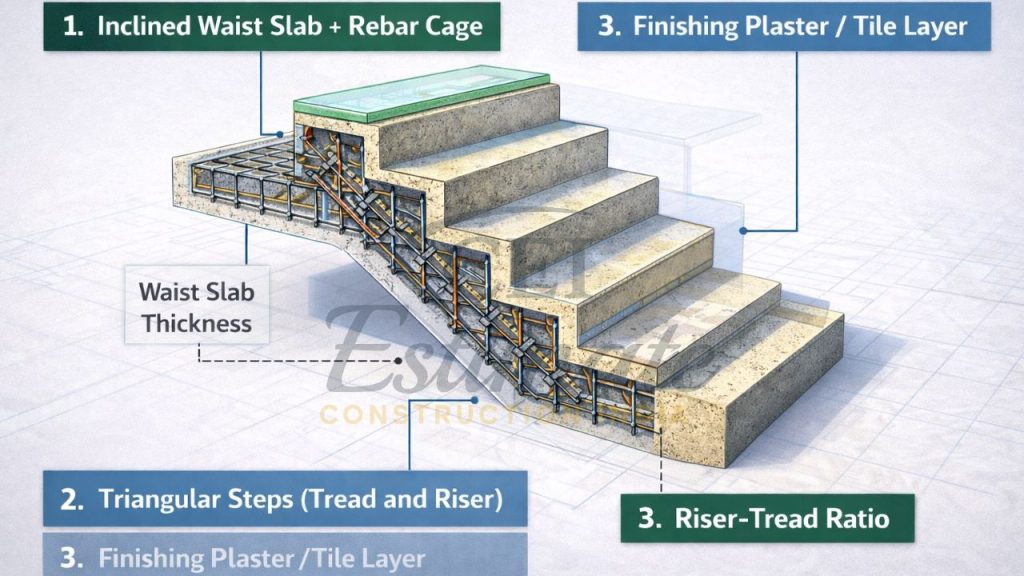
A typical RCC staircase in India consists of three main concrete components:
- Waist slab — the inclined structural slab that carries the load
- Steps — triangular sections formed on top of the waist slab (tread + riser)
- Landings — flat horizontal portions connecting flights
These elements are heavily reinforced with TMT bars (usually 8–12 mm main bars + 6–8 mm distribution bars) and poured with M20 or M25 grade concrete in most residential projects.
Cement is the binder that gives concrete its compressive strength, controls shrinkage, influences workability during placement and finishing, and determines long-term durability against wear, weathering, and micro-cracking.
For staircases, cement must deliver:
- Adequate early strength so formwork can be removed safely (usually 7–14 days)
- Low shrinkage to prevent cracks along risers and treads
- Good workability for smooth troweling and sharp edges on steps
- Resistance to surface abrasion from constant foot traffic
- Compatibility with proper curing (minimum 14 days moist curing is essential)
Residential stairs in India typically use M20 (1:1.5:3) or M25 (1:1:2) concrete. The cement portion directly affects finish quality — poor cement leads to honeycombing, weak bonding with aggregates, or powdery surfaces that wear quickly.
Cement Types and Grades Suitable for Stair Construction
Three main cement types are relevant for RCC stairs in India:
OPC (Ordinary Portland Cement) — pure clinker-based, fast strength gain
PPC (Portland Pozzolana Cement) — blended with fly ash, lower heat, superior long-term strength
PSC (Portland Slag Cement) — blended with slag, excellent chemical resistance
Here is a practical comparison for stair construction:
Cement Type / Grade | 28-Day Strength | Setting Time | Heat of Hydration | Workability & Finish | Crack Resistance | Best for Staircases in India |
33 MPa | 30–60 min | Low | Moderate | Moderate | Rarely used — insufficient for structural stairs | |
OPC 43 Grade | 43 MPa | 30–60 min | Medium | Good | Good | Most residential stairs — balanced strength & cost |
53 MPa | 20–40 min | High | Very good | Fair | Commercial / high-traffic stairs, fast-track projects | |
PPC (IS 1489) | 43–53+ MPa (long-term) | 30–90 min | Low | Excellent | Excellent | Best quality cement for residential staircase – crack-resistant finish |
PSC (IS 455) | 43–53+ MPa | 30–90 min | Low | Very good | Excellent | Coastal, humid, or chemically aggressive areas |
Key takeaway for 2026:
For most Indian homes, PPC is now the best quality cement for staircase because it offers lower heat of hydration (critical for thin waist slabs and steps), denser microstructure (better abrasion resistance on treads), and superior long-term durability. OPC 43 is still widely used and reliable when early strength is needed. OPC 53 is reserved for commercial staircases or projects requiring rapid de-shuttering.
Key Factors to Identify the Best Quality Cement for Stair Construction
Follow these expert checkpoints to select the right cement:
- Minimum Compressive Strength Residential RCC stairs require at least 43 MPa (OPC 43 or equivalent PPC). Higher is better for heavy-use stairs.
- Low Heat of Hydration Stairs have thin sections and dense reinforcement — high heat causes micro-cracks. Prefer PPC or PSC over OPC 53 unless special precautions (ice water, admixtures) are taken.
- Workability for Finishing Smooth troweling on treads and risers demands excellent flow. PPC typically outperforms OPC in workability and gives a better surface finish.
- Abrasion & Weather Resistance Exposed external stairs or high-traffic internal stairs need dense concrete. Blended cements (PPC/PSC) produce less permeable concrete that resists wear and efflorescence.
- Regional & Environmental Conditions Delhi’s dry heat → low-heat PPC Coastal humidity / sulphate soil → PSC Seismic zones → higher strength (OPC 53 or reinforced PPC)
- BIS Certification & Marking Look for IS 269 (OPC), IS 1489 (PPC), or IS 455 (PSC) mark. Insist on third-party test certificates from reputed brands.
- Freshness & Storage Condition Manufacturing date should be within 3 months. Reject bags with lumps, dampness, or torn packaging.
- Brand Reputation & Consistency Choose manufacturers with ISO-certified plants and consistent lab reports. Avoid unbranded or very cheap local brands — they often fail in long-term performance.
Top Recommended Cement Types and Brands for Stair Construction in India 2026
Best overall for residential staircase: PPC — excellent crack resistance, superior finish, and long-term durability
Best for high-traffic / commercial stairs: OPC 53 Grade — fast strength gain
Best in coastal / aggressive environments: PSC
Top trusted brands in 2026 (based on engineer feedback, lab consistency, and availability):
- UltraTech Cement — UltraTech Premium PPC is widely regarded as one of the best cement for residential staircase — superb workability and crack resistance.
- Ambuja Cement — Ambuja Plus PPC gives outstanding surface finish on treads and risers.
- ACC Cement — ACC Gold Water Shield PPC offers excellent abrasion resistance.
- JK Cement — JK Super Strong PPC is very popular in northern India for stair finishing.
- Birla Cement — MP Birla Perfect Plus and Birla Gold PPC are trusted for durable concrete stairs.
- Dalmia Bharat Cement — Dalmia DSP PPC and PSC variants excel in humid regions.
- Shree Cement — Shree Roofon Concrete Master is cost-effective yet high-performance for stairs.
- Bangur Cement — Bangur Roofon PPC is specially formulated for crack-free slabs and stairs.
- Max Cement & Chettinad Cement — Strong regional performers with consistent quality.
PPC variants from these brands dominate residential staircase projects in 2026 because they deliver the perfect balance of strength, finish, and longevity.
Common Mistakes to Avoid When Choosing Cement for Stairs
- Using low-grade cement (OPC 33 or unbranded) to save cost — leads to weak steps and early cracking.
- Choosing high-heat OPC 53 for residential stairs without proper curing — causes shrinkage cracks.
- Ignoring workability — poor-flow cement makes smooth tread finishing nearly impossible.
- Buying expired or improperly stored bags — strength loss of 20–40%.
- Skipping moist curing — even the best quality cement for staircase fails without 14–21 days of curing.
- Using different brands in one pour — inconsistent setting and strength.
- Neglecting regional climate — OPC in coastal areas accelerates corrosion.
Conclusion
Choosing the best quality cement for stair construction is a small decision with lifelong consequences. In 2026 India, PPC from trusted brands like UltraTech, Ambuja, ACC, JK, or Birla delivers the perfect combination of strength, workability, crack resistance, and long-term durability for most residential staircases. Match the cement type to your climate and usage, insist on BIS certification, and never compromise on curing.
A well-built staircase enhances safety, aesthetics, and property value — don’t let poor cement choice compromise it.
For accurate staircase material estimation, detailed BOQ including cement quantity, steel reinforcement, aggregates, or complete RCC stair construction cost planning in Delhi, Agra, or anywhere in India, contact Construction Estimator India — experts in precise, trade-specific construction estimates and quantity takeoffs.
Call/WhatsApp: 📞 8630676890
Professional estimates starting at only ₹10,000 — fast, detailed, reliable, and BIS-compliant.
Use a reliable Cement Calculator for Stairs to estimate quantities accurately and ensure optimal material usage for a strong, durable, and flawless staircase finish.
FAQs – Best Quality Cement for Stair Construction
What is the best cement for stair construction in India?
For most residential RCC stairs, PPC (Portland Pozzolana Cement) is the best quality cement for staircase in 2026 due to its low heat, excellent workability, and superior crack resistance.
Which cement grade is best for RCC staircase in residential buildings?
The best cement grade for staircase construction in homes is OPC 43 Grade or equivalent PPC. It provides sufficient strength (43 MPa+) while keeping shrinkage and heat low.
Is OPC 43 or PPC better for staircase construction?
PPC is generally better for residential stairs because of lower heat of hydration, better long-term strength gain, and smoother finishing on treads and risers. OPC 43 is still reliable and widely used.
Can PPC be used for stair construction?
Yes — PPC is not only suitable but often preferred for cement for RCC stairs India. It delivers denser concrete, reduced cracking, and excellent abrasion resistance on steps.
Which brand cement is best for concrete stairs in Delhi or India?
UltraTech PPC, Ambuja Plus, ACC Gold, JK Super Strong, and Birla Gold are consistently rated among the best cement for residential staircase projects in Delhi-NCR and across India.
How to check the quality of cement for stairs?
Check the ISI mark, manufacturing date (<3 months), no lumps, uniform grey colour, and smooth feel. Request lab test reports from reputed brands.
What cement is suitable for high-traffic staircase?
For commercial or high-traffic stairs, OPC 53 Grade or high-performance PPC gives faster strength and higher durability. Use proper admixtures for added abrasion resistance.
How much cement is needed for stair construction?
For a typical 10 ft high residential dog-legged staircase (1.2 m wide), expect 14–20 bags of cement (M20 mix). Use a reliable Cement Calculator for Stairs for exact quantities based on your dimensions.