
- Homepage
- Cement Calculator for PCC
Cement Calculator for PCC in India 2026 – Calculate Cement Bags & Concrete Volume for Plain Cement Concrete (PCC)
Highly Accurate Cement and Other Material Estimation
Cement Calculator for PCC
📊 PCC Material Estimation
| Item | Quantity |
|---|---|
| Wet Volume | |
| Cement Required | |
| Sand Required | |
| Aggregate Required |
Download Report
Plain Cement Concrete (PCC) serves as the foundational layer in most construction projects, providing a stable, level base for footings, floors, columns, roads, and other structural elements. Accurate estimation of PCC materials ensures proper load distribution, prevents settlement issues, and controls costs while minimizing wastage.
A Cement Calculator for PCC is an essential construction estimation tool that helps contractors, builders, engineers, and homeowners in India quickly determine the concrete volume, cement bags, sand, and aggregate required for PCC works. By entering dimensions and mix details, it delivers precise quantities based on standard Indian civil engineering practices.
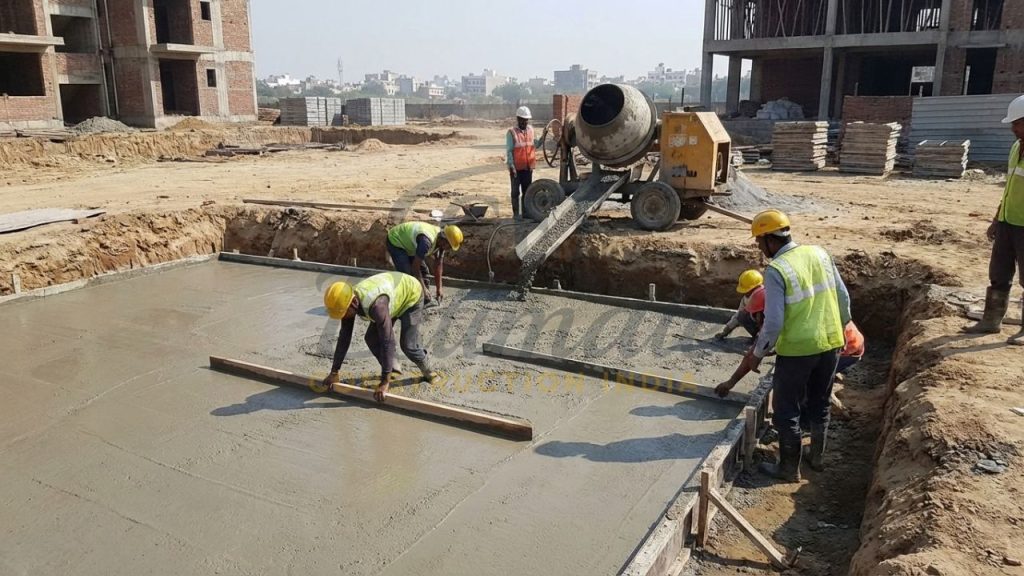
PCC is commonly used in:
- Foundation base under footings and columns
- Floor base under tiles, marble, or vitrified flooring
- Road sub-base and pavement layers
- Backfilling and leveling in plinth areas
- Mass concrete works like machine foundations
- Canal lining and water-retaining structures
Manual PCC calculations can lead to errors, material shortages, or excess purchases. A PCC Concrete Calculator automates the process, computing total volume and material proportions efficiently.
What is a Cement Calculator for PCC?
This tool estimates material quantities specifically for Plain Cement Concrete (non-reinforced). It calculates the volume first, then applies common lean mix ratios used in India to output cement bags (50 kg each), sand, and aggregates in cubic feet/meters.
It aids in accurate budgeting, material procurement, BOQ preparation, and reduces wastage during concreting.
PCC Concrete Volume Formula Used in Construction
PCC areas are typically rectangular or trapezoidal, but the basic formula is:
V = Length × Width × Thickness
Where:
- V = Concrete volume (cubic feet or cubic meters)
- Length = Length of PCC area
- Width = Width of PCC area
- Thickness = Depth of PCC layer (in feet or meters)
Typical Thickness for PCC in India
- Under footings/columns: 4–6 inches (100–150 mm)
- Floor base: 3–4 inches (75–100 mm)
- Road sub-base: 6–8 inches Always refer to structural drawings and IS 456 standards.
Understanding Each Variable
Length and Width
Measure the exact area to be concreted (subtract openings if applicable).
Thickness
Critical for stability. Thinner layers save cost but may compromise strength; thicker layers provide better support.
Importance of Concrete Volume Calculation
Precise volume calculation ensures:
- Correct cement bag estimation
- Proper sand and aggregate proportions
- Cost-effective material ordering
- Strong, uniform base layer
- Avoidance of rework due to shortages
Inputs Required for the Calculator
Key inputs:
- Length of PCC area (feet/meters)
- Width of PCC area (feet/meters)
- Thickness (inches/feet or mm)
- Concrete Mix Ratio — Common: M5, M7.5, M10
- Wastage Percentage — Typically 5–10%
Concrete Mix Ratios Used in India for PCC
PCC uses lean mixes for economy and workability:
Grade | Mix Ratio (Cement : Sand : Aggregate) | Typical Application |
M5 | 1 : 5 : 10 | Very lean base, non-structural |
M7.5 | 1 : 4 : 8 | Common foundation base |
M10 | 1 : 3 : 6 | Standard PCC under footings/floors |
M10 (1:3:6) is the most widely used for residential and general construction in India.
Cement Bags in India
Cement supplied in 50 kg bags; one bag ≈ 1.25 cubic feet (dry volume).
Step-by-Step Example Calculation
Typical footing base PCC:
- Length = 50 ft
- Width = 30 ft
- Thickness = 4 inches = 0.333 ft
- Mix = M10 (1:3:6)
- Wastage = 5%
Step 1: Wet Concrete Volume
Volume = 50 × 30 × 0.333 ≈ 500 cubic feet
Step 2: Dry Volume
Dry Volume = 500 × 1.54 ≈ 770 cubic feet
Step 3: Add Wastage
770 × 1.05 ≈ 808.5 cubic feet
Step 4: Cement Quantity
Total parts = 10
Cement = 808.5 ÷ 10 ≈ 80.85 cubic feet
Bags = 80.85 ÷ 1.25 ≈ 65 bags (round up to 68 bags)
Step 5: Sand Quantity
Sand = (3 ÷ 10) × 808.5 ≈ 242.55 cubic feet
Step 6: Aggregate Quantity
Aggregate = (6 ÷ 10) × 808.5 ≈ 485.1 cubic feet
Final Material Estimate
Material | Quantity |
Cement | ~68 bags |
Sand | ~243 cubic ft |
Aggregate | ~485 cubic ft |
Average Cement Cost in India (2026)
As of March 2026, cement prices range from ₹340–₹430 per 50 kg bag (average ₹360–₹410 in most regions; often ₹350–₹400 in Uttar Pradesh areas like Agra).
Example: 100 bags ≈ ₹34,000–₹43,000
For best results, choose from top cement brands in India in 2026 (trusted for PCC due to consistent quality and strength):
- UltraTech Cement — Largest brand, ideal for lean mixes like M10.
- Ambuja Cement — Excellent fineness and durability.
- ACC Cement — Reliable for foundation works.
- Shree Cement — Cost-effective and low-heat.
- JK Cement — Strong performance in northern regions.
- Birla Cement — Crack-resistant options.
- Dalmia Bharat Cement — High-quality blended PPC.
- Ramco Cement — Good compressive strength.
PPC variants are preferred for PCC to enhance workability and long-term performance.
Applications of PCC Concrete Calculations
- Foundation PCC beds
- Floor sub-base preparation
- Road and pavement bases
- Plinth leveling concrete
- Non-structural mass concrete
Benefits of Using a Cement Calculator for PCC
- Quick, accurate estimates
- Reduced material wastage
- Better cost control
- Supports contractors and DIY projects
- Ideal for BOQ preparation
Get a Professional Construction Estimate & BOQ
For detailed PCC estimates, full project quantity takeoffs, accurate Bills of Quantities (BOQ), or complete construction cost planning in Agra, Uttar Pradesh, or across India, contact Construction Estimator India – a trusted leader in precise construction cost estimating services.
Call: 📞 8630676890
Available nationwide for contractors, builders, and developers.
Frequently Asked Questions
How do you calculate PCC volume?
V = Length × Width × Thickness (convert units consistently).
Which mix ratio for standard PCC in India?
M10 (1:3:6) is most common for foundations and floors.
How many cement bags for 1000 sq ft PCC at 4 inches?
Around 60–75 bags (M10 with wastage; varies by exact dimensions).
Average cement price in Agra 2026?
Typically ₹350–₹420 per bag (check local suppliers).
Why use PPC cement for PCC?
Better workability, reduced heat, and improved durability.
Use a Cement Calculator for PCC to plan your foundation or base layer accurately and build a solid, reliable structure.