
- Homepage
- Cement Calculator for Driveway in India
Cement Calculator for Driveway in India 2026 – Calculate Cement Bags & Concrete Volume for Driveways
Highly Accurate Cement and Other Material Estimation
Cement Calculator for Driveway
📊 Driveway Material Estimation
| Item | Quantity |
|---|---|
| Total Concrete Volume | |
| Cement Required | |
| Sand Required | |
| Aggregate Required |
Download Report
Concrete is essential for home and infrastructure projects, and accurate estimation ensures durability, cost savings, and less wastage. Driveways—whether for homes, garages, or small commercial spaces—need a strong, level concrete slab to handle vehicle loads, weather, and daily use.
A Cement Calculator for Driveway helps homeowners, contractors, and builders in India quickly estimate concrete volume, cement bags, sand, and aggregates by entering simple dimensions, following standard Indian practices.
Common driveway types include:
- Residential parking areas
- Garage approaches
- Two-wheeler/light vehicle pathways
- Small commercial lots
- Garden/backyard driveways
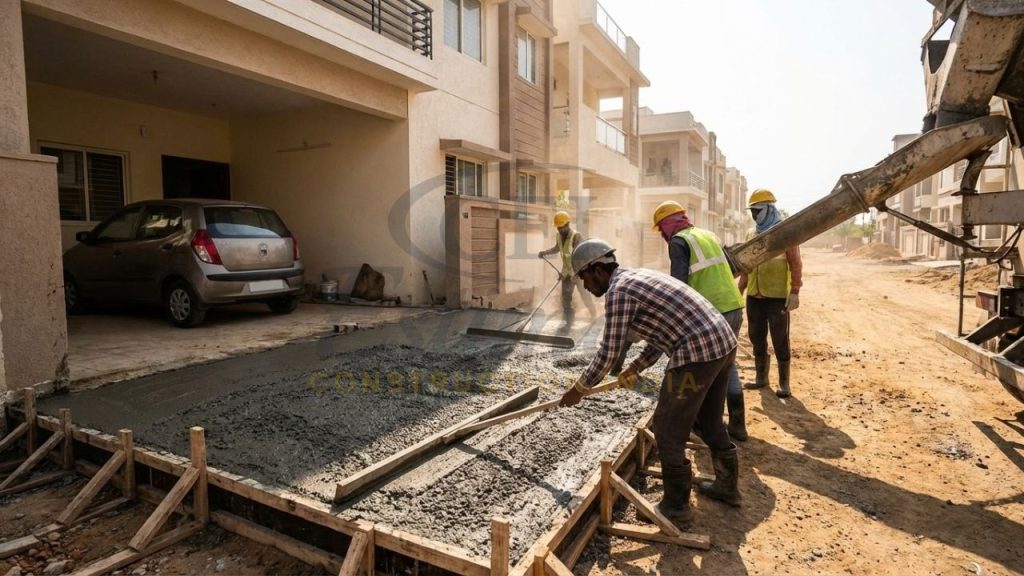
Manual calculations often cause errors and excess/shortage of materials. The Driveway Concrete Calculator automates volume calculation and breaks it down into cement, sand, aggregates, and more.
For best results, choose from the top cement brands in India in 2026 (widely trusted for driveways and residential use due to strength, durability, and availability):
- UltraTech Cement — India’s largest, excellent for high-strength M20 mixes.
- Ambuja Cement — Superior quality and eco-friendly options.
- ACC Cement — Reliable legacy brand with great workability.
- Shree Cement — Cost-effective and low-heat for larger slabs.
- JK Cement — Strong performance, popular in many regions.
- Birla Cement (MP Birla/Birla Gold) — Crack-resistant and durable.
- Dalmia Bharat Cement — High-quality blended cements.
- Ramco Cement — Excellent in southern India for compressive strength.
PPC variants from these brands are often ideal for driveways to improve workability and weather resistance. Check local availability in Agra or nearby areas, as prices and stock vary. Pairing a reputable brand with precise calculator estimates ensures a long-lasting, crack-free driveway.
What is a Cement Calculator for Driveway?
A Cement Calculator for Driveway is a user-friendly tool designed to estimate material requirements for concrete driveway slabs. It computes the slab’s volume and applies standard concrete mix ratios commonly used in India to output quantities in cubic feet/meters, cement bags (50 kg each), sand, and aggregates.
This tool supports accurate planning for projects like home driveways, helping with budgeting, material ordering, and BOQ (Bill of Quantities) preparation. It reduces wastage and ensures the driveway achieves the required strength for vehicle traffic.
Driveway Concrete Volume Formula Used in Construction
Driveways are typically rectangular slabs, so the volume formula is straightforward:
V = Length × Width × Thickness
Where:
- V = Concrete volume (in cubic feet or cubic meters)
- Length = Length of the driveway
- Width = Width of the driveway
- Thickness = Slab depth (usually in inches or feet)
Typical Thickness for Driveways in India
For standard residential driveways handling cars and SUVs, a thickness of 4 inches (0.33 feet or ~100 mm) is common and sufficient. For heavier loads (e.g., occasional trucks), increase to 5-6 inches.
Understanding Each Variable
Length and Width
These define the surface area. Measure the driveway area accurately, including any curves (approximate as rectangles or break into sections).
Thickness (Depth)
Critical for load-bearing capacity. A 4-inch slab provides good durability for most homes, while thinner slabs risk cracking under weight.
Importance of Concrete Volume Calculation
Accurate volume calculation is the foundation for material estimation. It determines:
- Cement bags needed
- Sand and aggregate quantities
- Overall project cost
- Reinforcement requirements (if any, like mesh for larger areas)
Proper estimation prevents shortages during pouring and avoids excess material costs.
Inputs Required for the Calculator
A reliable Driveway Cement Calculator needs these key inputs:
- Length of the driveway (in feet or meters)
- Width of the driveway (in feet or meters)
- Thickness of the slab (typically 4-6 inches)
- Concrete Grade — Common for driveways: M15 or M20
- Wastage Percentage — Usually 5-10% to cover spillage, uneven pouring, and site losses
Concrete Mix Ratios Used in India for Driveways
Driveways require durable yet workable concrete. Common grades and ratios in India include:
Concrete Grade | Mix Ratio (Cement : Sand : Aggregate) | Typical Application |
M15 | 1 : 2 : 4 | Driveways, floors, light pavements |
M20 | 1 : 1.5 : 3 | Stronger driveways, RCC elements |
For most residential driveways, M15 (1:2:4) or M20 (1:1.5:3) is preferred for balance of strength and cost.
Total parts example (M15): 1 + 2 + 4 = 7 parts
Example (M20): 1 + 1.5 + 3 = 5.5 parts
Cement Bags in India
Cement comes in 50 kg bags. One bag has a volume of approximately 1.25 cubic feet (dry volume basis).
Step-by-Step Example Calculation
Consider a typical residential driveway:
- Length = 20 ft
- Width = 10 ft
- Thickness = 4 inches = 0.33 ft
- Concrete Grade = M20 (1:1.5:3)
- Wastage = 5%
Step 1: Calculate Wet Concrete Volume
Volume = 20 × 10 × 0.33 ≈ 66 cubic feet
Step 2: Convert to Dry Volume
Dry Volume = Wet Volume × 1.54 (for 54% increase due to voids) ≈ 66 × 1.54 ≈ 101.64 cubic feet
Step 3: Add Wastage
With 5% wastage: 101.64 × 1.05 ≈ 106.72 cubic feet
Step 4: Calculate Cement Quantity
Total parts = 5.5
Cement portion = 106.72 ÷ 5.5 ≈ 19.4 cubic feet
Cement bags = 19.4 ÷ 1.25 ≈ 15.5 bags (round up to 16 bags)
Step 5: Calculate Sand Quantity
Sand portion = (1.5 ÷ 5.5) × 106.72 ≈ 29.1 cubic feet
Step 6: Calculate Aggregate Quantity
Aggregate portion = (3 ÷ 5.5) × 106.72 ≈ 58.2 cubic feet
Final Material Estimate
Material | Quantity |
Cement | ~16 bags |
Sand | ~29 cubic ft |
Aggregate | ~58 cubic ft |
This example illustrates how to estimate for a standard driveway.
Average Cement Cost in India (2026)
As of March 2026, cement prices in India vary by region, brand (OPC/PPC), and market conditions. The average price per 50 kg bag typically ranges from ₹340 – ₹430, with many areas around ₹360–₹410 for common grades. Prices may be lower in southern regions (~₹330–₹350) and higher in metros.
Example Cost: For 100 bags, approximate cement cost: ₹34,000 – ₹43,000
Using a Driveway Cement Calculator helps forecast these costs accurately.
Applications of Driveway Concrete Calculations
These calculations apply to:
- Home parking driveways
- Garage extensions
- Vehicle pathways in plots
- Small commercial parking areas
- Decorative stamped concrete driveways
Benefits of Using a Cement Calculator for Driveway
- Quick and accurate estimation
- Minimizes material wastage
- Better cost control and budgeting
- Supports DIY or contractor planning
- Ideal for BOQ and tender preparation
Construction Estimating Importance
Precise material takeoffs prevent delays, overruns, and disputes. Professional estimators use such tools alongside drawings for reliable project planning.
Get a Professional Construction Estimate & BOQ
For detailed estimates, BOQ, or full driveway/construction planning, contact professional services.
Call: 📞 8630676890
Available across India for accurate material and cost estimates.
Frequently Asked Questions
How do you calculate concrete volume for a driveway?
Use V = Length × Width × Thickness (convert thickness to feet/meters).
Which concrete grade is best for driveways in India?
M15 (1:2:4) or M20 (1:1.5:3) for residential use.
How many cement bags for a 20×10 ft driveway?
Depends on thickness and mix; ~15-20 bags for 4-inch M20 slab (with wastage).
What is the average cement price in India 2026?
₹340–₹430 per 50 kg bag, varying by region and brand.
Can this calculator handle irregular driveway shapes?
Yes — break into rectangular sections and sum volumes.
Why include wastage in calculations?
Accounts for spillage, uneven ground, and mixing losses (typically 5-10%).
Use a Cement Calculator for Driveway to plan your project efficiently and build a long-lasting surface.