
- Homepage
- Cement Calculator for Concrete
Cement Calculator for Concrete
Highly Accurate Cement Concrete Material Estimation
🧱 Cement Calculator for Concrete
📊 Concrete Material Estimation
| Item | Quantity |
|---|---|
| Cement | |
| Sand | |
| Aggregate |
Download Estimate Report
The Cement Calculator for Concrete (also known as Ready-Mix Concrete Material Calculator or RCC / PCC Cement Calculator) is a powerful online tool designed to help builders, contractors, civil engineers, site supervisors, and homeowners accurately estimate the quantity of cement, sand, aggregate (coarse), and water required for concrete mixing in various structural and non-structural elements.
Accurate material estimation is one of the most critical steps in concrete works during construction planning and execution. Using this calculator, you can quickly determine the exact quantities needed for different concrete grades (M15, M20, M25, M30, etc.), helping you control project costs, avoid material shortages or excess inventory, and minimize wastage on site.
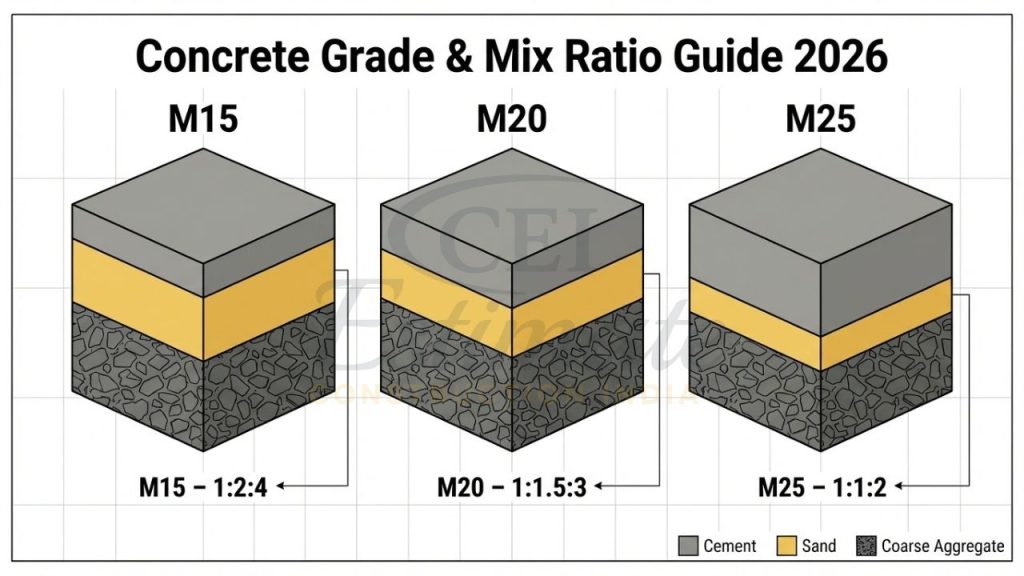
Instead of relying on time-consuming manual volume calculations, thumb rules, or trial-and-error batches, the concrete cement calculator provides instant, reliable, and IS-code-compliant results based on concrete volume, grade, mix design proportions, and wastage/dry volume allowance.
What is Concrete in Construction?
Concrete is a composite material made by mixing cement, sand (fine aggregate), coarse aggregate (gravel/crushed stone), and water in controlled proportions. When reinforced with steel bars, it becomes Reinforced Cement Concrete (RCC), widely used for structural strength. Plain Cement Concrete (PCC) is used as a base layer without reinforcement.
Common concrete grades and typical applications in India (as per IS 456:2000 and current CPWD practices in 2026):
- M15 / M20 — PCC base under foundations, flooring, non-structural works
- M20 — Residential slabs, beams, columns, footings (most common for houses)
- M25 — RCC slabs, beams, columns in multi-storey residential/commercial buildings
- M30 and above — High-rise structures, heavy-load industrial floors, bridges
Concrete is used in:
- RCC slabs (floors and roofs)
- Beams, columns, and lintels
- Foundations and footings
- Plinth beams and grade beams
- Roads, pavements, and driveways
- Water tanks, retaining walls, and precast elements
Concrete consumes large volumes of cement and aggregates, so precise calculation before batching or ordering ready-mix concrete (RMC) is essential.
Why Use a Cement Calculator for Concrete?
Manual mix design calculations can be complex and prone to errors due to varying aggregate sizes, moisture content, bulking of sand, wastage during transit/mixing, and site conditions. A digital concrete calculator simplifies everything by instantly estimating materials.
Key Benefits
- Accurate Material Estimation The calculator determines the exact quantity of: • Cement (in bags and kg) • Sand (in m³, tons, or kg) • Coarse Aggregate (in m³, tons, or kg) • Water (in liters) based on concrete volume and selected grade/mix ratio.
- Reduced Material Wastage Precise estimates prevent over-ordering and minimize leftover concrete or shortages during pouring.
- Faster Project Planning Contractors and engineers can immediately know requirements before concrete casting begins.
- Cost Control Accurate quantities help manage concrete budgets by avoiding unnecessary purchases or RMC over-ordering.
Who Should Use a Concrete Cement Calculator?
This tool is useful for everyone involved in concrete works.
- Builders and Contractors — To estimate materials before slab/beam/column casting.
- Civil Engineers — For quick mix design checks, BOQ preparation, and site planning.
- Architects — To estimate concrete quantities during structural design phases.
- Homeowners — To understand requirements for house construction, extension, or renovation.
- Construction Estimators — To prepare detailed cost estimates and project budgets.
- Ready-Mix Concrete Suppliers — For accurate order quantities and dispatch planning.
Practical Tips for Concrete Work
Even with accurate calculations, proper execution ensures strong, durable concrete.
- Always use fresh OPC 43/53 grade or PPC cement from reputed brands.
- Use clean, well-graded river sand (Zone II/III) and 10–20 mm crushed stone aggregate.
- Maintain the specified water-cement ratio (critical for strength — never add extra water).
- Use mechanical mixers for uniform concrete in large pours.
- Provide proper vibration to eliminate voids and honeycombing.
- Cure concrete properly (ponding, wet hessian, or curing compound) for at least 7–14 days.
- Add 5–10% extra volume for wastage, spillage, formwork absorption, and uneven pouring.
- For hot weather (common in Delhi summers), use chilled water or ice and retarders if needed.
Final Thoughts
A Cement Calculator for Concrete is an essential digital tool for modern construction projects. By simply entering concrete volume (length × width × thickness), desired grade (M20, M25, etc.), mix ratio or standard proportions, and wastage factor (typically 5–10%), builders can instantly determine the required quantities of cement, sand, aggregate, and water.
This not only improves accuracy and efficiency but also helps control costs, ensures better structural quality, reduces rework due to material shortages, and supports sustainable use of resources.
For any construction involving concrete — whether a small house slab or a large commercial foundation — precise material estimation is the foundation of strong, long-lasting structures, and tools like concrete cement calculators make this process faster, smarter, and more reliable.