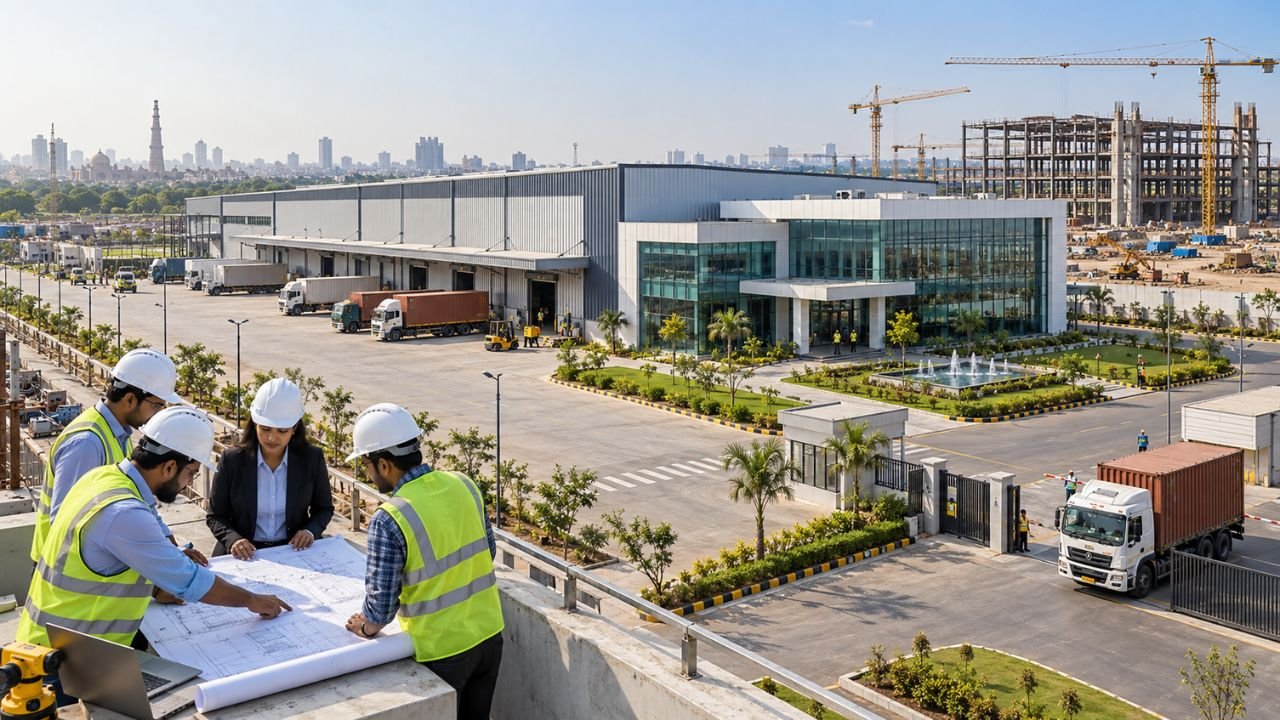
Imagine building your dream house in Aligarh or Lucknow, only to see hairline cracks spiderwebbing across your 9-inch brick walls after the first monsoon. Or worse, a boundary wall in Rajasthan collapsing under wind load because the mortar was too weak. These aren’t rare stories – they’re happening right now in Uttar Pradesh, Bihar, Madhya Pradesh, and beyond due to wrong cement mortar ratios. As a mason or small contractor, you know weak mortar means leakage, poor bonding, and costly repairs. But with the right 1:4, 1:5, or 1:6 ratios (updated for 2026 standards), your walls stay rock-solid for decades. Construction Estimator India helps thousands avoid this – let’s fix it for you today.
Why Cement Mortar Ratio Is Critical for Strong Brickwork?
Cement mortar is the “glue” that binds bricks – a mix of cement, sand, and water that fills joints and transfers loads. Get the cement:sand ratio wrong, and your walls fail fast.
Here’s why it matters:
- Bond strength: Right ratio grips bricks tightly, preventing slips under load or earthquake shakes (key in seismic zones like Uttarakhand or Himachal).
- Compressive strength: Supports heavy roofs without crumbling – vital for load-bearing walls in 2-3 storey houses.
- Workability: Smooth spreading without lumps for fast, neat masonry.
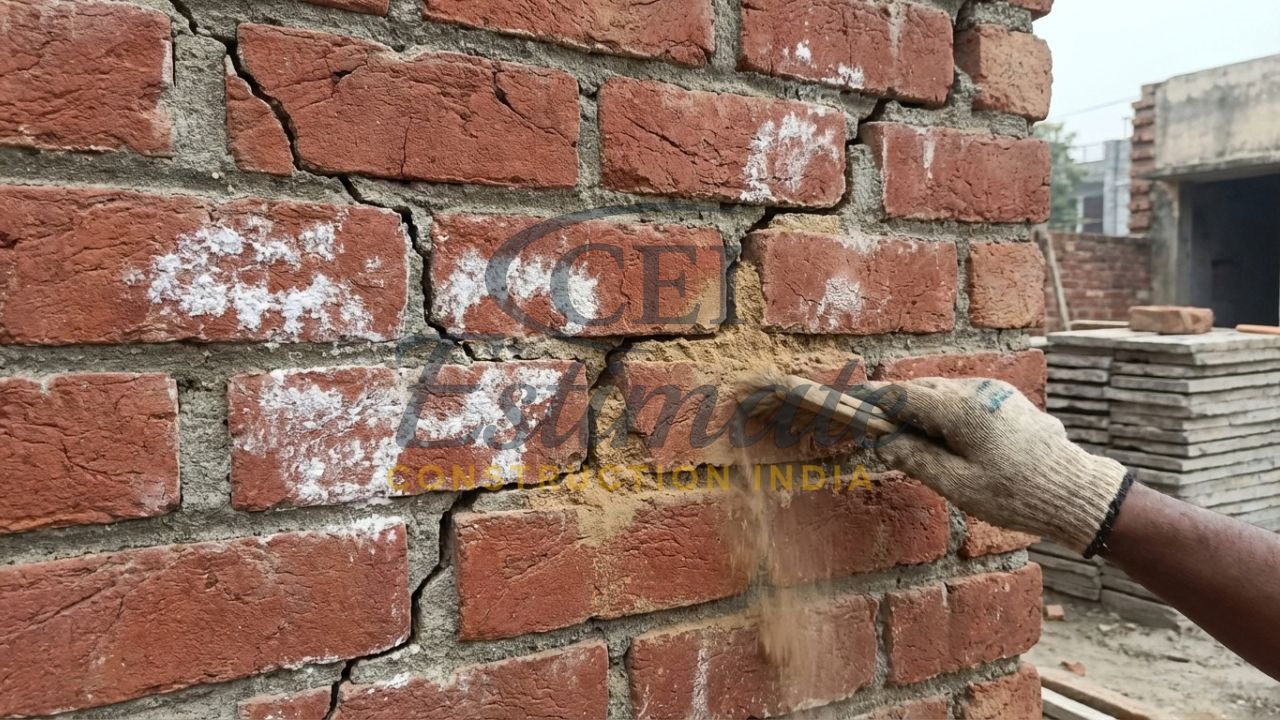
- Shrinkage cracking: Too much water or lean mix causes cracks as it dries.
- Water-tightness: Blocks rain seepage, avoiding damp walls and efflorescence.
- Cost control & durability: Balances strength with economy – no cement waste, lasts 50+ years against Indian weather.
Weak mortar? Expect repairs in 2-5 years. Strong mix? Bulletproof walls.
Recommended Cement Mortar Ratios for Brickwork in India 2026
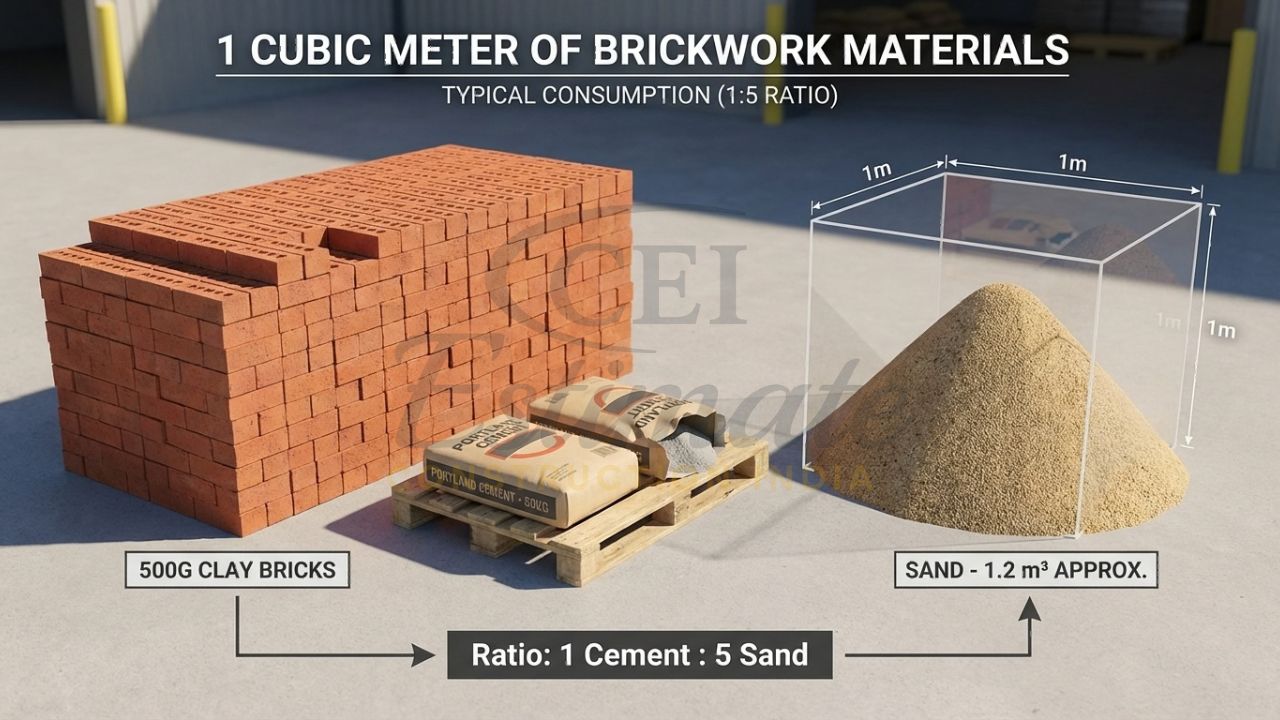
In 2026, IS 2250 and NBC guidelines stick to these proven ratios for burnt clay bricks (first-class) or fly ash bricks. Never go leaner than 1:6 for structural work – it risks wall failure.
| Ratio (Cement:Sand) | Use Case | Strength Level |
| 1:3 | Rare – high-strength plasters or heavy engineering (not typical residential) | Very rich, max strength |
| 1:4 | Load-bearing/external walls, high-rise, seismic zones (Delhi NCR, Rajasthan) | Rich mix, excellent durability |
| 1:5 | Most popular for residential 9″/4.5″ walls, small commercial (UP, Bihar, MP) | Balanced strength + economy |
| 1:6 | Internal partitions, boundary walls (low-rise, non-load bearing) | Economical, sufficient for light loads |
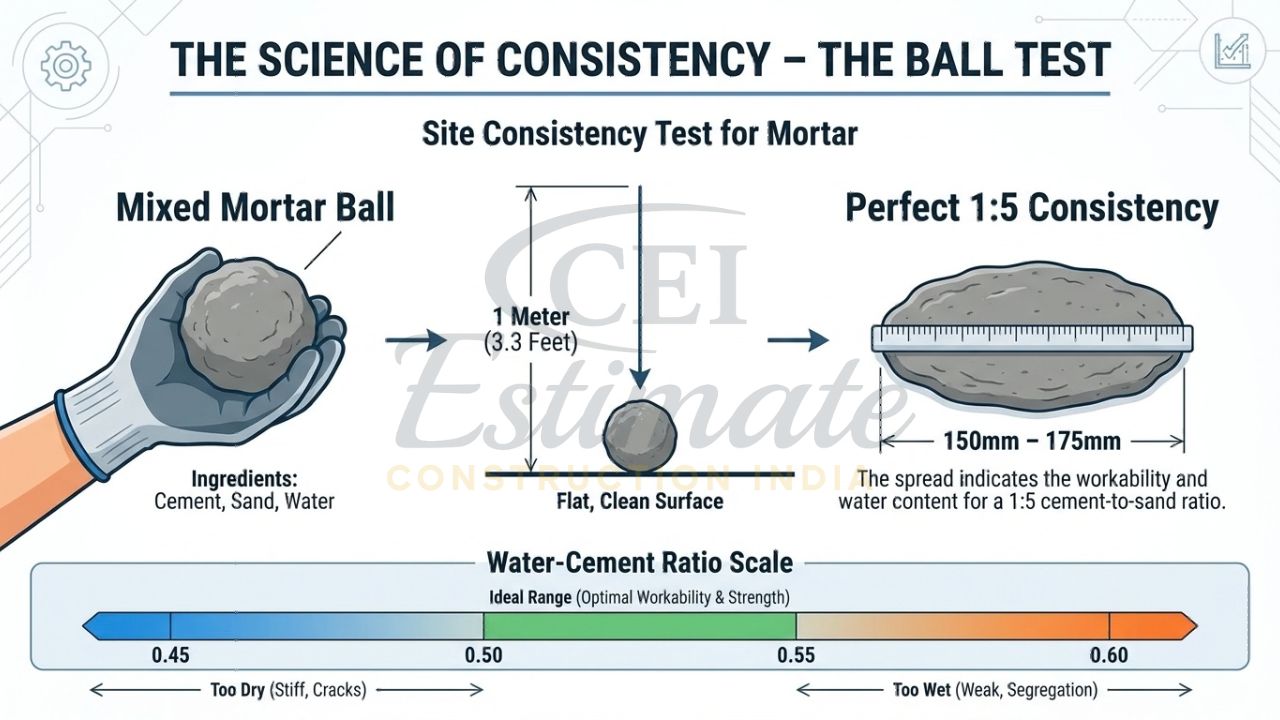
Water-cement ratio: Keep at 0.50–0.60 (25-30L water per 50kg cement bag). Max 0.65 for workability – excess weakens everything.
Factors That Change the Ideal Cement:Sand Ratio on Site
No one-size-fits-all – tweak based on your site:
- Brick type: First-class burnt clay → 1:5. Fly ash bricks → slightly richer (1:4.5). AAC blocks → 1:6 with adhesive.
- Sand quality: River sand → standard ratio. M-sand (common in Telangana, AP) → add 5-10% more cement (e.g., 1:4.5).
- Weather: Hot/dry (Rajasthan summers) → richer mix (1:4). Monsoon (Odisha, Chhattisgarh) → control water, use plasticizers.
- Wall type: Load-bearing/external → 1:4/1:5. Partitions/internal → 1:6.
- Additives: Plasticizers let you use 1:6 with 1:5 strength – saves 10-15% cement.
Test sand fineness: Zone II river sand is gold standard.
Step-by-Step – How to Prepare Perfect Cement Mortar for Brickwork
Mix on a clean platform (not ground). Use weight for accuracy (1 bag cement = 50kg ≈ 1.25 cu m mortar in 1:5). Construction Estimator India recommends this for zero waste.
- Measure: For 1:5 (1000 bricks, 9″ wall) – 0.22 bags cement + 1.1 cu ft sand. Weigh: 11kg cement + 55kg sand.
- Dry mix: Spread sand, add cement, mix 2-3 mins till uniform grey (no lumps).
- Add water gradually: Start with 0.50 w/c (13-15L per 50kg). Mix 3-5 mins.
- Consistency tests:
- Ball test: Drop ball from 1m – flattens to 150-175mm patty.
- Trowel test: Peaks without flow.
- Hand feel: Sticky, not sloppy.
- Mix time: Total 5-8 mins by hand/machine. Pot life: 1-2 hours max – remix if stiff.
Typical Cement & Sand Consumption for Brickwork
For standard 9″ brick walls (230x115x75mm bricks, 10% wastage). Assumes 9-10 bricks/sq m single layer.
| Ratio | Cement Bags per 1000 Bricks (9″ Wall) | Cement per sq m (9″ Wall) | Sand (cu m per 1000 Bricks) |
| 1:4 | 0.25–0.30 | 0.10–0.12 | 0.08–0.10 |
| 1:5 | 0.20–0.25 | 0.08–0.10 | 0.10–0.12 |
| 1:6 | 0.16–0.20 | 0.06–0.08 | 0.12–0.14 |
Pro tip: For full house (1000 sq m wall), 1:5 needs ~25 bags cement. Construction Estimator India calculates exact for you!
Common Mortar Mistakes & How to Avoid Them
Don’t learn the hard way – these kill walls:
- Too much water (>0.65 w/c) → shrinkage cracks, leaky joints. Fix: Measure water precisely.
- Too lean mix (>1:6) → poor bonding, collapse risk. Fix: Stick to 1:5 for residential.
- Bad water (lake/pond) → salts cause efflorescence. Fix: Use potable water only.
- Dry bricks → mortar sucks water, dries fast, weak bond. Fix: Soak bricks 24hrs.
- Poor mixing → lumps create weak spots. Fix: Dry mix first, uniform colour.
Need Accurate Brickwork Material Estimate & Full House Budget?
Building in UP, Bihar, or Rajasthan? Construction Estimator India delivers precise quantities!
Our 4-step process:
- Share wall details (length, height, type – 9″/4.5″, load-bearing?).
- Tell us bricks (fly ash? Burnt?), sand type, location.
- We calculate exact cement bags, sand cu m, BOQ (1:5 ratio default).
- Get full house masonry budget + tips.
WhatsApp +91 8630676890 now for brickwork estimate from Construction Estimator India!
Frequently Asked Questions (FAQ)
- What’s the best mortar ratio for 9-inch residential walls in Uttar Pradesh?
1:5 – perfect balance for strength and cost, as per Construction Estimator India. - Can I use 1:6 for external boundary walls?
Yes, if low-rise/non-load bearing. Go 1:5 for rain exposure. - How much water per cement bag for mortar?
25-30L (0.50-0.60 w/c). Test consistency. - Fly ash bricks – same ratio as clay bricks?
Slightly richer, 1:4.5. Soak less. - M-sand vs river sand – ratio change?
M-sand needs +5-10% cement (e.g., 1:4.5). - Plasticizers – worth it?
Yes! Leaner mix, same strength, less water. - Pot life of mortar in hot weather?
45-60 mins. Mix small batches. - Cement per sq m for 4.5-inch partition?
0.04-0.06 bags at 1:6. - Soaking bricks mandatory?
Yes – prevents weak bonds. - 2026 updates to ratios?
No major changes; focus on M-sand & additives per IS 2250. Ask Construction Estimator India for site-specific.
Build Crack-Free Walls – Start with the Right Mix Today!
You’ve got the 2026 ratios, tips, and consumption – now execute like a pro. Strong 1:5 mortar means no cracks, no leaks, no regrets. Trust Construction Estimator India for the rest.
Ready for your brickwork material quantity calculation, detailed BOQ, and full house construction budget estimate? WhatsApp +91 8630676890 NOW – “Send my estimate!” We’ll reply in minutes from Construction Estimator India.