
If you think of your house as a human body, RCC pillars (columns) are the legs that support the entire structure. If the legs are weak, the entire body becomes unstable. In the same way, if the cement used in pillars is wrong or poor quality, your house may develop cracks, settlement issues, or even structural distress within 5–10 years.
Across India — whether you are building a G+1 home in Agra, Uttar Pradesh, or a two-storey house in another city — one of the most common construction mistakes in 2026 is choosing cement only based on price or brand popularity. Many homeowners simply ask the contractor to use “OPC 53” because someone told them it is the strongest cement. But in real civil engineering practice, strength alone is not the only factor that determines durable RCC columns.
In fact, pillars require a careful balance of several properties:
- High compressive strength
- Good bonding with reinforcement steel
- Controlled heat of hydration
- Low shrinkage to prevent cracks
- Good workability for proper compaction
- Long-term durability against soil chemicals and groundwater
In regions like Agra and much of Uttar Pradesh, soil conditions can vary significantly. Some areas have alkaline soil, fluctuating groundwater levels, or minor seismic activity (Zone III). This makes it even more important to choose the correct cement grade for pillars and follow proper construction practices.
Another big mistake homeowners make in 2026 is ignoring curing and mix design. Even the best cement for pillars will fail if:
- Water–cement ratio is wrong
- Concrete is not properly vibrated
- Curing is inadequate
In this expert guide, I’ll explain everything you need to know as a homeowner or builder:
- OPC vs PPC vs PSC — which is better for RCC pillars
- The correct cement grade for columns in residential houses
- The advantages and disadvantages of each cement type
- Recommended cement brands used by professionals
- Practical site tips used by civil engineers to ensure strong pillars
By the end of this article, you will clearly understand which cement is best for pillar construction in house building in India in 2026.
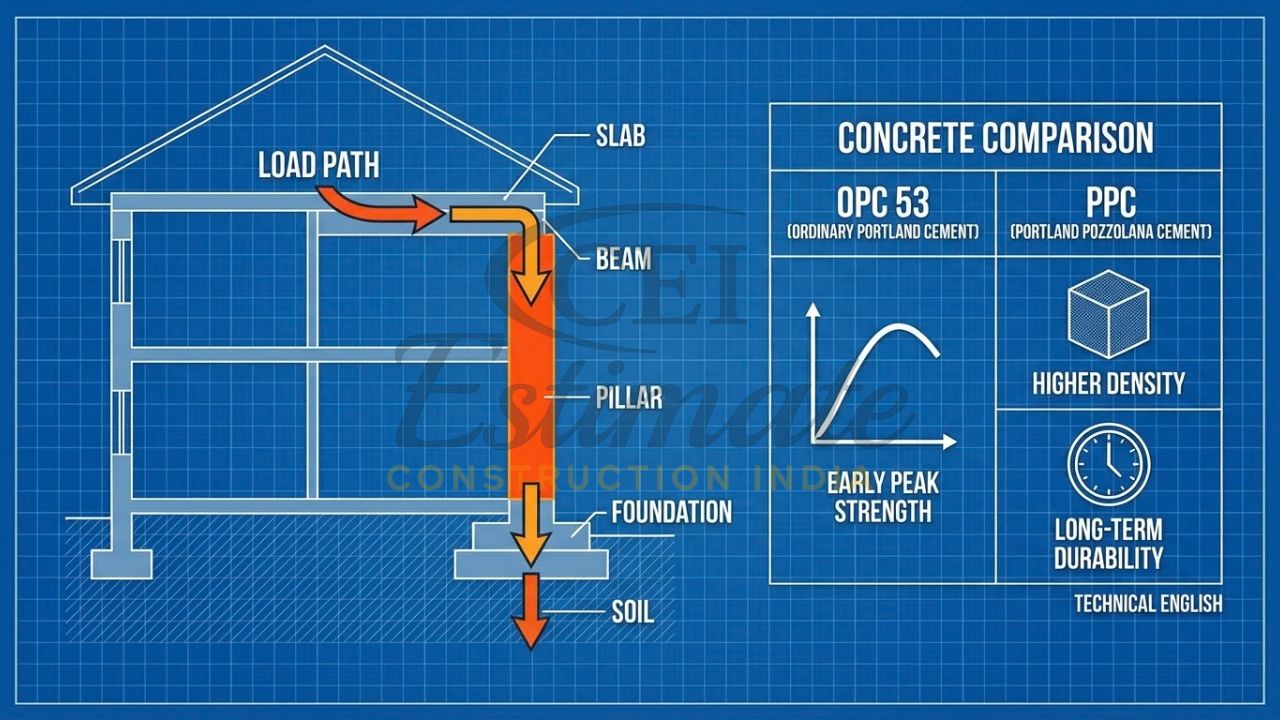
Understanding RCC Pillars & Cement Requirements
Before choosing the best cement for pillars, you must understand what RCC columns actually require from concrete.
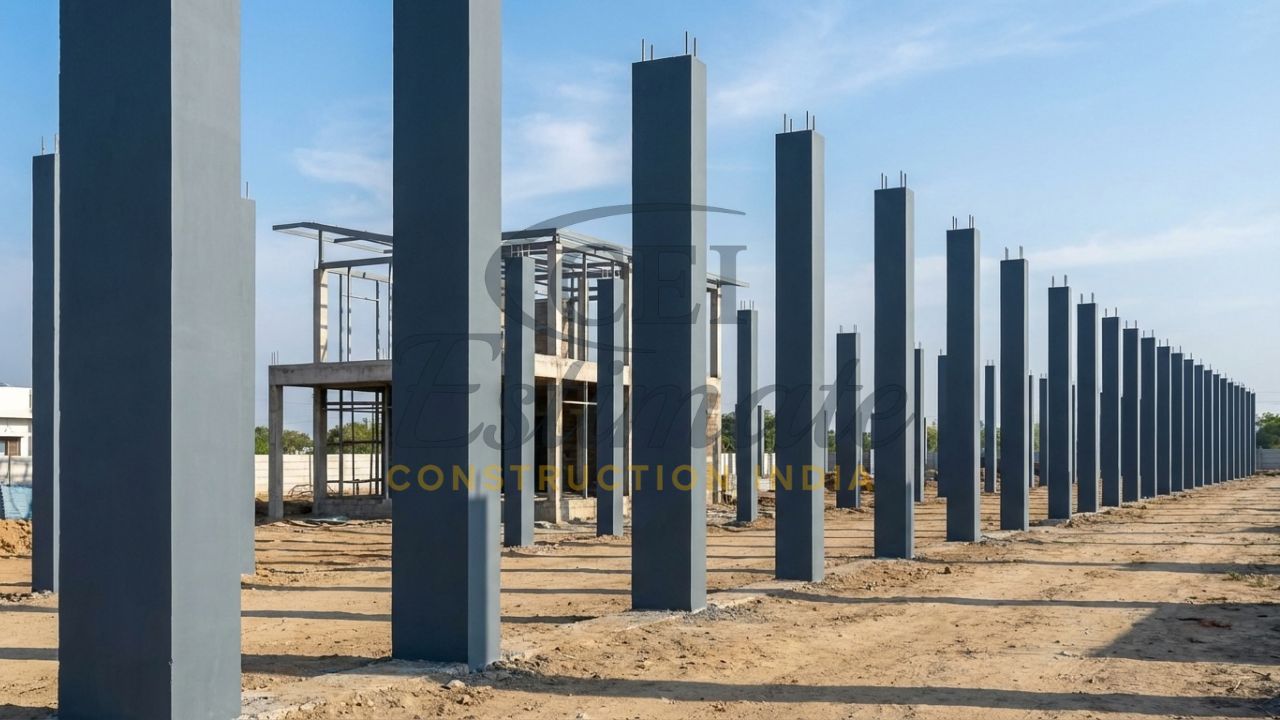
A column carries the entire vertical load of the building, including:
- Roof slab loads
- Beam loads
- Wall loads
- Live loads (people, furniture, etc.)
This load travels from slab → beam → column → foundation → soil.
Because of this, RCC columns must have high structural reliability and durability.
Strength Requirements
For most residential houses in India:
- M20 concrete is the minimum recommended grade
- M25 concrete is commonly used today
- M30 concrete is used for high-quality construction
Concrete grade represents the compressive strength after 28 days.
Example:
- M20 = 20 MPa compressive strength
- M25 = 25 MPa compressive strength
The cement used must help achieve these strengths consistently.
Early Strength vs Long-Term Strength
Columns require both early strength and long-term durability.
Early strength is needed because:
- Formwork removal happens quickly
- Construction continues to upper floors
But long-term strength matters more because the structure must last 50–100 years.
Heat of Hydration
When cement reacts with water, it produces heat.
In thick structural members like pillars:
- Too much heat can cause thermal cracking
- High-grade OPC cements produce more heat
This is why blended cements like PPC or PSC are gaining popularity in 2026.
Workability
Concrete used in columns must flow easily around reinforcement bars.
Poor workability causes:
- Honeycombing
- Voids
- Weak columns
Blended cements improve workability significantly.
Durability & Rebar Protection
Steel reinforcement must remain protected from:
- Corrosion
- Moisture penetration
- Sulphate attack
- Alkali reactions
This requires dense, low-permeability concrete, which certain cement types provide better.
Relevant Indian Standards
Several BIS codes govern cement and RCC design:
- IS 456:2000 – Plain and Reinforced Concrete
- IS 269 – OPC 33 grade
- IS 8112 – OPC 43 grade
- IS 12269 – OPC 53 grade
- IS 1489 – PPC cement
- IS 455 – PSC cement
These standards ensure consistent quality across India.
2026 Construction Trend in India
In recent years, the Indian construction industry has shifted towards blended cements like PPC and PSC because they provide:
- Better durability
- Lower carbon footprint
- Reduced cracking
- Improved long-term strength
Many structural engineers now recommend PPC cement for residential RCC construction unless early strength is critical.
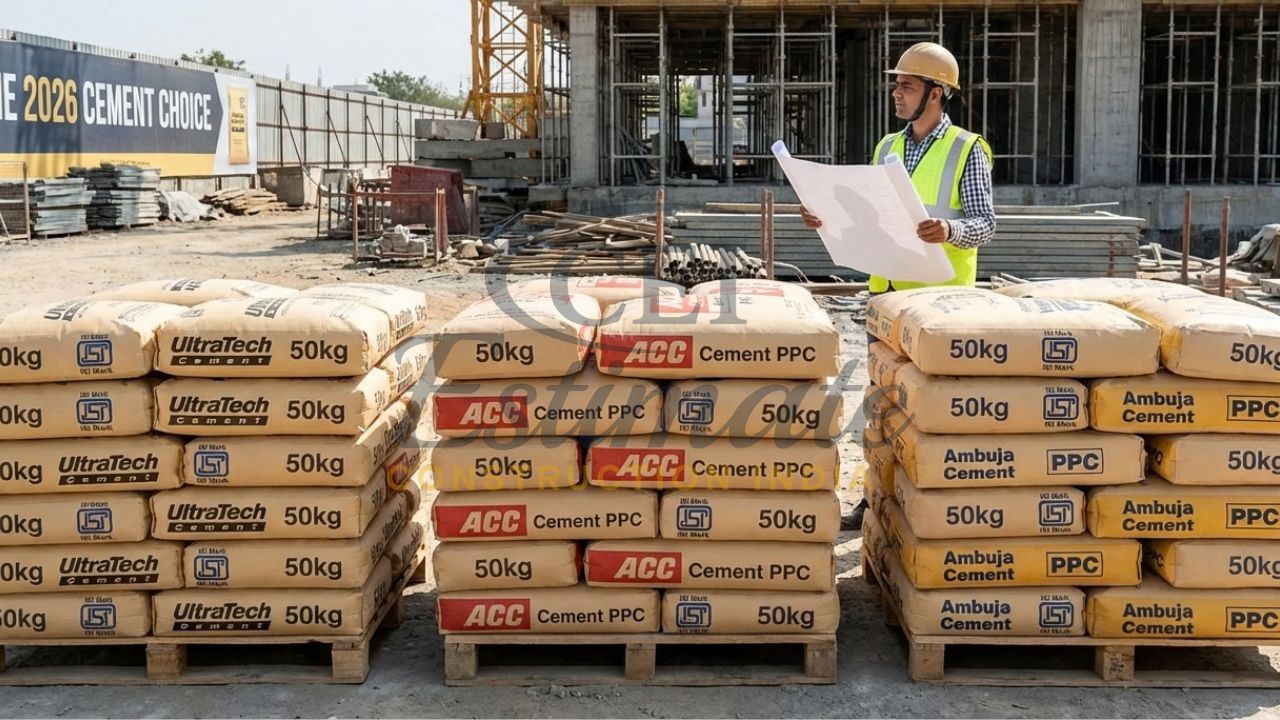
Types of Cement for RCC Pillars in India – Detailed Comparison
OPC Cement (Ordinary Portland Cement)
OPC cement is the most traditional cement used in India.
It is available in three grades:
- OPC 33
- OPC 43
- OPC 53
OPC 33 Grade
Rarely used today in structural construction.
Strength at 28 days = 33 MPa.
Used mostly for:
- Masonry
- Plaster
- Non-structural works
OPC 43 Grade
Balanced cement with moderate early strength.
Commonly used for:
- RCC beams
- Slabs
- Columns in small houses
Advantages:
- Moderate heat generation
- Good workability
- Reliable strength
OPC 53 Grade
High-strength cement widely used in India.
Advantages:
- Very high early strength
- Fast construction cycles
Disadvantages:
- Higher heat generation
- More shrinkage cracks if curing is poor
Many contractors blindly use OPC 53 everywhere, but this is not always the best practice.
PPC Cement (Portland Pozzolana Cement)
PPC cement contains fly ash, a by-product of thermal power plants.
Fly ash improves concrete properties significantly.
Advantages:
- Lower heat of hydration
- Better workability
- Reduced permeability
- Higher long-term strength
- Better crack resistance
Disadvantages:
- Slightly slower early strength gain
Because of these benefits, many engineers recommend PPC for RCC pillars in residential houses.
PSC Cement (Portland Slag Cement)
PSC cement contains blast furnace slag.
Advantages:
- Excellent sulphate resistance
- Very durable concrete
- Low permeability
- Suitable for aggressive soils
PSC is widely used in:
- Coastal regions
- Industrial environments
Detailed Cement Comparison Table
| Cement Type | 28-Day Strength | Early Strength | Heat of Hydration | Durability | Workability | Price (2026) | Best for Pillars |
| OPC 53 | 53 MPa | Very High | High | Moderate | Moderate | ₹420–₹500 | Yes (with proper curing) |
| OPC 43 | 43 MPa | High | Medium | Good | Good | ₹400–₹480 | Good |
| PPC | 33–53 MPa equivalent | Moderate | Low | Excellent | Excellent | ₹380–₹460 | Best for most houses |
| PSC | High long-term | Moderate | Very Low | Excellent | Good | ₹380–₹450 | Good in aggressive soils |
Which Cement is Truly Best for Pillars? 2026 Recommendations
Best Cement for Pillars in Normal Residential Houses
For most houses in India (G+1 or G+2):
PPC cement is usually the best choice.
Reasons:
- Lower shrinkage cracking
- Better long-term durability
- Improved workability
- Cost-effective
- Good compatibility with Indian climate
In cities like Agra, where temperatures fluctuate widely, lower heat generation helps prevent cracking.
When to Use OPC 53 Cement
OPC 53 is recommended when:
- High load-bearing columns
- Multi-storey structures
- Fast construction schedule
But it must be used carefully with:
- Strict curing
- Controlled water ratio
- Good supervision
OPC 43 Grade
OPC 43 provides a balanced solution.
Suitable for:
- G+1 houses
- Moderate load columns
- Normal residential construction
PSC Cement
Recommended for:
- Coastal regions
- Sulphate-rich soils
- Industrial environments
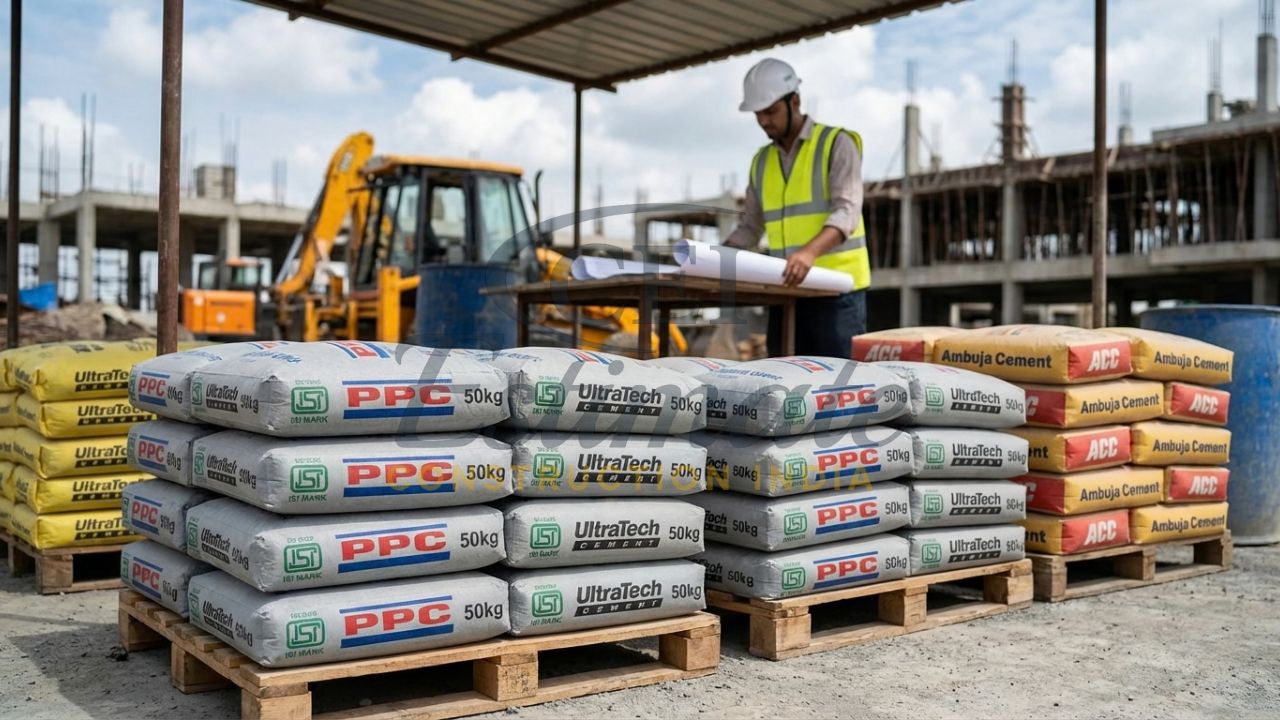
Top Cement Brands Recommended for Pillars in India 2026
Some cement brands are known for consistent quality.
- UltraTech Cement — One of the most trusted brands. UltraTech PPC is widely used for RCC construction.
- ACC Cement — High durability and consistent strength.
- Ambuja Cement — Known for strong bonding and good workability.
- Dalmia Cement — Excellent durability and sustainable cement options.
- JK Cement — Reliable cement with good structural performance.
- Shree Cement — Cost-effective with consistent quality.
- Bangur Cement — Popular in North India for residential construction.
- Birla Cement — Widely used across central India.
Step-by-Step Guide: How to Choose & Use Cement for Your Pillars
Step 1: Check Cement Freshness
Always ensure cement bag is fresh.
Old cement loses strength.
Step 2: Verify ISI Mark
Check BIS certification on bag.
Step 3: Use Proper Mix Ratio
For M20 concrete:
1 : 1.5 : 3 (cement : sand : aggregate)
For M25:
1 : 1 : 2
Step 4: Maintain Water–Cement Ratio
Ideal ratio:
0.45 – 0.50
Too much water weakens concrete.
Step 5: Proper Vibration
Use a needle vibrator to remove air pockets.
Step 6: Proper Curing
Columns should be cured for minimum 7–14 days.
Poor curing causes cracks.
FAQs
Is PPC better than OPC 53 for RCC pillars?
For most residential houses, PPC provides better durability and crack resistance.
Can I use PPC for columns in my G+1 house?
Yes. PPC works very well for residential RCC columns.
Which cement gives stronger pillars long term?
PPC often produces stronger concrete in the long run.
What if soil in Agra has alkali content?
Blended cements like PPC or PSC help improve durability.
Conclusion
Choosing the best cement for pillars in India requires more than just picking the strongest grade.
For most residential houses:
- PPC cement is the best balanced choice
- OPC 53 should be used selectively
- Proper curing and mix design are critical
A good cement combined with proper engineering practices ensures strong RCC columns that can support your home safely for decades.
Need accurate RCC quantity takeoff, pillar/column material estimates, or full-house cost breakdown? Get professional, fast help from experts!
WhatsApp: +91 8630676890