The bedroom is the most personal sanctuary in an Indian home, a place dedicated to rest, recovery, and quiet reflection. While we often spend weeks debating the perfect mattress or the exact shade of wardrobe laminate, the ceiling is frequently treated as an afterthought. However, a thoughtful false ceiling design for bedroom can fundamentally alter the way the room feels and functions. In modern Indian apartments and independent houses, the “fifth wall” is not just a structural necessity but a powerful tool to hide messy wiring, manage acoustics, and introduce sophisticated lighting that a flat slab simply cannot accommodate.
👉 Transform Your Bedroom with a Modern False Ceiling Design.
When planning your sanctuary, it is essential to look beyond just aesthetics. A well-designed ceiling manages the volume of the room, ensuring that a large master bedroom feels cozy rather than cavernous, or that a compact city bedroom feels airy rather than claustrophobic. This guide is designed to help Indian homeowners navigate the practicalities of ceiling types, lighting logic, and material selection. If you are unsure about the financial implications of your design choices, Construction Estimator India provides professional services to help you calculate the exact costs and material requirements. You can reach out to Construction Estimator India on WhatsApp or Call at +91 8630676890 for a personalized estimate before you finalize your renovation plans.
What a False Ceiling Does for Your Bedroom?
A false ceiling is far more than a decorative layer; it is a functional installation that enhances the livability of your bedroom. In many Indian urban settings, structural beams often cut through bedrooms in awkward positions, or electrical points for ACs and fans are not ideally located. A false ceiling allows you to correct these architectural flaws seamlessly, creating a clean, uniform canvas that supports modern living.
Mood, Comfort, and Privacy
The primary psychological benefit of a false ceiling design for bedroom is the ability to control the mood through indirect lighting. Unlike the harsh glare of a central tube light, which can be jarring when you are trying to wind down, a false ceiling allows for “cove lighting.” This technique hides LED strips within a recess, bouncing light off the main ceiling to create a soft, ambient glow. This indirect light mimics the natural fading of daylight, signaling to your brain that it is time to relax. Additionally, the extra layer of gypsum or POP acts as a minor thermal and acoustic buffer, helping to keep the room slightly cooler in the summer and dampening the noise from neighbors living on the floor above.
Hiding Services and Neatening the Room
From a practical standpoint, the false ceiling acts as a technical void. It provides the necessary space to conceal copper piping for split ACs, heavy-duty wiring for home automation, and even internal ducting if you are opting for a VRV/VRF system. In Indian homes where external wiring is often an eyesore, the ceiling offers a way to achieve a sleek, hotel-like finish where only the elegant fixtures are visible.
The following table compares the major style families used in contemporary Indian bedrooms to help you identify which direction suits your space and budget best.
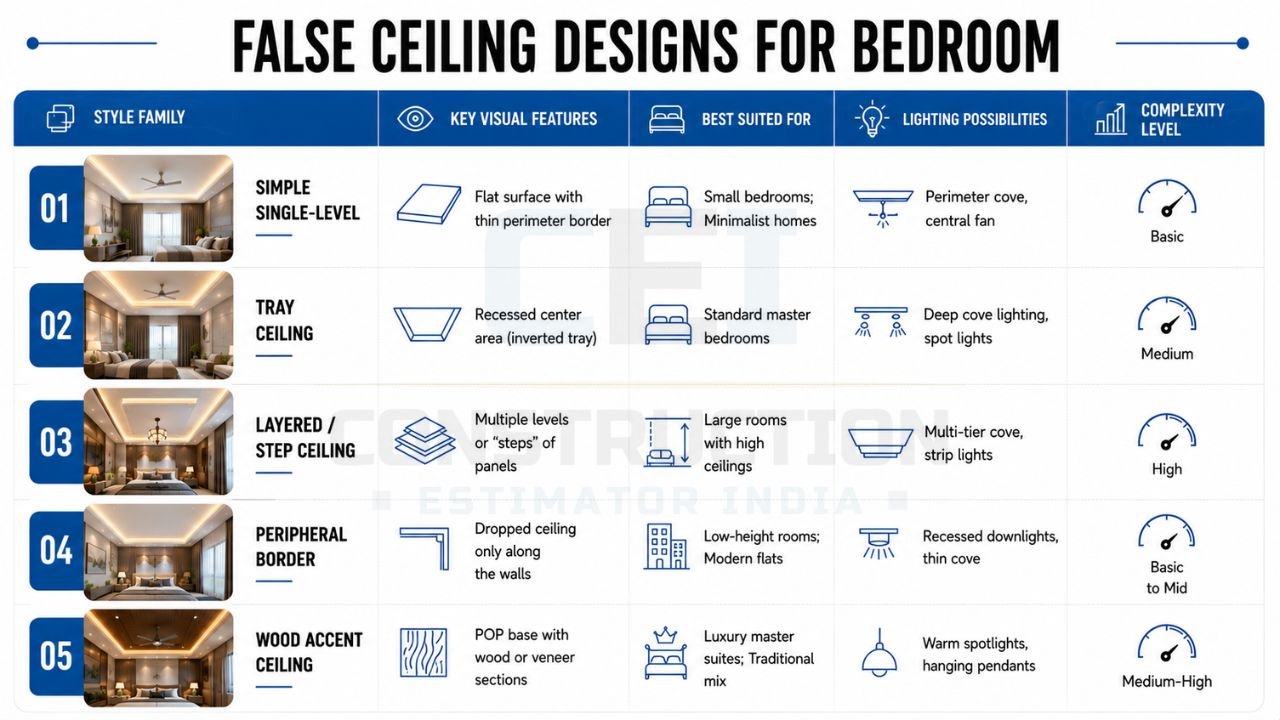
| Style Family | Key Visual Features | Best Suited For | Lighting Possibilities | Complexity Level |
|---|---|---|---|---|
| Simple Single-Level | Flat surface with thin perimeter border | Small bedrooms; Minimalist homes | Perimeter cove, central fan | Basic |
| Tray Ceiling | Recessed center area (inverted tray) | Standard master bedrooms | Deep cove lighting, spot lights | Medium |
| Layered/Step Ceiling | Multiple levels or “steps” of panels | Large rooms with high ceilings | Multi-tier cove, strip lights | High |
| Peripheral Border | Dropped ceiling only along the walls | Low-height rooms; Modern flats | Recessed downlights, thin cove | Basic to Mid |
| Wood Accent Ceiling | POP base with wood or veneer sections | Luxury master suites; Traditional mix | Warm spotlights, hanging pendants | Medium-High |
This table serves as a starting point for your design journey. For instance, if you have a compact 10×12 foot bedroom, a “Peripheral Border” or “Simple Single-Level” design is often superior because it maintains the central height while providing the benefits of cove lighting. Conversely, a “Wood Accent Ceiling” is a fantastic choice for those looking to add warmth and a premium feel to a larger master suite. To understand the cost difference between these simple single-level ceilings and more layered, designer ceilings with indirect lighting, you can consult with Construction Estimator India for a detailed cost breakdown.
👉 Get Customized False Ceiling Designs for Your Dream Bedroom.
Choosing Bedroom False Ceiling Style by Room Size and Height
The physical dimensions of your bedroom—specifically the floor-to-ceiling height—are the most critical constraints when choosing a design. A design that looks stunning in a high-ceilinged bungalow might feel oppressive in a standard 9.5-foot apartment room.
Small and Low-Height Bedrooms
In small bedrooms, the mantra should be “less is more.” If your ceiling height is already low, avoid dropping the entire ceiling by 6 or 8 inches. Instead, opt for a peripheral design where only the edges (about 12 to 18 inches from the walls) are dropped. This creates a “well” in the center, making the ceiling feel higher than it actually is. Use light, reflective colors—standard white or off-white—to ensure the room feels open. Avoid dark wood or heavy patterns, as these tend to “lower” the ceiling visually.
Medium and Large Bedrooms
Larger bedrooms offer the luxury of zoning. You can use the ceiling design to define the sleeping area versus a seating nook or a dressing area. A tray ceiling placed specifically over the bed can act as a canopy, creating a sense of intimacy within a large room. In these spaces, you can experiment with layered designs or even geometric patterns that add architectural interest without making the room feel crowded.
Master Bedroom vs Kids’ Bedroom vs Guest Bedroom
The function of the room should dictate the style. A master bedroom often benefits from symmetrical, balanced designs—like a classic tray or a sophisticated wood-accented perimeter—that promote a sense of calm and luxury. In contrast, a kids’ bedroom is a place for creativity. You might use circular cutouts, “starry night” fiber-optic lighting, or playful shapes like clouds. For a guest bedroom, a simple, low-maintenance design that provides good general illumination and a clean look is usually the most practical and cost-effective choice.
Materials and Finishes for Bedroom False Ceilings
The durability of your ceiling depends heavily on the materials used, especially given the varying humidity and temperature levels in different parts of India.
POP/Gypsum Board for Smooth, Versatile Designs
Gypsum board is the gold standard for false ceiling design for bedroom installations in India. These pre-fabricated boards are fixed to a galvanized iron (GI) framework, resulting in a perfectly smooth, seamless finish that is much harder to achieve with manual plastering. Plaster of Paris (POP) is often used for finishing joints or for creating intricate, customized curves and moldings. These materials are fire-resistant and provide excellent thermal insulation, which is a major plus in the Indian climate.
Wood/wood-look and Warm Panels
Wood brings an organic warmth that no paint can match. However, because real solid wood is heavy and prone to termite damage, most Indian homeowners opt for MDF with high-quality veneers, charcoal panels, or WPC (Wood Plastic Composite) rafters. These are typically used as “accents”—perhaps a 4-foot wide wooden section that runs up the wall behind the headboard and continues onto the ceiling—to create a unified, luxurious look.
PVC/WPC and Other Panel Options
PVC panels are becoming popular for their ease of installation and moisture resistance. While they were historically reserved for bathrooms, high-end PVC panels with realistic wood finishes are now used in bedrooms, especially in coastal areas like Mumbai or Chennai where humidity can affect gypsum boards over time. They are easy to wipe clean and require no painting, making them a very low-maintenance option.
The table below outlines the practical differences between these materials to help you make an informed decision for your home.
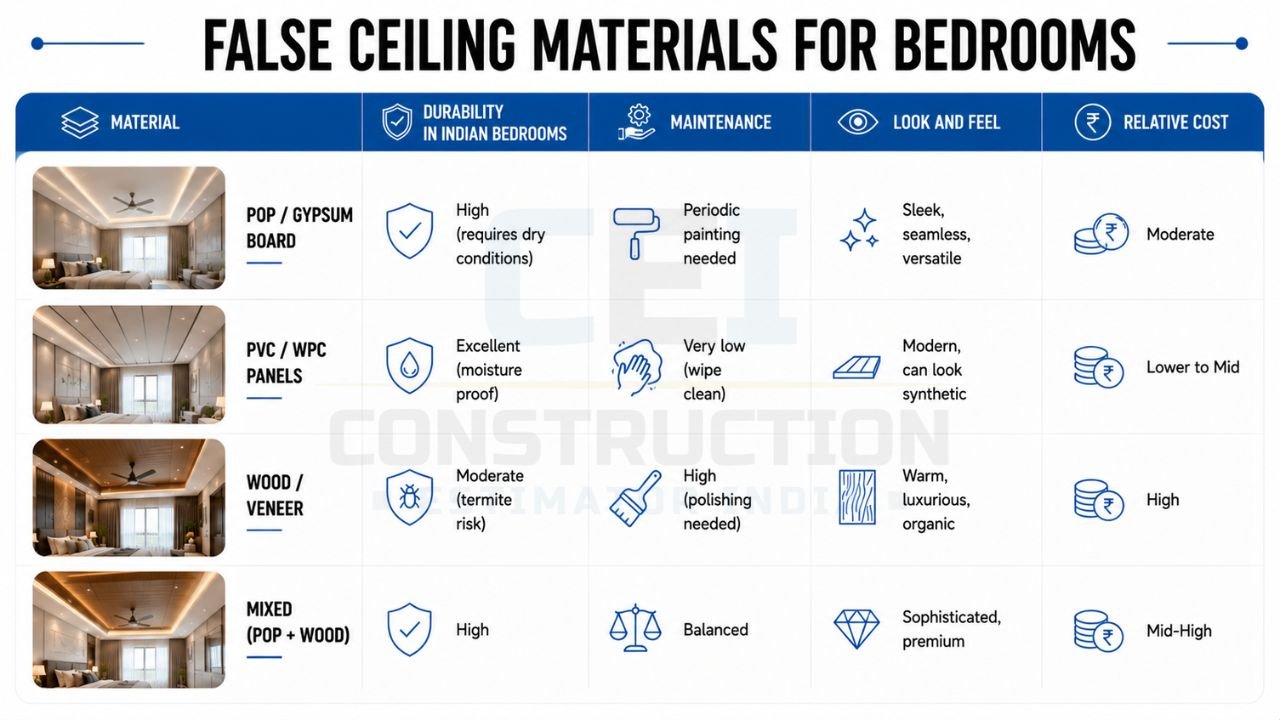
| Material | Durability in Indian Bedrooms | Maintenance | Look and Feel | Relative Cost |
|---|---|---|---|---|
| POP/Gypsum Board | High (requires dry conditions) | Periodic painting needed | Sleek, seamless, versatile | Moderate |
| PVC/WPC Panels | Excellent (moisture proof) | Very low (wipe clean) | Modern, can look synthetic | Lower to Mid |
| Wood/Veneer | Moderate (termite risk) | High (polishing needed) | Warm, luxurious, organic | High |
| Mixed (POP + Wood) | High | Balanced | Sophisticated, premium | Mid-High |
When deciding on a material mix, it is vital to have a clear quantity estimate to avoid wastage. Construction Estimator India can help you by checking the quantity and cost of gypsum/POP, framing channels, panels, and paint for your bedroom ceiling. Knowing exactly how many boards and running feet of wooden rafters you need can help you negotiate better with contractors and save thousands of rupees.
👉 Design a Bedroom That Combines Comfort, Style, and Elegance.
Lighting Design Inside Bedroom False Ceiling
Lighting is the element that breathes life into a ceiling design. In a bedroom, you need a balance between “task lighting” (for reading or dressing) and “ambient lighting” (for relaxation).
Cove Lighting for Soft, Relaxing Glow
Cove lighting is the backbone of any modern false ceiling design for bedroom. By placing LED strips inside a hidden recess, you avoid direct glare. For bedrooms, it is highly recommended to use “Warm White” (2700K to 3000K) LEDs. This color temperature mimics the glow of a sunset and helps in the production of melatonin, the hormone responsible for sleep. If your budget allows, invest in dimmable LED strips so you can adjust the brightness based on the time of day.
Spotlights, Downlights, and Bedside Focus
While cove lights provide the mood, recessed spotlights provide the function. A common mistake is placing a spotlight directly above the pillow area, which can be blinding when you are lying down. Instead, position spotlights towards the wardrobe, over the dressing mirror, or to highlight a piece of art. For reading, you might skip the ceiling lights entirely and rely on wall-mounted sconces or pendant lights that drop down from the false ceiling on either side of the bed.
Fan, Pendant, and Chandelier Placement
In India, the ceiling fan is a non-negotiable fixture. Your ceiling design must account for the fan’s placement to ensure both aesthetics and efficiency. The fan should ideally be centered over the bed, but the false ceiling must be reinforced at that point with a heavy-duty hook attached to the original slab. If you are adding a chandelier, ensure it doesn’t interfere with the fan’s blades or create “strobe” shadows when the fan is running.
The table below focuses on aligning your design priorities with the right ceiling and lighting approach.
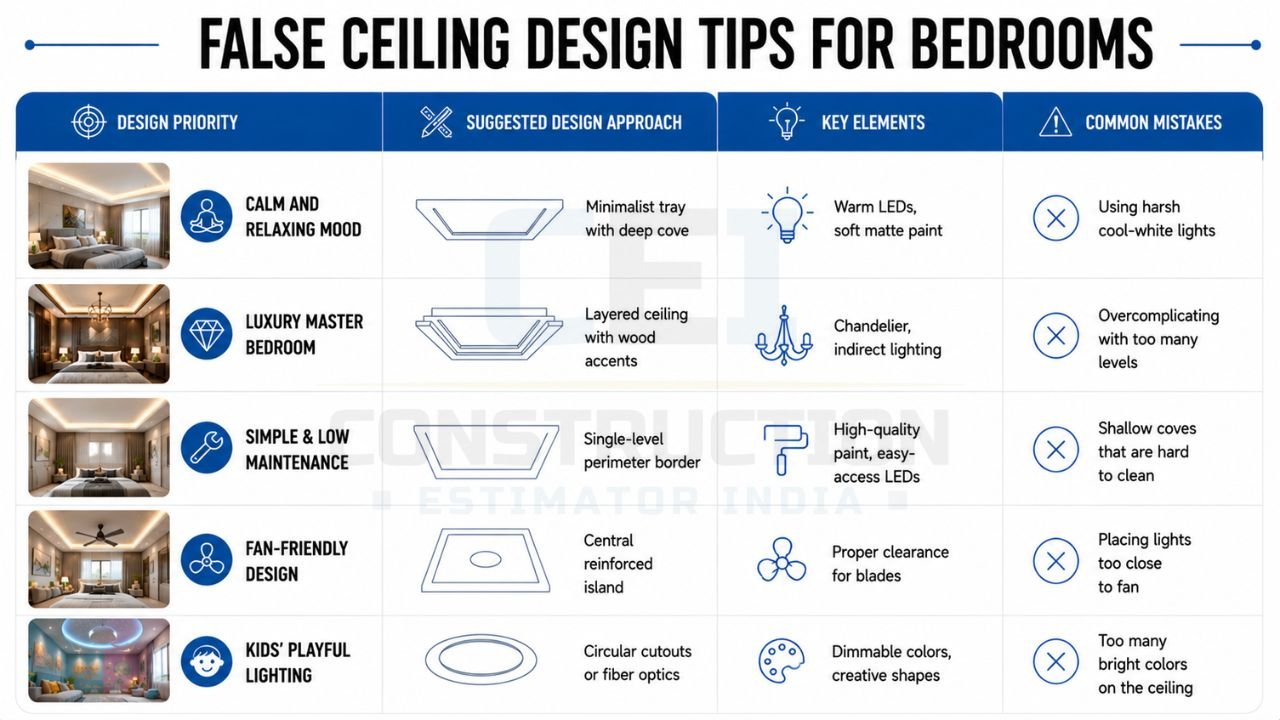
| Design Priority | Suggested Design Approach | Key Elements | Common Mistakes |
|---|---|---|---|
| Calm and Relaxing Mood | Minimalist tray with deep cove | Warm LEDs, soft matte paint | Using harsh cool-white lights |
| Luxury Master Bedroom | Layered ceiling with wood accents | Chandelier, indirect lighting | Overcomplicating with too many levels |
| Simple & Low Maintenance | Single-level perimeter border | High-quality paint, easy-access LEDs | Shallow coves that are hard to clean |
| Fan-Friendly Design | Central reinforced island | Proper clearance for blades | Placing lights too close to fan |
| Kids’ Playful Lighting | Circular cutouts or fiber optics | Dimmable colors, creative shapes | Too many bright colors on the ceiling |
Using this table, you can see that if your goal is a “Calm and Relaxing Mood,” you should prioritize deep coves and warm lighting over complex shapes. Before finalizing these details, remember that Construction Estimator India is available to help you estimate false ceiling costs for different bedroom sizes and designs, ensuring that your dream lighting setup doesn’t lead to a budget nightmare.
👉 Bring Your Dream Bedroom to Life with Customized False Ceiling Designs.
False Ceiling Design for Different Bedroom Types
Every bedroom has its own personality, and the ceiling should reflect that while solving specific spatial challenges.
Master Bedroom
The master bedroom ceiling should be a statement of elegance. A popular modern design involves a large rectangular tray that mimics the footprint of the bed below. This creates a sense of “enclosure” and luxury. You can enhance this by adding a wooden veneer panel inside the tray or using a subtle textured paint. The lighting should be multi-layered: coves for mood, spotlights for the wardrobe, and perhaps a low-hanging pendant over a bedside table for a contemporary touch.
Kids’ Bedroom
This is the one room where you can break the rules of symmetry. A “starry night” ceiling—using tiny fiber-optic lights—is a perennial favorite that helps children feel calm at night. Alternatively, using a geometric design with a few panels painted in a soft pastel color can add a sense of playfulness. Just ensure that the design isn’t so “childish” that it needs to be ripped out in five years; aim for a balance that can grow with the child.
Guest Bedroom and Secondary Rooms
For guest rooms, the focus should be on clean lines and budget-friendly comfort. A peripheral border design is usually the best bet. it allows you to hide the AC piping and provide enough light for a guest to feel comfortable without the high cost of complex multi-layered structures. Stick to high-quality white paint and standard LED fixtures that are easy to replace.
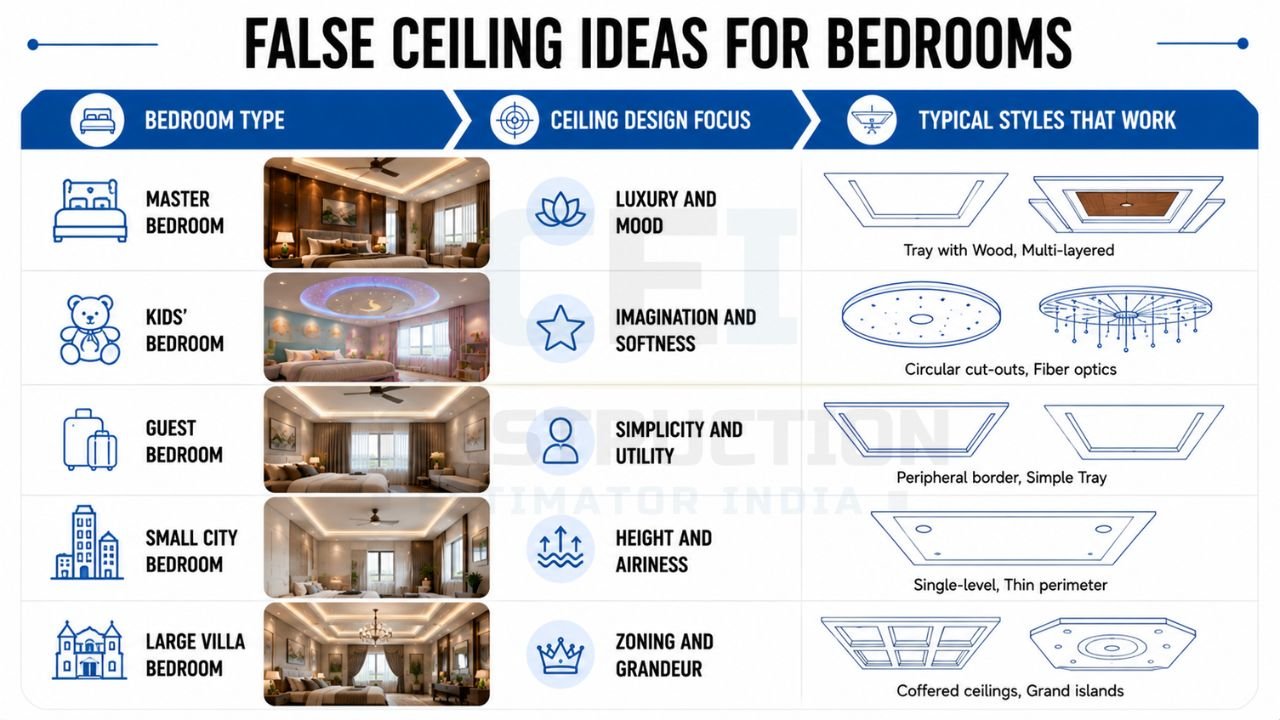
| Bedroom Type | Ceiling Design Focus | Typical Styles That Work |
|---|---|---|
| Master Bedroom | Luxury and Mood | Tray with Wood, Multi-layered |
| Kids’ Bedroom | Imagination and Softness | Circular cut-outs, Fiber optics |
| Guest Bedroom | Simplicity and Utility | Peripheral border, Simple Tray |
| Small City Bedroom | Height and Airiness | Single-level, Thin perimeter |
| Large Villa Bedroom | Zoning and Grandeur | Coffered ceilings, Grand islands |
When planning these varied rooms, it is easy to lose track of the total material requirement. Construction Estimator India can help homeowners estimate the costs and quantities of all materials involved, from the metal channels to the specific types of LED drivers, helping you align your choices with your overall renovation budget.
👉 Design a False Ceiling That Enhances Comfort and Visual Appeal.
Height, Fan Performance, and Practical Details
Technical precision is what separates a good ceiling from a great one. In the Indian context, two things are paramount: the height of the room and the performance of the ceiling fan.
How Much to Drop the Ceiling?
A standard false ceiling “drop” is usually between 5 to 7 inches. This provides enough space for most recessed spotlights and LED drivers. However, if you are hiding AC ducts, you might need a drop of 12 to 14 inches. Always ensure that the final clear height of the room—from the floor to the lowest part of the false ceiling—is at least 8.5 feet. Anything lower can start to feel claustrophobic and may trap heat, making the room feel warmer.
Planning for AC, Wiring, and Future Changes
Don’t bury everything blindly. Ensure there are “trap doors” or access panels near AC indoor units and where the LED drivers are located. This allows for repairs without having to break the ceiling. Also, ensure that the wiring used is of high quality and has the capacity to handle additional light points if you decide to add them later.
Easy Cleaning and Maintenance
In India, dust is a constant battle. Avoid designs with too many deep, narrow grooves (like thin rafters) where dust can settle and become hard to reach. Smooth, flat surfaces finished with high-quality, washable acrylic emulsion paint are much easier to maintain over the years.
Cost Planning for Bedroom False Ceiling Design
Understanding the financial side of a false ceiling design for bedroom project is crucial to avoid mid-project halts.
What Drives Cost Most
The cost is typically calculated per square foot of the “covered area.” However, complexity adds a premium. A flat ceiling is the cheapest, while every “step” or vertical drop adds to the labor and material cost. Curved designs are the most expensive because they require more time and precision. Additionally, the type of lighting—standard vs. branded vs. smart LEDs—can significantly swing the final bill.
Getting a Good Bedroom Ceiling Within Normal Budget
If you are on a tight budget, focus your design energy on just one area—usually the section directly above the bed. You can keep the rest of the room as a simple flat slab and only install a false ceiling “island” over the bed to house your cove lights and fan. This gives you the look and feel of a designer bedroom at a fraction of the cost.
How Construction Estimator India Helps with Bedroom Ceiling Costing?
Navigating quotes from contractors can be overwhelming. Construction Estimator India provides a professional, unbiased check of the realistic costs involved. They help you understand the budget impact before you commit to a specific design. By providing a detailed Bill of Quantities (BOQ), Construction Estimator India empowers you to purchase the right amount of material, ensuring you aren’t overcharged for “wastage” by your contractor.
Common Mistakes in False Ceiling Design for Bedrooms
- Overdoing Shapes and Colours: A bedroom ceiling shouldn’t look like a playground. Too many intersecting lines or bright colors can be visually distracting when you are trying to sleep.
- Poor Lighting Planning: Using “Cool White” (blue-ish) lights in a bedroom is a major mistake. It feels clinical and ruins the cozy atmosphere. Always opt for warm or natural white.
- Ignoring Fan Clearance: If the false ceiling drop is too close to the fan blades, it creates a “buffeting” noise and reduces the air throw. Maintain at least 10-12 inches of clear space between the fan blades and any vertical drops of the ceiling.
👉 Start Your Bedroom Transformation with Trusted Design Experts.
FAQs: False Ceiling Design for Bedroom
Which false ceiling style is best for small bedrooms?
For small bedrooms, a “Peripheral Border” or a “Simple Single-Level” tray is best. These designs allow for cove lighting which adds depth and makes the room feel larger without significantly reducing the central height.
How much height is needed for a bedroom false ceiling?
You should aim for a minimum clear height of 8.5 to 9 feet from the floor to the false ceiling. A standard drop is about 5-6 inches, so your original slab should ideally be around 9.5 feet high.
What lighting is best for a relaxing bedroom atmosphere?
Warm White LED strips (3000K) for cove lighting are the best for relaxation. Combine this with dimmable spotlights for a truly customized experience.
How much does a bedroom false ceiling typically cost?
In India, basic gypsum ceilings start at ₹90-₹110 per square foot, while premium designs with wood accents and high-end lighting can exceed ₹200-₹250 per square foot.
When to involve Construction Estimator India for bedroom ceiling cost and quantity checks?
You should involve Construction Estimator India during the planning phase, right after you have a basic design or drawing. This helps you verify if the design is within your budget before you hire a contractor.
Conclusion: Design a Bedroom False Ceiling That Feels Calm, Comfortable, and Easy to Live With
A successful false ceiling design for bedroom is one that you eventually stop noticing because it blends so perfectly with your lifestyle. It should provide a soft, warm glow when you wake up, keep the room cool and quiet, and hide all the technical clutter that modern life requires. By balancing height, choosing the right materials, and planning your lighting logically, you can turn a standard room into a high-end sanctuary.
Remember, the ceiling is a permanent part of your home’s structure. While you can change wall paint in a day, fixing a poorly designed or poorly budgeted ceiling is a messy and expensive ordeal. To ensure your project is built on a foundation of clear financial planning and accurate material estimation, contact Construction Estimator India on WhatsApp or Call at +91 8630676890. Whether you are building a new villa or renovating a city flat, their experts will help you understand the exact costs and practical options for your dream bedroom ceiling.