If you’ve ever stared at a stack of drawings wondering where to even begin costing a project, you’re not alone. Learning how to prepare a BOQ in civil engineering is one of the most valuable skills a civil engineer, quantity surveyor, or contractor can master — and getting it wrong can cost lakhs in disputes, delays, and material wastage.
At Construction Estimator India, we’ve prepared Bills of Quantities for residential, commercial, and industrial projects across Uttarakhand, UP, Delhi-NCR, Gujarat, and every major state in India for over 10 years. In this guide, we’re walking you through the exact BOQ preparation process our estimation team uses — the same step-by-step BOQ preparation method that has helped 500+ contractors, builders, and homeowners get accurate, tender-ready documents.
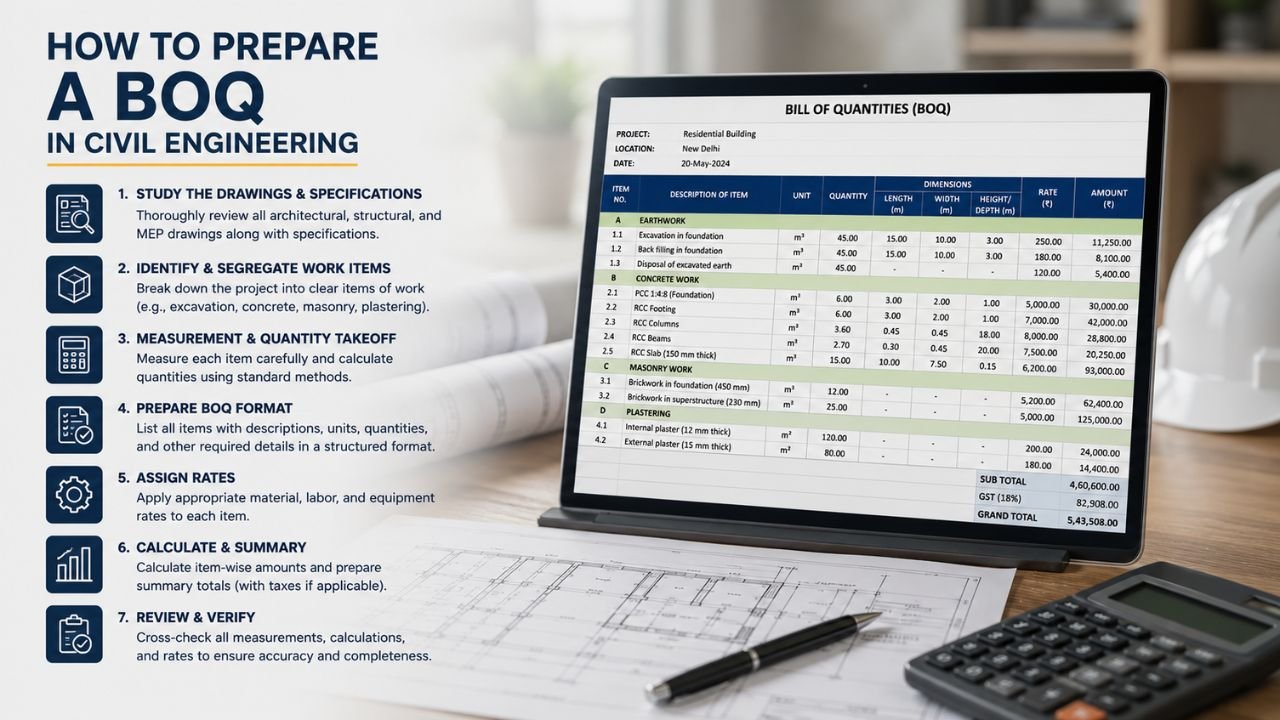
To prepare a BOQ in civil engineering, you need to (1) study the drawings and specifications, (2) take off quantities using standard measurement rules, (3) describe each item clearly, (4) apply current material and labor rates, (5) add GST, overheads and contingencies, (6) prepare an abstract/summary, and (7) check and finalize the document before tendering. Using a structured Excel BOQ Template with built-in GST and labor calculations makes this process significantly faster and error-free.
What is a BOQ in Civil Engineering?
A Bill of Quantities (BOQ) is a detailed document that lists every material, labor item, and work activity required to complete a construction project, along with its measured quantity, unit rate, and total cost. Think of it as the financial blueprint of your building — translating architectural and structural drawings into a priced, itemized list.
A BOQ typically includes:
- Item description (e.g., RCC work in foundation, brickwork in superstructure)
- Unit of measurement (cum, sqm, running meter, kg, number)
- Quantity (calculated from drawings)
- Rate (material + labor cost per unit)
- Amount (quantity × rate)
For Indian construction projects, a well-prepared BOQ also aligns with IS code standards, follows tender documentation formats, and factors in GST as per current government norms.
Why Accurate BOQ Preparation Matters in 2026
With material prices fluctuating and labor costs rising across Indian cities, an inaccurate BOQ can throw an entire project budget off track. In our decade of experience with 500+ clients, we’ve seen how a poorly prepared BOQ leads to:
- Cost overruns from missed or underestimated items
- Payment disputes between contractors and clients
- Tender rejections due to incomplete or inconsistent documentation
- Material shortages or over-ordering on site
A precise BOQ preparation process, on the other hand, gives you a realistic budget, smoother tendering, better negotiation power with suppliers, and fewer surprises during execution. This is exactly why the BOQ preparation process 2026 demands more rigor — with digital tools, GST compliance, and standardized formats now expected by clients and contractors alike.
Step-by-Step Process to Prepare a BOQ in Civil Engineering
Here’s the exact step by step BOQ preparation method our Quantity Surveyor team follows on every project, from a single-family home to multi-storey commercial buildings.
Step 1: Study the Drawings and Specifications
Before any quantity is measured, our estimators thoroughly review the architectural, structural, and MEP (mechanical, electrical, plumbing) drawings along with the project specifications. This step is where how to make BOQ in civil engineering really begins — you cannot measure what you don’t understand.
What to check:
- Drawing scale and dimensions
- Structural details (footing sizes, column/beam schedules, slab thickness)
- Material specifications (grade of concrete, steel, brick type)
- Any addenda or revised drawings
Pro tip from our team: Always cross-check dimensions between the architectural and structural drawings — mismatches here are one of the most common sources of quantity errors.
✅ Prepare tender-ready BOQs that improve budgeting, bidding, and project planning.
Step 2: Take Off Quantities (Measurement)
This is the core of quantity takeoff — systematically measuring every structural and finishing element from the drawings using standard measurement rules (as per IS 1200 or the relevant method of measurement).
| Work Item | Unit | Measurement Basis |
| Earthwork excavation | Cum | Length × Breadth × Depth |
| PCC/RCC work | Cum | Volume as per structural drawing |
| Brickwork | Cum | Volume, deducting openings |
| Plastering | Sqm | Surface area |
| Flooring/Tiling | Sqm | Floor area |
| Reinforcement steel | Kg/MT | Bar bending schedule |
| Painting | Sqm | Surface area, coats considered |
Following best practices for accurate quantity takeoff and BOQ preparation at this stage prevents cascading errors in every later step.
Step 3: Describe the Items Clearly
Each BOQ item needs a precise, unambiguous description covering the material grade, work method, and location. A vague description like “RCC work” is not enough — it should read something like: “Providing and laying M20 grade RCC in foundation footing including formwork, curing and compaction as per structural drawing.”
Clear descriptions protect both the contractor and client during execution and billing, and reduce the chance of disputes later.
Step 4: Apply Current Rates (Material + Labor)
Once quantities are finalized, current market rates for materials (cement, steel, bricks, sand, aggregate) and labor are applied to each item. In 2026, rates vary significantly by region — a BOQ prepared for Rudrapur will differ from one prepared for Ahmedabad or Delhi-NCR.
Our team maintains updated regional rate databases sourced from local material suppliers and labor contractors, ensuring your BOQ reflects real, on-ground pricing rather than outdated averages.
Step 5: Add GST, Overheads and Contingencies
A complete BOQ must factor in:
- GST as applicable on construction materials and services
- Contractor overheads (typically 10–15%)
- Contingency provisions (usually 3–5%) for unforeseen site conditions
- Profit margin, where applicable for tendering contractors
Missing this step is one of the most frequent reasons project budgets fall short mid-construction.
Step 6: Prepare Abstract and Summary
Once every item is rated and totaled, the individual items are consolidated into an abstract sheet — a summary page that groups costs by work category (earthwork, concrete, masonry, finishing, electrical, plumbing) and gives the client a clear, top-level view of the total project cost.
This abstract is what most clients and banks (for loan sanctioning) actually review first, so it needs to be clean, categorized, and easy to interpret.
Step 7: Check and Finalize the BOQ
Before the BOQ is issued for tendering or client approval, our team runs a final quality check:
- Cross-verify quantities against drawings
- Confirm rate consistency across similar items
- Recheck GST and overhead calculations
- Format the document for tender submission or client presentation
A finalized BOQ should be internally consistent, arithmetically accurate, and presentable — ready to go straight into a tender package or client meeting.
Common Mistakes to Avoid While Preparing BOQ
Even experienced engineers fall into these traps. Here are the ones we see most often:
- Skipping deductions for door/window openings in brickwork and plastering quantities
- Using outdated rates instead of current regional material and labor costs
- Vague item descriptions that lead to billing disputes
- Forgetting GST or applying the wrong GST slab on specific materials
- Not cross-checking architectural vs structural drawings, leading to quantity mismatches
- Manual calculation errors in large spreadsheets without formula validation
- Ignoring contingency provisions, leaving no buffer for site variations
Avoiding these mistakes is central to any reliable BOQ preparation process 2026 — and it’s exactly where a structured template or professional estimation service makes the biggest difference.
Tools and Software Used for BOQ Preparation in 2026
The Indian construction industry uses a mix of tools depending on project scale:
- Excel/Google Sheets — still the most widely used tool for small to mid-size projects because of its flexibility and ease of sharing with clients and contractors
- CostX, PlanSwift — advanced digital takeoff software for larger commercial projects
- AutoCAD-linked quantity extraction — used for extracting quantities directly from CAD drawings
- BIM-based estimation (Revit, Navisworks) — increasingly used for large infrastructure and commercial projects in 2026 for automated quantity extraction
- ERP-integrated estimation modules — used by larger construction firms for end-to-end project cost tracking
For most residential and mid-size commercial projects across India, a well-structured Excel BOQ Template remains the fastest, most accessible, and most cost-effective option — especially when it includes built-in GST and labor rate calculations.
How an Excel BOQ Template Simplifies the Entire Process
Manually building a BOQ from scratch in Excel is time-consuming and error-prone — every formula, GST calculation, and abstract sheet has to be built and cross-checked by hand.
Our ready-to-use Excel BOQ Template solves this by giving you:
- Pre-built item categories aligned to standard Indian construction practices
- Auto GST and labor cost calculations, so you don’t manually compute every line
- Ready abstract/summary sheets that update automatically as you enter quantities
- A format that’s immediately usable for tenders, client presentations, or bank loan documentation
Instead of spending days building a BOQ structure from zero, engineers and contractors using our template report cutting preparation time significantly while reducing calculation errors.
How Construction Estimator India Helps with Professional BOQ Preparation
We know that not every project team has the in-house bandwidth to prepare a fully detailed, accurate BOQ — especially under tight tender deadlines. That’s where our team steps in.
With our 10+ years of construction estimating expertise, Construction Estimator India offers:
- Fast and accurate BOQ and quantity takeoff services for residential, commercial, and industrial projects
- House construction cost estimation services tailored to Indian material and labor markets across states
- Professional house construction estimation services for contractors, architects, and homeowners
- Ready-to-use Excel BOQ Templates with auto GST and labor calculations
- Professional 3D house plans and renderings to visualize your project alongside its cost breakdown
- End-to-end turnkey construction services, from planning to execution
Whether you’re a first-time homeowner trying to understand construction costs or a contractor preparing a tender submission, our estimation team ensures your BOQ is accurate, compliant, and ready to use.
For accurate BOQ preparation, professional estimation or Excel BOQ Template across India, WhatsApp or call us today at +91 8630676890.
Frequently Asked Questions
- What is the difference between a BOQ and an estimate? An estimate gives an approximate project cost based on broad assumptions, while a BOQ is a detailed, item-wise breakdown with exact quantities and rates — making it far more precise and suitable for tendering and contracts.
- Who prepares the BOQ in a construction project? A BOQ is typically prepared by a quantity surveyor, civil engineer, or a professional estimation team like Construction Estimator India, based on approved architectural and structural drawings.
- How long does it take to prepare a BOQ for a residential house? For a standard residential project, BOQ preparation can take anywhere from a few days to over a week, depending on the complexity of the drawings and whether a structured Excel BOQ Template is used to speed up the process.
- Is GST included in a BOQ? Yes, a complete BOQ should include applicable GST on materials and services as a separate line item or built into the rate analysis, so the final cost reflects actual payable amounts.
- Can I prepare a BOQ myself using Excel? Yes, many homeowners and small contractors prepare their own BOQ using Excel. Using a pre-built Excel BOQ Template with auto GST and labor calculations makes this process significantly easier and reduces manual errors.
- What happens if my BOQ has errors? Errors in a BOQ can lead to budget overruns, payment disputes with contractors, and delays during execution. This is why a final quality check step is essential before finalizing any BOQ.
- Does a BOQ change during construction? Yes, BOQs are often revised during construction if there are design changes, site condition variations, or client-requested modifications — this is typically handled through variation orders.
- Why should I hire a professional for BOQ preparation instead of doing it myself? While Excel templates simplify the process, professional estimators bring regional rate accuracy, code compliance, and experience across hundreds of projects — reducing the risk of costly quantity or costing errors.
Conclusion
Learning how to prepare a BOQ in civil engineering is a skill every engineer, contractor, and homeowner benefits from — but doing it accurately, especially under India’s evolving GST and tender requirements in 2026, takes both the right process and the right tools.
Whether you follow the seven-step BOQ preparation process outlined above using your own Excel BOQ Template, or you’d rather hand it over to experts who’ve done this for 500+ projects across India, Construction Estimator India is here to help.
For accurate BOQ preparation, professional estimation or Excel BOQ Template across India, WhatsApp or call us today at +91 8630676890.