Imagine standing on a job site in the heart of Delhi-NCR or overlooking a new villa project in the hills of Uttarakhand. You have the blueprints, the crew is ready, and the client is eager. But there is a nagging doubt: Are your BOQ Rates accurate for today’s market? In 2026, a single error in calculating your Bill of Quantities (BOQ) can be the difference between a profitable venture and a financial nightmare. With fluctuating material costs and complex GST slabs, guessing is no longer an option.
📞 Download the BOQ Rates Template today and simplify your estimating process.
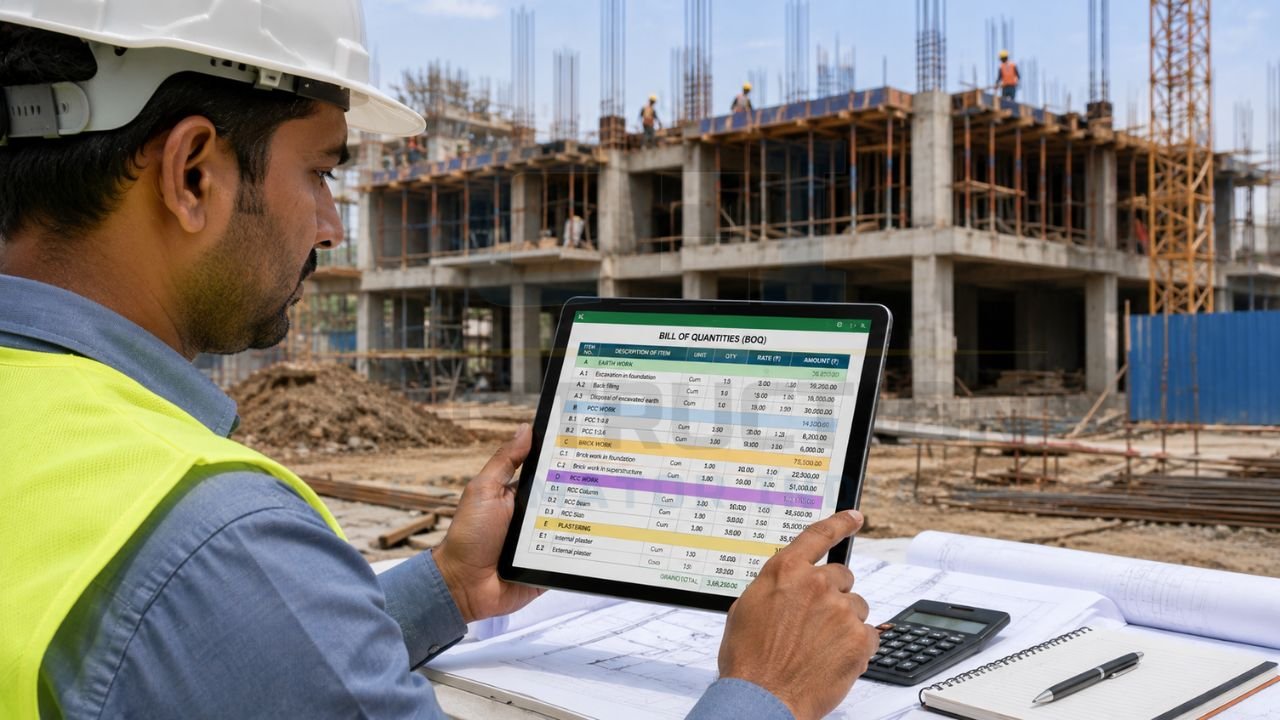
BOQ Rates (Bill of Quantities Rates) are the comprehensive unit costs assigned to every individual item of work in a construction project, including material, labor, equipment, wastage, and profit. In 2026, these rates are influenced heavily by the latest 2026 GST and construction rate trends affecting BOQ preparation and must align with regional PWD or CPWD standards to be competitive.
The Essentials of BOQ Rates
- Definition: The “Rate” part of “Quantity × Rate = Amount.”
- Core Components: Material cost + Labor cost + Overhead/Wastage + GST + Profit.
- 2026 Trend: Increased reliance on automated tools like the Excel BOQ Template to handle real-time rate updates.
- Pro Tip: For latest BOQ rates, accurate BOQ preparation, Excel BOQ Template or professional estimation across India, WhatsApp or call us today at +91 8630676890.
What are BOQ Rates and Why They are Critical in Construction
At Construction Estimator India, we define BOQ Rates as the financial pulse of any project. Whether you are a homeowner in Gujarat or a large-scale developer in Uttar Pradesh, the BOQ acts as your roadmap. The “Rates” within this document are not just numbers; they are a synthesis of our 10+ years of construction estimating expertise.
Why are they critical? Because they provide:
- Financial Clarity: They allow all stakeholders to see exactly where every rupee is going.
- Tender Competitiveness: In 2026, government and private tenders are won on the precision of these rates.
- RERA Compliance: Accurate rates ensure that the project budget filed with authorities remains realistic, preventing legal delays.
Without a standardized set of rates, you risk “scope creep,” where the project costs slowly balloon beyond the initial budget. Using standard BOQ rates and quantity takeoff practices in India 2026 ensures that your project starts on a firm financial foundation.
Current BOQ Rates in India 2026: Item-Wise Overview
As of July 2026, we have seen a stabilization in cement prices but a slight uptick in high-grade TMT reinforcement steel. Our team at Construction Estimator India has compiled a sample list of current rates based on 500+ projects we have managed across the country.
Sample BOQ Rate List (Item-Wise)
| Item Description | Unit | Sample Rate Range (₹) | Key Cost Driver |
|---|---|---|---|
| Earthwork Excavation (Soft Soil) | Cum | 180 – 240 | Labor & Fuel |
| RCC Work (M25 Grade) excluding Steel | Cum | 6,800 – 7,500 | Cement & Coarse Sand |
| TMT Steel Reinforcement (Cutting & Binding) | Kg | 82 – 95 | Market Volatility |
| Brickwork (1:4 Mix) with Fly Ash Bricks | Cum | 5,800 – 6,400 | Brick Quality |
| Internal Plastering (1:4 Mix, 12mm) | Sqm | 240 – 310 | Finish Quality |
| Vitrified Tile Flooring (Premium) | Sqm | 1,200 – 1,800 | Material Selection |
These rates are inclusive of local labor and material but exclude specific GST variations which can change based on your specific location and tax status. For a precise house construction cost estimation services report tailored to your city, always consult an expert.
📊 Download a professional BOQ Rates Template and estimate construction costs with confidence.
Factors That Affect BOQ Rates: From GST to Location
Applying a “one-size-fits-all” rate is one of the most dangerous things a contractor can do. In the 2026 Indian context, several variables can shift your BOQ Rates by as much as 20%.
- Geographic Location: A project in the remote hills of Uttarakhand will naturally have higher logistical costs than a project in Delhi-NCR due to transportation overheads.
- GST Impact: The latest 2026 GST and construction rate trends affecting BOQ preparation indicate that while civil works generally sit at 12%, finishing items and services may attract 18%. This must be factored into the unit rate to avoid losing profit at the billing stage.
- Market Fluctuations: Steel and bitumen prices change almost weekly. An expert BOQ should use a “Rate Analysis” that accounts for these shifts.
- Material Quality: The difference between “Grade A” river sand and “Crushed Stone Sand” can significantly alter your mix design costs.
- Project Scale: Economies of scale allow for lower rates on a 50,000 sq. ft. commercial building compared to a 1,500 sq. ft. residential villa.
How to Prepare Accurate BOQ Rates for Residential and Commercial Projects
Preparing accurate rates requires a disciplined approach. At Construction Estimator India, we follow a rigorous 5-step process to ensure our clients never lose money on a bid.
- Step 1: Material Rate Analysis: Contact at least three local vendors (e.g., in Noida, Mumbai, or Ahmedabad) to get current quotes for cement, steel, and sand.
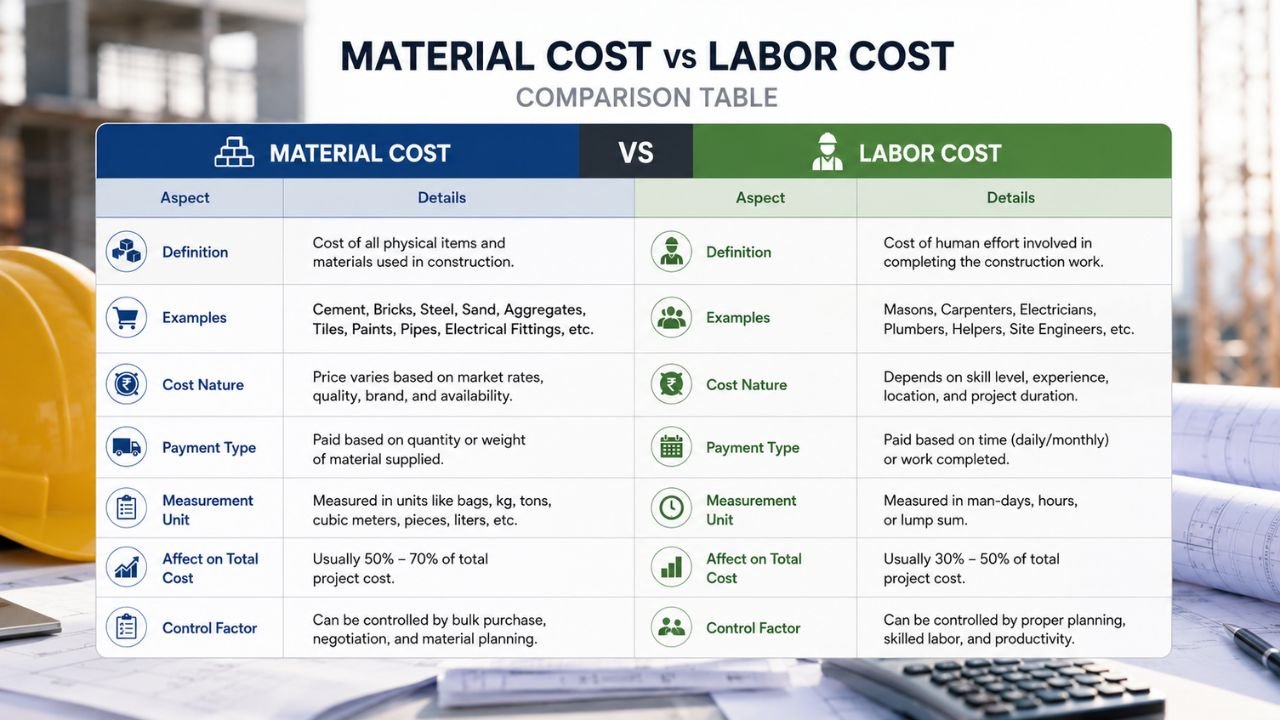
- Step 2: Labor Productivity Mapping: Estimate how many hours a mason and helper need for a specific task (e.g., laying 100 bricks).
- Step 3: Wastage Factor Inclusion: Always add a 3–5% wastage factor for materials like tiles, pipes, and bricks.
- Step 4: Overhead & Profit (O&P): Typically, 10–15% is added to cover site office expenses, tools, and contractor profit.
- Step 5: Tax Integration: Apply the correct GST slab to the final subtotal.
By adhering to best practices for accurate BOQ rate preparation in Indian construction projects, you ensure that your professional house construction estimation services are both competitive and sustainable.
Difference Between BOQ Rates and Market Rates
This is where many newcomers get confused. A “Market Rate” is what a shopkeeper tells you a bag of cement costs. A BOQ Rate is the total cost of that cement delivered, mixed, and cured on your site.
BOQ vs. Market Rates
| Feature | Market Rate | BOQ Rate |
|---|---|---|
| Inclusivity | Usually material only. | Material + Labor + Tools + Profit + Tax. |
| Logistics | Often excludes transport. | Includes delivery to the specific site floor. |
| Wastage | Not accounted for. | Built-in 5% average wastage factor. |
| Usage | Quick estimation. | Legal billing and tender submission. |
| Tax | May exclude GST in quotes. | Must be GST-compliant. |
Common Mistakes Contractors Make While Applying BOQ Rates
Even seasoned pros can fall into these traps. Here is what we have observed at Construction Estimator India over our 10+ years in the industry:
- Using Outdated DSR (Delhi Schedule of Rates): Relying on 2022 or 2023 rates in 2026 is a recipe for disaster.
- Ignoring “Lead” Charges: Forgetting the cost of carrying material from the truck to a 5th-floor apartment.
- Underestimating Specialized Labor: Premium Italian marble flooring requires different labor rates than standard vitrified tiles.
- Copy-Pasting from Other Projects: Every site has unique challenges (e.g., high water table in Gujarat vs. hard rock in UP).
For latest BOQ rates, accurate BOQ preparation, Excel BOQ Template or professional estimation across India, WhatsApp or call us today at +91 8630676890.
How an Excel BOQ Template Helps Apply Correct Rates Quickly
In the fast-paced world of 2026, you don’t have days to manually calculate rates for 500+ items. This is why our Excel BOQ Template has become a best-seller for Indian contractors.
- Auto-Calculations: You change one master rate for cement, and it reflects across all 50 tabs (concrete, plaster, brickwork) instantly.
- GST Dashboards: Automated tax breakdowns for CGST, SGST, and IGST based on your project location.
- Pre-Loaded Items: Over 500+ items already formatted according to standard BOQ rates and quantity takeoff practices in India 2026.
- Error Prevention: Built-in formula protection means you won’t accidentally delete a critical calculation.
Using a template transforms a 6-hour task into a 30-minute one, allowing you to focus on winning more bids.
Tips to Keep BOQ Rates Updated and Competitive
To stay ahead in 2026, you must treat your rate list as a living document.
- Subscribe to Material Indices: Follow price trends for TMT bars and Bitumen.
- Network with Local Vendors: Establish “Rate Lock” agreements for 3–6 months to hedge against inflation.
- Review Labor Laws: Stay updated on minimum wage changes in states like Maharashtra, Delhi, and Gujarat.
- Analyze Completed Projects: Compare your estimated BOQ rates with the actual “As-Built” costs to refine your future bids.
📝 Customize rates for Residential, Commercial, Industrial, and Government projects.
How Construction Estimator India Helps with Accurate BOQ Rates
We are more than just a software provider; we are your partners in growth. With 10+ years of experience and 500+ happy clients, our team provides:
- Custom BOQ Preparation: Detailed, tender-ready documents for any project size.
- Rate Analysis Services: Deep-dive breakdowns for complex industrial and commercial items.
- Excel BOQ Template: Our flagship automated tool used by site engineers across Pan-India.
- 3D Renderings & Plans: Visualizing your project before the first brick is laid.
Whether you are in Uttarakhand, UP, Delhi-NCR, or Gujarat, we bring precision to your doorstep.
Frequently Asked Questions (FAQ)
- What is the standard GST rate for BOQ items in 2026?
Generally, civil works are taxed at 12%, while finishing services and luxury materials often attract 18% GST. - How often should I update my BOQ rate list?
We recommend a monthly review for high-volatility items like steel and fuel, and a quarterly review for labor and cement. - Does your Excel BOQ Template work for interior design?
Yes! It includes dedicated sections for false ceilings, modular woodwork, and premium lighting rates. - Can I use CPWD rates for private residential projects?
While CPWD provides a great benchmark, you must adjust them for local market availability and private labor rates, which are often higher than government schedules. - How do I factor in material wastage in my rates?
Standard practice is to add a 3–7% “Wastage and Contingency” multiplier to your base material cost within the rate analysis. - Why are rates higher in hilly regions like Uttarakhand?
The “Hill Loading” factor accounts for difficult transportation, limited storage space, and lower labor productivity in extreme weather.
Conclusion: Take Control of Your Project Profits Today
Mastering BOQ Rates is the single most important skill for any construction professional in 2026. It protects your margins, builds trust with your clients, and ensures your business scales without the “human error” that leads to bankruptcy. Don’t leave your success to chance.
At Construction Estimator India, we have spent over a decade perfecting the art of estimation. Let us help you win your next tender or build your dream home with 100% financial accuracy.
Written by the team at Construction Estimator India – Pan-India construction cost estimation experts with 10+ years helping 500+ families and contractors across India with accurate BOQ rates, Excel BOQ Templates, 3D renderings and construction cost estimators.