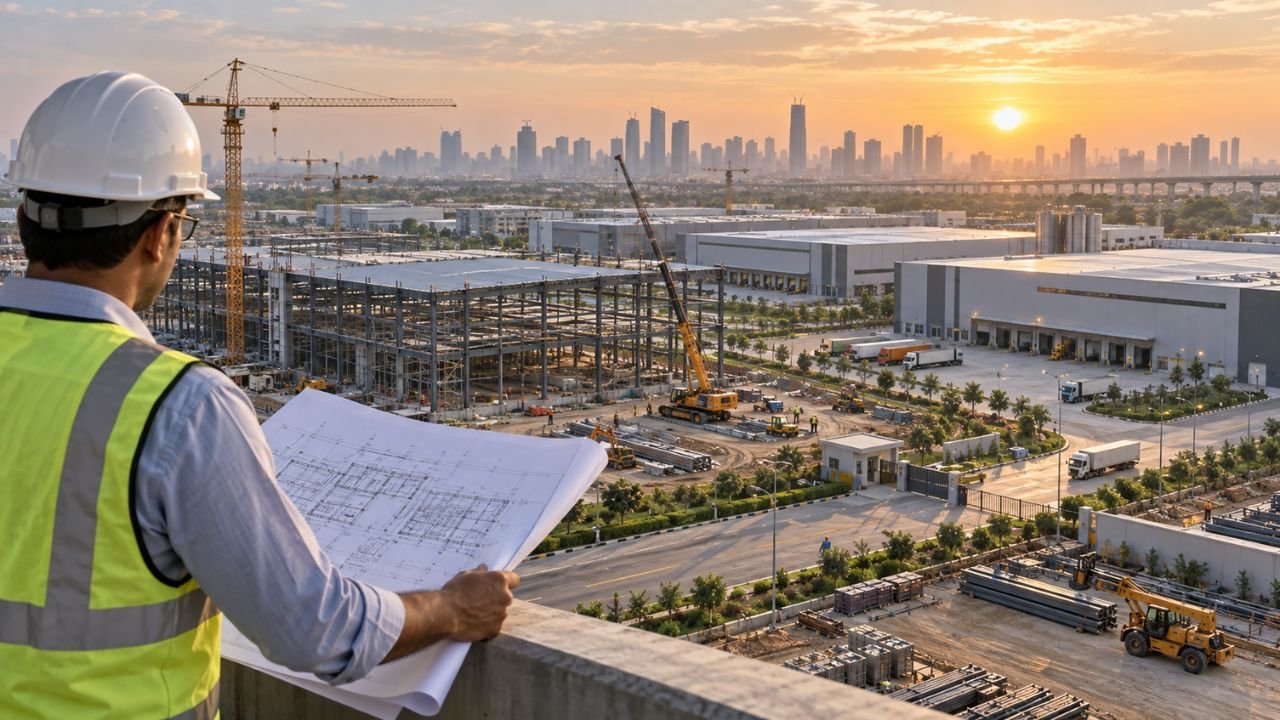
In the evolving landscape of Indian residential architecture, the concept of a small house front design has gained significant importance as urban plots become increasingly compact. Many homeowners today deal with narrow frontages of 15 to 25 feet, often fearing that their limited space will prevent them from achieving a modern or impressive exterior. However, a small house does not have to mean a small architectural impact. Thoughtful design, strategic use of materials, and a focus on clean proportions can transform a modest facade into a welcoming and stylish home. This guide explores how to balance aesthetics with structural logic and budget constraints, specifically for the Indian context.
👉 Planning a Double Floor House? Get Expert Guidance for Modern Front Elevation Design.
At Construction Estimator India, we specialize in helping homeowners bridge the gap between creative design and financial reality. Our team provides precise construction cost estimations and quantity takeoffs, ensuring that your dream elevation is both beautiful and buildable. If you are in the early stages of planning and want to understand the financial implications of different design choices, feel free to contact Construction Estimator India on WhatsApp / Call +91 8630676890 for professional guidance.
Understanding the Challenges and Potential of Small House Fronts
What Makes a House “Small” from the Front?
A house is typically perceived as “small” when it occupies a narrow plot or has a limited height, such as a single-story or a compact double-story structure. In most Indian cities, small house front design is defined by the plot width, where the distance between the side boundary walls is tight, leaving little room for grand, sprawling porches or wide lawns. This physical constraint forces the design to be more vertical and concentrated. However, visual impression is shaped more by composition than by total square footage. A small house front can feel grand if the elements—like the entrance, windows, and roofline—are scaled correctly to the building’s overall size.
Common Problems Homeowners Face with Small Fronts
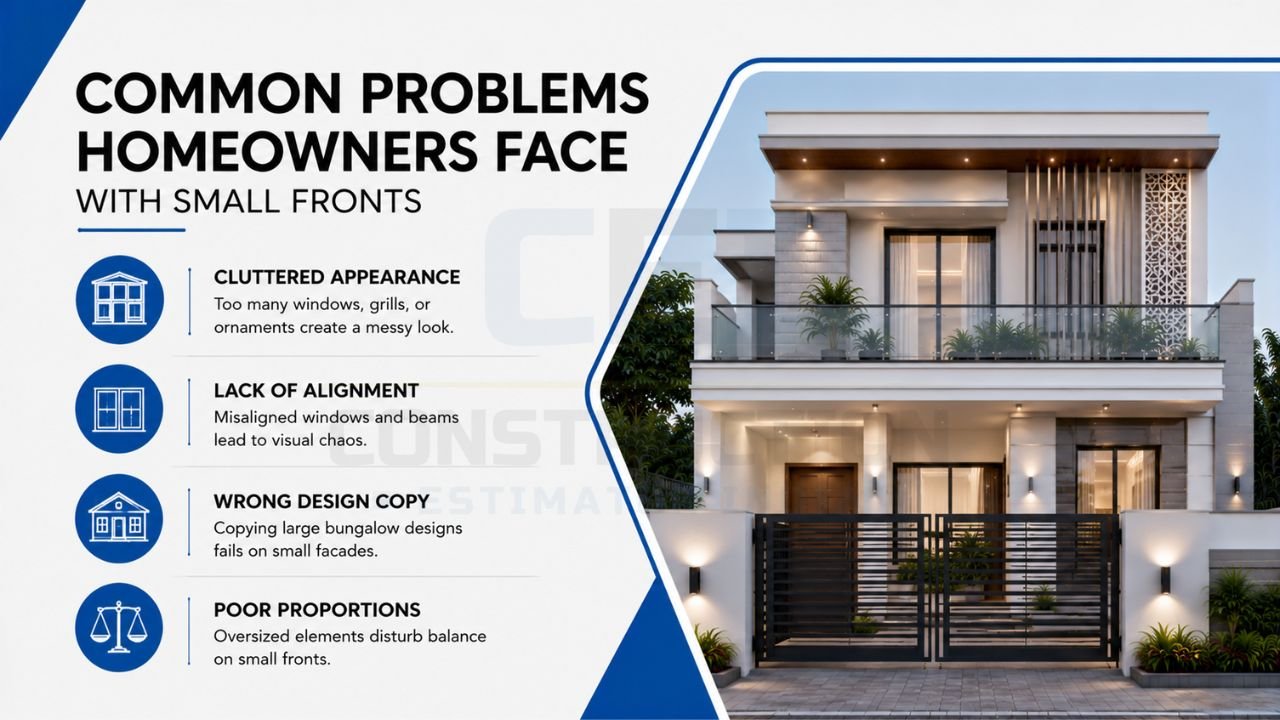
Homeowners often struggle with a cluttered appearance on small facades. In an attempt to make the house look “luxurious,” there is a tendency to add too many random windows, bulky grills, or excessive ornamentation. This often results in a messy look where nothing stands out. Another common pitfall is the lack of alignment; when window positions do not match the internal floor plan or the structural beams, it creates visual chaos on the outside. Furthermore, many people try to copy elevation designs meant for large bungalows, which usually fails because those features require a much larger surface area to look proportionate.
👉 Transform Your Double Floor House with a Stunning and Functional Front Design.
Seeing a Small Front as a Design Opportunity
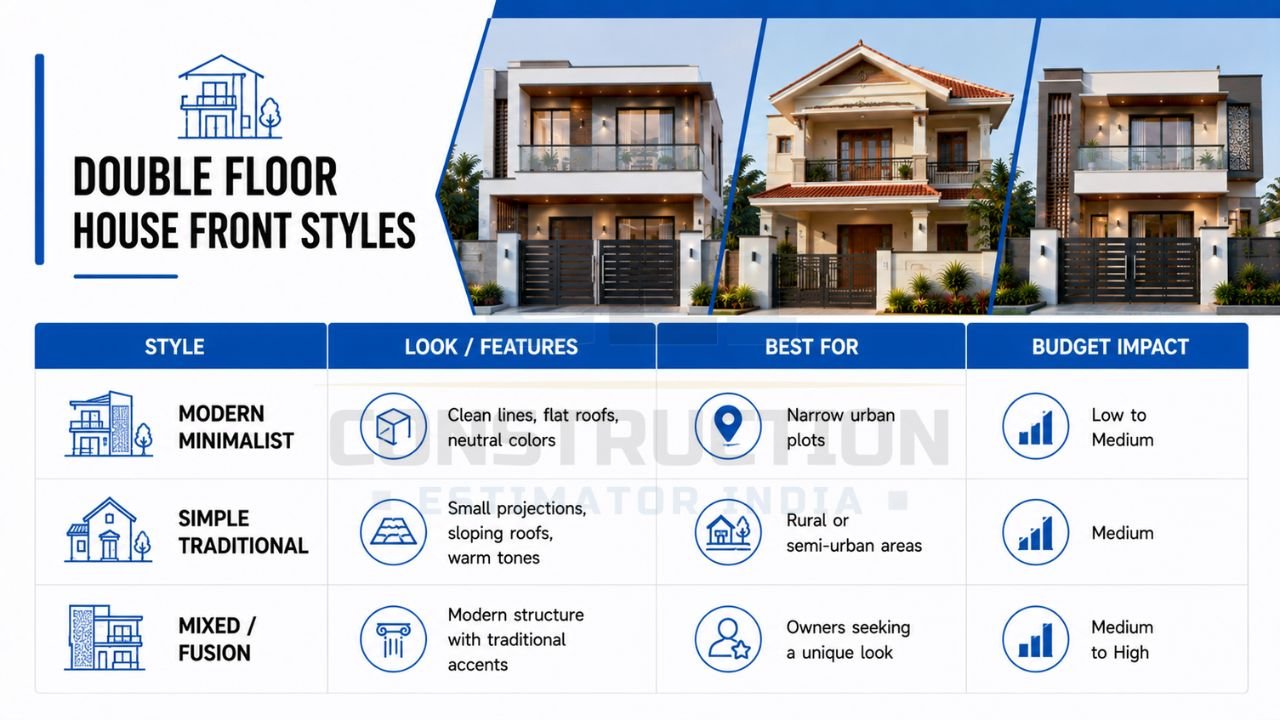
Instead of viewing a small footprint as a limitation, homeowners should see it as an opportunity for refined, minimalist design. A compact facade is often easier to maintain and cheaper to finish because you are dealing with a smaller total area. By focusing on a few strong architectural moves—such as a well-framed entrance or a single vertical texture—you can create a high-impact look for a fraction of the cost. The table below compares different overall styles that are particularly suited for small house front designs in India.
The following table provides a comparison of the three most popular architectural styles used for compact Indian residences, highlighting their main features and budget implications.
| Style | Look / Features | Best For | Budget Impact |
|---|---|---|---|
| Modern Minimalist | Clean lines, flat roofs, neutral colors | Narrow urban plots | Low to Medium |
| Simple Traditional | Small projections, sloping roofs, warm tones | Rural or semi-urban areas | Medium |
| Mixed / Fusion | Modern structure with traditional accents | Owners seeking a unique look | Medium to High |
As shown in the table, the Modern Minimalist approach is often the most budget-friendly and effective for narrow plots because it avoids expensive, bulky structures that might overwhelm a small facade. Construction Estimator India can help you evaluate which style fits your financial plan before you finalize your blueprints.
👉 Get Customized Double Floor House Front Designs Tailored to Your Vision.
Choosing a Suitable Style for a Small House Front
Modern Minimalist Small House Front Design
The modern minimalist style is perhaps the most successful approach for a small house front design today. It relies on the “less is more” philosophy, using simple rectangular forms and a restrained color palette to create a sense of calm and space. By eliminating unnecessary decorative carvings or heavy pillars, you allow the building’s basic shape to speak for itself. This style often uses large glass openings and slim-profile frames to make the house feel more open and connected to the street. It is particularly effective for very narrow plots as it emphasizes verticality and clean edges.
Simple Traditional or Semi-Traditional Look for Small Homes
For those who prefer a more grounded or classic feel, a semi-traditional style can be adapted for a compact frontage. This might involve using small concrete sunshades that mimic traditional eaves or adding a modest sloping roof section over the porch. The key is to scale these elements down. Instead of large, heavy arches, one might use a simple curved frame around the main entrance. This style works well in regions with heavy rainfall where sloping elements are functional as well as aesthetic. It provides a sense of warmth and familiarity without making the small front look dated or heavy.
Matching Style with Neighborhood and Budget
While your personal taste is paramount, it is wise to consider the surrounding environment and your local climate. A ultra-modern glass facade might look out of place in a historic neighborhood or might be difficult to keep clean in a very dusty area. Budget is also a major factor; complex shapes and specialized materials increase both labor and material costs. Construction Estimator India can guide you on how to align your preferred elevation features with your total construction budget, ensuring that you don’t spend excessively on the front while compromising on the interior quality.
Planning Openings and Proportions on a Small Front
Door and Main Entry Composition
The main entrance is the soul of any small house front design. It acts as the primary focal point that anchors the entire facade. On a narrow plot, the entrance should feel significant but not bulky. Framing the door with a simple concrete projection or a change in wall texture can make it stand out. If the house has a first floor, aligning the main door with a balcony or a large window directly above it creates a strong vertical axis, which makes the house appear taller and more organized. A neat, well-lit porch area adds depth to the entrance, making it feel more inviting.
Window Placement and Size for Small Fronts
In a compact house, the size and placement of windows can make or break the design. Too many small, randomly placed windows will make the facade look busy and unplanned. Instead, designers often prefer fewer but larger, well-proportioned windows. Standardizing the window heights and aligning their top edges (the lintel level) creates a sense of harmony. For small houses, vertical windows are often preferred over wide ones as they draw the eye upward, increasing the perceived height of the building. Using slim-frame aluminum or UPVC windows can provide a modern, high-end look without requiring much space.
Using Vertical and Horizontal Lines to Stretch or Widen the Front Visually
Architects use “visual tricks” to manipulate how we see a building’s size. If your plot is exceptionally narrow, adding vertical elements like narrow stone-clad pillars or vertical plaster grooves (called “groove work”) can make the house look taller. Conversely, if you feel your house is too tall and thin, adding horizontal bands or extending the parapet wall horizontally can help it look wider and more stable. These lines are often created using simple cement plaster or by varying the paint colors, making them very cost-effective ways to enhance a small house front design.
Material and Color Strategies for Small House Front Design
Limiting Materials to Avoid a Busy Look
One of the most important rules for a small facade is to limit the variety of materials used. Using too many different textures—like brick, stone, wood, and tile all at once—can overwhelm a tiny surface. A successful small house front design usually sticks to two or three main finishes. For instance, a combination of high-quality exterior paint with a single vertical panel of stone cladding or wood-look HPL (High-Pressure Laminate) sheets can look incredibly premium. By keeping the materials limited, you ensure that the eye has a clear place to rest, making the house look more sophisticated.
Color Combinations for Compact Elevations
Color has a massive impact on the perceived scale of a home. Light base colors like off-white, cream, or light grey are ideal for small houses as they reflect more light and make the structure feel airy and open. Darker colors should be used strategically as “accents”—for example, on a recessed wall section, a window frame, or the main gate. This contrast creates depth, preventing the house from looking like a flat, boring box. Avoid using very bright or saturated colors on large areas, as they can make a small house look smaller and less professional.
Balancing Style with Cost and Maintenance on Small Houses
When choosing materials, it is vital to think about the long-term cost and effort required to keep them looking good. While natural wood looks beautiful, it requires regular polishing in the harsh Indian sun. Similarly, very light-colored textures may show dust more easily in urban areas. Construction Estimator India helps homeowners navigate these choices by providing a detailed Bill of Quantities (BOQ) that compares the cost of various finishes. If you are unsure whether to splurge on stone cladding or stick to a high-quality texture paint, contacting Construction Estimator India for a cost comparison is a smart move before you start purchasing materials.
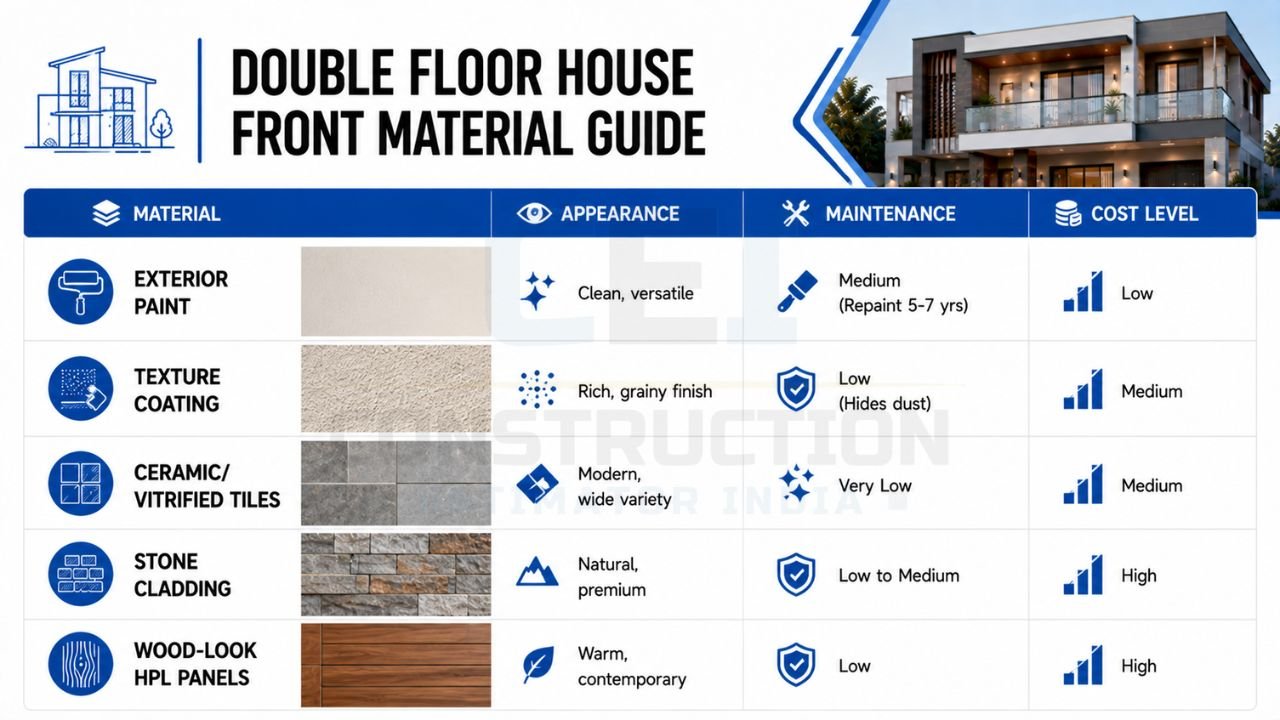
The following table summarizes common materials used in Indian house fronts, comparing their aesthetic appeal, maintenance needs, and relative cost levels.
| Material | Appearance | Maintenance | Cost Level |
|---|---|---|---|
| Exterior Paint | Clean, versatile | Medium (Repaint 5-7 yrs) | Low |
| Texture Coating | Rich, grainy finish | Low (Hides dust) | Medium |
| Ceramic/Vitrified Tiles | Modern, wide variety | Very Low | Medium |
| Stone Cladding | Natural, premium | Low to Medium | High |
| Wood-look HPL Panels | Warm, contemporary | Low | High |
This table shows that while premium materials like stone or HPL panels offer a high-end look, they come with a higher initial investment. Simple paint and texture options remain the most cost-effective way to achieve a great small house front design.
👉 Bring Your Dream House Elevation to Life with Expert Design and Planning.
Ground-Level Design for Small House Fronts
Entry Steps, Porch, and Threshold
The transition from the street to the house is a critical part of the ground-floor experience. Even with very limited space, having one or two wide steps leading to the main door creates a sense of arrival. A small porch projection—even if it is only 3 or 4 feet deep—provides essential shade and protection from rain. Using a premium flooring material like granite or anti-skid vitrified tiles for the entry steps can elevate the look of the entire ground zone. This area should be well-integrated with the main gate and the parking space to ensure a smooth flow for both residents and guests.
Parking and Gate on Narrow or Small Fronts
In many Indian urban plots, the parking area takes up a significant portion of the front frontage. The challenge is to make this space functional without letting it ruin the elevation. The gate design is crucial here; a sliding gate is often more space-efficient for narrow plots than a swing gate. The gate should match the architectural language of the house. For a modern small house front design, a simple gate with horizontal metal slats or a laser-cut CNC design looks much better than a heavy, ornate iron gate. Properly placing the gate pillars so they don’t block the car’s turning radius is a practical necessity that must be planned during the foundation stage.
Ground Floor Security and Privacy in a Small House
Security is a major concern for houses on small plots where the living room is often very close to the street. Instead of using heavy, prison-like grills, consider using modern, minimalist grill designs that are integrated into the window frames. Frosted glass or tinted glass can provide privacy during the day without blocking natural light. Another strategy is to keep the “sill level” of the front windows slightly higher (around 3 to 4 feet) so that passersby cannot easily see into the house, while still allowing the residents to have a view of the street.
First Floor or Terrace Treatment for Small Houses
Small Balcony or French Balcony Options
If your small house has a first floor, a balcony is a great way to add “depth” to the facade. On very tight plots, a full-sized balcony might not be possible. In such cases, a “French balcony” (a large window with a railing placed directly outside) or a narrow standing ledge can provide the same visual benefit without taking up much space. These elements break the flat surface of the wall and provide a place for plants, which adds a touch of life to the small house front design. The choice of railing—whether toughened glass, stainless steel, or simple masonry—should complement the overall style of the house.
Parapet Design and Terrace Edge
The roofline or the parapet wall is the “cap” of your house. For a small building, the parapet should be kept neat and uncluttered. A simple flat parapet with a slight projection at the top (a coping) is often the most elegant choice. You can add interest by introducing a small “slit” or a change in height in one section of the parapet. Avoid adding too many decorative elements at this height, as it can make the house look “top-heavy.” A clean top line ensures that the building looks modern and professionally designed.
Using Railings, Pergolas, or Simple Frames
To add a three-dimensional feel to a small facade, architects often use concrete or steel frames. A simple frame around a window or a balcony can create interesting shadows throughout the day. Pergolas—open-roof structures made of concrete or metal—are another great way to add style to a terrace or a porch. They provide a sense of luxury and can be used to support climbing plants, providing natural shade. These features are relatively inexpensive but add a significant amount of “character” to a small house front design.
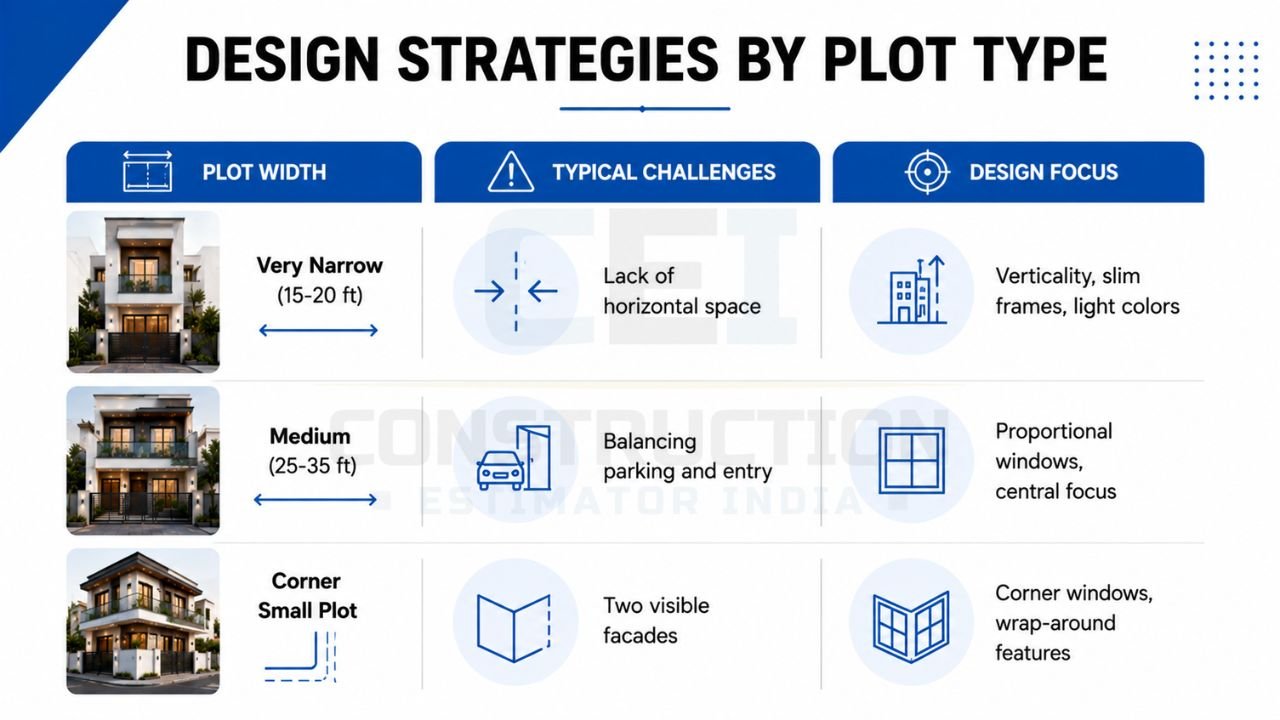
The table below focuses on design priorities based on the width of the plot, helping homeowners focus on the right elements.
| Plot Width | Typical Challenges | Design Focus |
|---|---|---|
| Very Narrow (15-20 ft) | Lack of horizontal space | Verticality, slim frames, light colors |
| Medium (25-35 ft) | Balancing parking and entry | Proportional windows, central focus |
| Corner Small Plot | Two visible facades | Corner windows, wrap-around features |
Understanding these priorities helps in making smarter design decisions. For example, on a very narrow plot, trying to fit a wide porch is a mistake; instead, the focus should be on making the house look tall and elegant.
👉 Build a Beautiful Double Floor Home with Professional Architectural Guidance.
Light, Ventilation, and Orientation in Small House Fronts
Making the Most of Natural Light
A small house can feel cramped if it is dark inside. The front facade is often the primary source of light, so window placement must be strategic. If your house faces North or East, you can afford to have larger windows as the light is gentle. However, if the house faces West or South, large windows can lead to excessive heat gain. In such cases, using deep sunshades or “louvers” (slats) can block the harsh sun while still allowing light and air to enter. This practical response to orientation often results in a more interesting and functional small house front design.
Cross Ventilation and Room Layout Behind a Small Front
A beautiful facade is useless if the house is stuffy inside. The internal floor plan must be designed alongside the elevation to ensure cross-ventilation. Aligning the front windows with windows at the back or side of the house allows for a natural breeze. Even in a compact house, creating a small internal courtyard or an “open-to-sky” (OTS) duct can significantly improve airflow and light. When the internal rooms are bright and breezy, the windows on the front serve a much higher purpose than just looking good.
Street Noise, Dust, and Privacy Management
Small houses on busy Indian streets face the constant challenge of noise and dust. Double-glazed windows are an excellent investment for front-facing rooms as they provide superior sound insulation. If space permits, planting a small hedge or a few tall plants in the front setback can act as a natural filter for dust and noise. These green elements also soften the look of the building, making the small house front design feel more peaceful and connected to nature.
Cost Planning for Small House Front Design
Which Front Design Choices Affect Cost the Most
It is a common misconception that a good-looking front must be expensive. In reality, the most significant cost drivers are specialized materials and complex structural projections. Large expanses of toughened glass, heavy stone cladding, and intricate metal pergolas can quickly increase your budget. On the other hand, focusing on perfect proportions, a smart two-tone paint scheme, and simple cement groove work can achieve a high-end look for much less. By identifying these “costly” features early, you can decide where to splurge and where to save.
Achieving a Premium Look on a Limited Budget
To get a premium look on a budget, follow the “one-feature” rule. Instead of trying to add several expensive materials, pick one standout element—like a beautiful main door or a single vertical panel of high-quality tiles—and keep the rest of the facade simple and clean. This creates a focused, high-end appearance. Using high-quality exterior-grade LED lighting is another cost-effective way to make a small house look like a luxury villa at night. Simple wall-washers or spotlights can highlight the textures of your walls and make the house stand out in the neighborhood.
How Construction Estimator India Helps Owners of Small Houses?
At Construction Estimator India, we believe that transparency is the key to a stress-free building process. We help small house owners by providing detailed cost evaluations of different elevation designs. Our service allows you to see the price difference between a simple painted front and one with extensive cladding or glass work. By knowing these numbers before the construction starts, you can avoid the heartbreak of running out of funds halfway through the project. We encourage you to reach out to us for a quantity takeoff and budget planning session to ensure your small house front design is financially feasible.
Common Mistakes in Small House Front Design
Trying to Fit “Too Much Design” on a Tiny Front
The biggest mistake homeowners make is “over-designing.” In an attempt to make the house look grand, they add arches, sloping roofs, multiple cladding types, and decorative railings all on the same small facade. This creates a cluttered, confusing look where no single element can be appreciated. A successful small house front design is about restraint. Pick a style and stick to it, ensuring that every element has a purpose and contributes to the overall harmony of the building.
Ignoring Alignment with the Floor Plan and Structure
A facade should never be an “afterthought” or a “skin” pasted onto a building. If your windows on the outside don’t align with the rooms on the inside, the house will look awkward and unplanned. Furthermore, every architectural projection needs structural support. If you design a heavy balcony without considering the underlying beams and columns, it can lead to structural cracks or high costs for additional reinforcement. Always ensure that your aesthetic vision is aligned with the structural logic of the house.
Copying Big Bungalow Designs Without Scaling Down
It is tempting to look at photos of massive luxury villas and try to copy their features. However, a feature that looks great on a 60-foot wide mansion—like a massive grand entrance or a wide wrap-around porch—will look cramped and out of place on a 20-foot wide plot. The key is to “adapt” rather than “copy.” Take the “vibe” or the “material palette” from your inspiration images, but apply them in a way that respects the smaller scale of your home.
👉 Turn Your Dream Elevation into Reality with Trusted Design and Construction Experts.
FAQs: Small House Front Design in India
How can I make my narrow front look wider?
To make a narrow front look wider, use horizontal design elements. This can include horizontal paint bands, wide windows, or a parapet wall that extends slightly beyond the main walls. Using light colors for the majority of the surface also helps in making the building appear broader and more open.
Are glass railings better than solid walls for small balconies?
Glass railings are generally better for small houses because they are transparent and don’t block the view, making the facade feel lighter and more modern. However, they require more frequent cleaning. If you prefer privacy, a slim metal railing or a thin masonry parapet with a small opening can also work well.
How much does a front elevation design typically cost for a small house?
The “extra” cost for elevation features—cladding, premium railings, and lighting—usually ranges from 5% to 12% of the total building cost. However, this varies greatly based on your choice of materials. You should contact Construction Estimator India to get a precise estimate based on your specific design preferences.
Can a single-floor house have a modern front design?
Absolutely. A single-floor house (ground floor only) can look incredibly stylish by using a “box-style” parapet, a well-defined porch, and a smart mix of paint and texture. Focusing on the entrance and the window proportions is the key to making a single-story home look modern and premium.
When is the best time to contact Construction Estimator India?
The best time to involve us is after you have a basic floor plan and a rough sketch of the elevation, but before you finalize the structural drawings. This allows us to help you adjust the design to fit your budget, ensuring that your small house front design is both beautiful and affordable.
Conclusion: Make Your Small House Front Simple, Smart, and Budget-Friendly
Designing a small house front design is a journey of balancing your aesthetic dreams with the practical realities of urban Indian living. A successful compact facade is one that embraces simplicity, respects proportions, and uses materials wisely. By avoiding the temptation to over-decorate and focusing instead on clean lines, balanced openings, and a cohesive color palette, you can create a home that is the pride of your street. Remember that architectural beauty is not determined by the size of the plot, but by the thoughtfulness of the design.
Building a home is a significant investment, and every choice you make has a financial impact. Do not leave your budget to chance. Early planning and professional estimation are the best ways to ensure a smooth construction experience without unexpected costs. Whether you are looking for a simple minimalist look or a more detailed semi-traditional facade, knowing your material quantities and costs is essential.
Before you take the final step and finalize your small house front design, reach out to the experts who can provide you with the clarity you need. Contact Construction Estimator India on WhatsApp / Call +91 8630676890 today to get a professional evaluation of your project. We are here to help you build a high-quality, stylish home that fits perfectly within your budget.