
In the landscape of Indian public infrastructure, the Central Public Works Department (CPWD) serves as the primary authority for establishing construction standards and execution protocols. For any civil engineer, quantity surveyor, or contractor aiming to navigate government projects, mastering the cpwd boq for civil works is not just an advantage—it is a core professional necessity. This document acts as the definitive financial and technical blueprint that bridges the gap between architectural drawings and site execution.
 Click Here to Purchase the Civil Work BOQ Template for ₹249
A Bill of Quantities (BOQ) prepared under CPWD norms ensures that every taxpayer rupee is accounted for through standardized measurements and market-reflective rates. This guide provides an in-depth exploration of the cpwd boq for civil works, its inextricable link with the Delhi Schedule of Rates (DSR), and a step-by-step practical approach to preparing, understanding, and utilizing these documents for successful tendering and billing. Whether you are bidding on a multi-crore PSU project or managing a local government facility, the principles outlined here will serve as your roadmap to compliance and profitability.
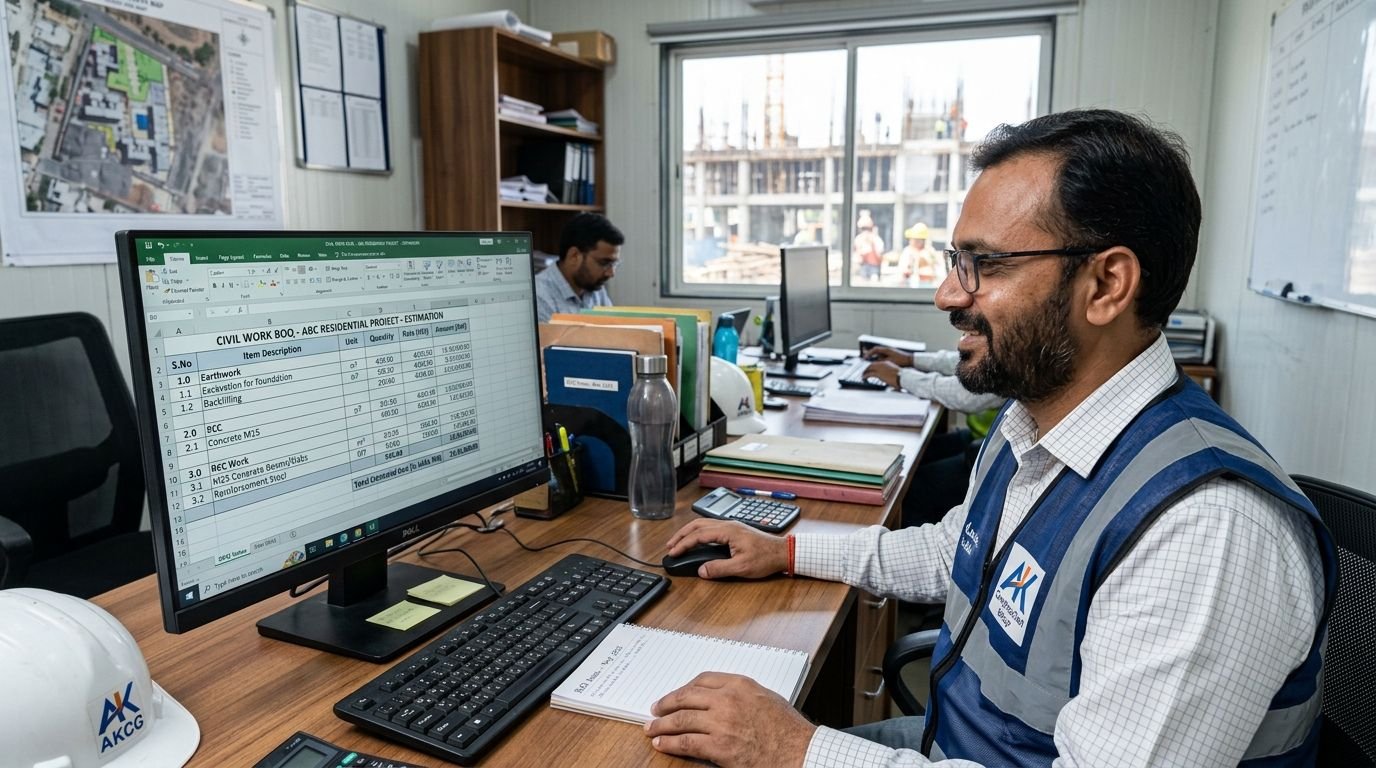
What Is CPWD BOQ for Civil Works?
In the context of CPWD projects, a Bill of Quantities (BOQ) is a structured schedule of work items derived from detailed architectural and structural drawings. It itemizes every activity—from the initial site clearance to the final coat of paint—providing precise quantities for each. The cpwd boq for civil works is fundamentally different from a simple quote used in the private sector because its descriptions and measurement units are strictly governed by official standards.
The BOQ serves as the “commercial heart” of a government tender. When a department like CPWD or a state PWD invites a bid, the BOQ is the document where the contractor fills in their rates. The product of these quantities and rates determines the total bid value, which is then used to identify the lowest bidder (L1). Beyond tendering, it remains the baseline for all financial transactions, including the preparation of Running Account (RA) bills and final project closure.
Click Here to Purchase the Civil Work BOQ Template for ₹249
Relationship Between CPWD BOQ and CPWD DSR
The CPWD DSR civil works (Delhi Schedule of Rates) is the foundation upon which every government BOQ is built. The DSR is a comprehensive compendium of thousands of construction items, updated periodically (typically every two years) to reflect modern materials and techniques. It provides a standardized description, code, and “basic rate” for every conceivable task in civil construction.
The relationship between the BOQ and DSR is absolute:
- Item Descriptions: A standard BOQ item for a CPWD project must use the exact wording found in the DSR. This ensures that there is no ambiguity regarding the quality of materials or the method of execution.
- Units of Measurement: The units—whether cubic meters (cum) for concrete, square meters (sqm) for plaster, or kilograms (kg) for steel—must strictly adhere to DSR standards, which are themselves aligned with IS 1200.
- Rate Analysis: While contractors quote their own rates in a tender, the department’s internal “Justification of Rates” or “Estimated Cost” is calculated by applying a Cost Index to the DSR rates. This index adjusts the base Delhi rates to local market conditions (e.g., Lucknow, Mumbai, or Guwahati).
Many other organizations, including state PWDs, PSUs (like NTPC or NHPC), and even private developers, adopt bill of quantities as per CPWD standards because they offer a legally robust and technically sound framework for cost management.
Click Here to Purchase the Civil Work BOQ Template for ₹249
Standard CPWD BOQ Format and Columns
A professional CPWD BOQ format is designed for clarity, transparency, and ease of auditing. In modern e-tendering, this is usually presented as an Excel file (often referred to as the ‘.xls BOQ’) which is uploaded to the Central Public Procurement Portal (CPPP).
Header and Tender Details
The top section of the BOQ provides the administrative context:
- Name of Work: A formal title of the project (e.g., Construction of Office Building for Income Tax Dept at Lucknow).
- NIT Number: The Notice Inviting Tender reference.
- Estimated Cost: The department’s calculation of the project value (often hidden in certain tender types).
- Completion Period: The time allowed for the project.
Core BOQ Columns
The table body typically contains these essential columns:
- Item No.: A hierarchical serial number (e.g., 1.1, 2.3.1) often corresponding to DSR chapters.
- Description of Item: The full technical specification of the work. It must describe the grade of material, the thickness, the method of application, and any included accessories (shuttering, curing, etc.).
- Unit: The measurement unit as per DSR (cum, sqm, kg, tonne, Nos, etc.).
- Quantity: The precise amount calculated by the department engineers from drawings. In most CPWD tenders, this column is locked and cannot be edited by the bidder.
- Rate: The field where the contractor enters their per-unit price. This rate is usually inclusive of all taxes (GST), labor, tools, and contractor profit.
- Amount: The mathematical product of Quantity and Rate. In digital BOQs, this is a formula-driven cell.
Sub-heads and Grouping
To make the document manageable, items are grouped into logical chapters or “Sub-heads” such as:
- Sub-head I: Earthwork
- Sub-head II: Concrete Work
- Sub-head III: RCC Work
- Sub-head IV: Masonry Work
- Sub-head V: Finishing (Plastering, Painting)
Each sub-head has its own total, and these sub-totals are aggregated on a “Grand Summary” page to arrive at the final tender value.
Click Here to Purchase the Civil Work BOQ Template for ₹249
How CPWD BOQ Is Used in Tendering and Estimation
Understanding the lifecycle of a CPWD tender BOQ is essential for both government staff and private contractors.
For Department Engineers
Before a project is even advertised, engineers use architectural and structural drawings to perform a “Quantity Take-off.” They then select appropriate items from the DSR and apply the current Cost Index to arrive at the “Preliminary Estimate” and subsequently the “Detailed Estimate.” The resulting BOQ ensures that the project budget is realistic and technically compliant.
For Contractors and Bidders
During the bidding phase, the contractor analyzes the BOQ items. They must check if the provided quantities are realistic, but their primary task is “Rate Analysis.” They calculate their own cost for material, labor, and machinery, then add their overheads and profit to fill in the Rate column. A deep understanding of CPWD specifications is required here; for example, if an item mentions “vibrating and curing,” the contractor must ensure those costs are factored into the rate.
Click Here to Purchase the Civil Work BOQ Template for ₹249
For Billing and Execution
Once the contract is awarded, the BOQ becomes the basis for payment. As work progresses, the site engineer measures the actual work done and records it in the Measurement Book (MB). These measurements are then matched against the BOQ item rates to generate RA bills. If there are deviations (quantities exceeding the BOQ) or extra items (work not in the original BOQ), they are handled through separate “Deviation Statements” or “Extra Item Statements,” referencing the original BOQ logic.
Step-by-Step: Preparing a CPWD-Style BOQ for Civil Works
Preparing a boq for government civil projects requires a meticulous and standardized workflow to pass through technical and audit scrutinies.
- Step 1: Drawing Review: Thoroughly study all architectural, structural, and MEP drawings to understand the full scope of work. Identify specialized requirements like high-grade concrete or specific waterproofing systems.
- Step 2: Sectional Breakdown: Break the project into DSR-compliant sub-heads (Earthwork, Masonry, etc.). This ensures that no category of work is missed.
- Step 3: Quantity Take-off: Calculate exact quantities using standard measurement rules. In India, this must follow IS 1200 or the CPWD specific measurement guidelines. Use a separate “Measurement Sheet” for these calculations to maintain a clear audit trail.
- Step 4: Item Selection and Description: Find the corresponding item numbers in the latest CPWD DSR. Copy the description exactly as it appears in the DSR. If an item is not available in the DSR, it is treated as a “Non-Schedule Item” (NSI), which requires a separate market rate analysis.
- Step 5: Compilation in Excel: Use a standardized template with the columns discussed earlier. Ensure that units are correct—for instance, reinforcement steel is always in “kilograms” or “tonnes,” never in “running meters” for payment.
- Step 6: Review and Validation: Cross-check the BOQ against the drawings one last time to ensure no major “Quantity Variation” will occur later. In government works, large deviations can lead to administrative delays and inquiries.
Example Structure of a CPWD BOQ for Civil Works (Illustrative)
Below is a simplified example showing how items are typically presented in a CPWD BOQ for civil works. This example uses paraphrased DSR-style descriptions for educational purposes.
| Item No. | Description of Work | Unit | Quantity | Rate (₹) | Amount (₹) |
|---|---|---|---|---|---|
| 1.0 | SUB-HEAD: EARTHWORK | ||||
| 1.1 | Earthwork in excavation by manual means in foundation trenches… up to 1.5m depth including dressing of sides and ramming of bottoms… | cum | 450.00 | 185.00 | 83,250 |
| 2.0 | SUB-HEAD: CONCRETE WORK | ||||
| 2.1 | Providing and laying in position Cement Concrete of specified grade excluding the cost of centering and shuttering – All work up to plinth level : 1:4:8 (1 Cement : 4 coarse sand : 8 graded stone aggregate 40 mm nominal size). | cum | 15.50 | 5,850.00 | 90,675 |
| 3.0 | SUB-HEAD: RCC WORK | ||||
| 3.1 | Reinforced cement concrete work in beams, suspended floors, roofs… up to floor five level, excluding the cost of centering, shuttering, finishing and reinforcement, with M25 grade concrete. | cum | 42.00 | 8,450.00 | 3,54,900 |
| 3.2 | Steel reinforcement for R.C.C. work including straightening, cutting, bending, placing in position and binding all complete above plinth level. Thermo-Mechanically Treated bars of grade Fe-500D or more. | kg | 6,500 | 82.50 | 5,36,250 |
Note: The above table is for illustrative purposes. Actual descriptions in a live tender will be much more detailed.
Best Practices When Working With CPWD BOQ for Civil Works
- Standardization is Key: Never use local names or abbreviated terms. Always use the full nomenclature from the CPWD DSR or the specific Notice Inviting Tender (NIT).
- Adherence to IS 1200: Measurement protocols must be strictly followed. For example, deductions in plaster for doors and windows must be calculated exactly as per the code to avoid audit objections.
- Dynamic Excel Sheets: Use formulas for all calculations. Avoid manual entries in “Amount” or “Total” cells to eliminate human error. Lock the quantity cells before circulating the sheet to prevent accidental changes.
- Audit Trail for NSI: If you use a Non-Schedule Item, ensure you have three market quotations and a detailed “Rate Analysis” sheet to justify the price to the technical sanctioning authority.
- Version Control: Clearly mark the DSR edition being used (e.g., DSR 2024) and the applicable Cost Index. Rates change significantly across editions.
Common Mistakes in CPWD BOQs and How to Avoid Them
Even experienced billing engineers can make errors that lead to financial loss or project delays.
- Vague Descriptions: Using “Concrete for Slab” instead of the full DSR description. This leads to disputes over whether formwork or vibrating was included. Fix: Always copy-paste the full DSR text.
- Incorrect Units: Measuring a 4-inch brick wall in cubic meters instead of square meters. Fix: Refer to IS 1200; thick walls are volume-based, while thin partitions are area-based.
- Ignoring Lead and Lift: Forgetting that carrying materials to higher floors (lift) or over long distances (lead) often requires separate DSR items. Fix: Check the “General Notes” of the DSR for height and distance inclusions.
- Math Errors: Manually typing totals. Fix: Use the SUM function and cross-check totals with an “Abstract” sheet.
Digital Tools and Excel Templates for CPWD-Style BOQ
In 2026, the era of handwritten BOQs is over. Most government departments now use e-tendering portals that require the BOQ to be uploaded in a specific ‘.xls’ format.
Modern civil engineers leverage “Smart Excel Templates” that are pre-loaded with DSR descriptions and automated calculation engines. These tools allow you to enter a quantity, and the sheet automatically pulls the DSR description and suggests the latest market rate. For contractors, using such templates ensures that their bids are mathematically perfect and professional. Furthermore, keeping separate sheets for “Schedule Items” (DSR) and “Non-Schedule Items” (Market) within the same workbook allows for better financial clarity during site meetings.
CPWD BOQ vs. Private Sector BOQ: Key Differences
While the private sector values speed and flexibility, the government sector values protocol and auditability.
| Feature | CPWD BOQ | Private Sector BOQ |
|---|---|---|
| Basis | Strict adherence to DSR and IS 1200. | Flexible; often uses “all-in” market rates. |
| Quantities | Generally fixed; deviations require formal approval. | More fluid; often based on actuals at site. |
| Descriptions | Long, technical, and standardized. | Short, brand-focused, or functional. |
| Audit | Subject to CAG and internal audits. | Internal management review only. |
| Taxation | Strict GST and Cess compliance required. | Often lump-sum or inclusive of all. |
Learning the CPWD style makes an engineer highly employable. If you can prepare a BOQ that satisfies a CPWD Executive Engineer, you can handle any project in the private sector with ease.
Conclusion: Mastering CPWD BOQ for Civil Works as a Core Career Skill
Mastering the cpwd boq for civil works is foundational for any professional involved in India’s infrastructure development. It is more than just a list of numbers; it is a document that ensures technical quality, financial transparency, and legal protection for all stakeholders.
For students and freshers, studying the DSR and practicing quantity take-off from real drawings is the best way to start. For contractors, investing in professional automated templates and staying updated with the latest CPWD works manuals will directly impact your tender success rate and project profitability. As India continues its massive push for public infrastructure, the demand for experts who can speak the “language of BOQs” will only continue to grow.
Click Here to Purchase the Civil Work BOQ Template for ₹249
Disclaimer: This article is intended as a practical guide for educational purposes. For actual projects, always refer to the latest official CPWD Works Manual, CPWD Specifications, and Delhi Schedule of Rates (DSR) published by the Central Public Works Department, Government of India.