Imagine standing before a newly completed multi-storey apartment complex in Noida or a sprawling luxury villa in Meerut. The structure is sound, the plastering is crisp, and now it is time to apply the final “skin” that defines its character. But a critical question looms: do you have enough paint to ensure a seamless finish, or will you end up with hundreds of liters of expensive, wasted emulsion? In 2026, where material prices for premium coatings have reached historic highs, knowing how to calculate paint quantity for building is no longer just a contractor’s task—it is a vital financial safeguard for every developer and homeowner.
The direct answer to how to calculate paint quantity for building projects is a precise three-step formula: (Total Surface Area – Deductions for Openings) x Number of Coats / Paint Coverage Rate. However, achieving a professional-grade Bill of Quantities (BOQ) requires adjusting for surface porosity, India’s extreme humidity factors, and the specific “hiding power” of 2026’s high-tech pigments. At Construction Estimator India, we have seen how a 10% error in calculation can swing a project budget by lakhs.
For accurate paint quantity calculation or full BOQ for your building painting project in India, WhatsApp or call us today at +91 8630676890.
2026 Building Paint Calculation Quick Reference
| Surface Category | Standard Formula | 2026 Avg. Coverage (2 Coats) | Expert Cost Saving Tip |
|---|---|---|---|
| Interior Walls | (L x H) – Openings | 140–160 sq. ft. / Litre | Use high-hiding primer to save 15% on paint |
| Ceilings | Length x Width | 120–140 sq. ft. / Litre | POP surfaces drink 25% more; prime twice |
| Exterior Walls | Total Area x 1.2* | 50–70 sq. ft. / Litre | Use heat-reflective paint for energy ROI |
| Steel Trusses | Perimeter x Length | 80–110 sq. ft. / Litre | Factor in 15-20% wastage for overspray |
Why Precision in Paint Quantity Calculation for Building India Matters?
In our our 10+ years of construction estimating expertise, we have identified that painting is the most frequently miscalculated trade in Indian construction. Most contractors provide a “per square foot” guess, but a detailed BOQ ensures transparency and accountability.
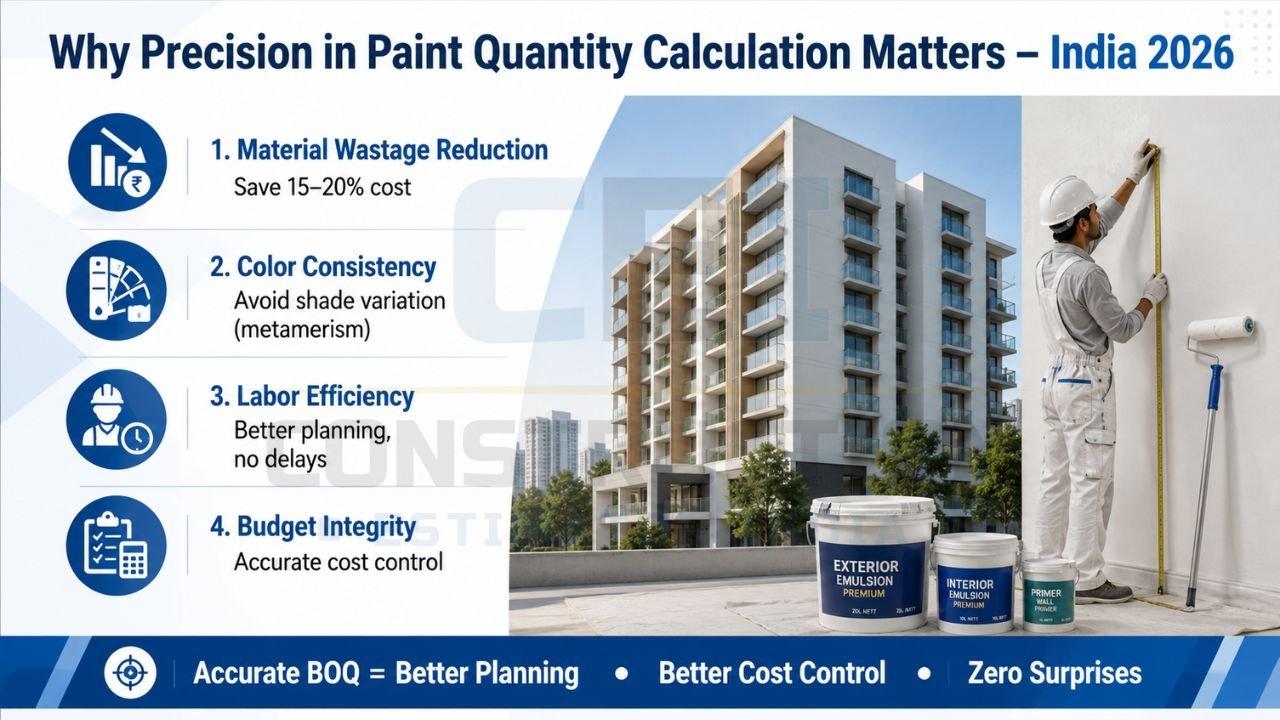
- Material Wastage Reduction: Accurate calculations typically save our clients 15–20% on wasted material costs.
- Color Consistency: Buying all your paint in one batch prevents “Metamerism” (color shift) between production runs, which is critical for large multi-storey buildings.
- Labor Efficiency: Knowing if you need a third coat beforehand allows for better scheduling and prevents “emergency runs” to the paint shop.
- Budget Integrity: Paint can account for a significant portion of the interior painting cost per sq ft in India 2026.
Leveraging house construction cost estimation services allows you to integrate these painting costs into your overall structural budget with zero surprises.
Step 1: Measuring Gross Surface Area for the Entire Building
To determine how to calculate paint quantity for building projects, you must first calculate the “skin” area of the entire structure.
Interior Wall Measurement
Measure the length and height of every wall in every room.
- Formula: Length (ft) x Height (ft) = Gross Area (sq. ft.).
- Total Interior Area: Sum of all individual wall areas.
Exterior Wall Measurement
Exteriors are more complex due to parapets, balconies, and architectural moldings.
- Formula: (Perimeter of Building x Total Height) + Balcony Inner Walls.
- Pro Tip: For textured exteriors, we multiply the flat area by a factor of 1.2 to account for the increased surface area of the texture.
Step 2: Calculating Deductions for Doors, Windows, and Voids
A common mistake in a paint estimator for building 2026 is failing to subtract “Dead Areas” where paint isn’t applied.
- Standard Door Deduction: 21 sq. ft. (7ft x 3ft).
- Standard Window Deduction: 12–15 sq. ft. depending on size.
- Net Paintable Area: Gross Area – Total Openings Area.
At Construction Estimator India, we use detailed CAD takeoffs to ensure that even small ventilators and niche spaces are accurately accounted for in the BOQ.
Step 3: Applying 2026 Coverage Rates and Surface Factors
Coverage varies drastically based on the “solids content” of the paint. Higher-end paints like Royale Glitz have better “hiding power,” meaning they cover more area with less liquid.
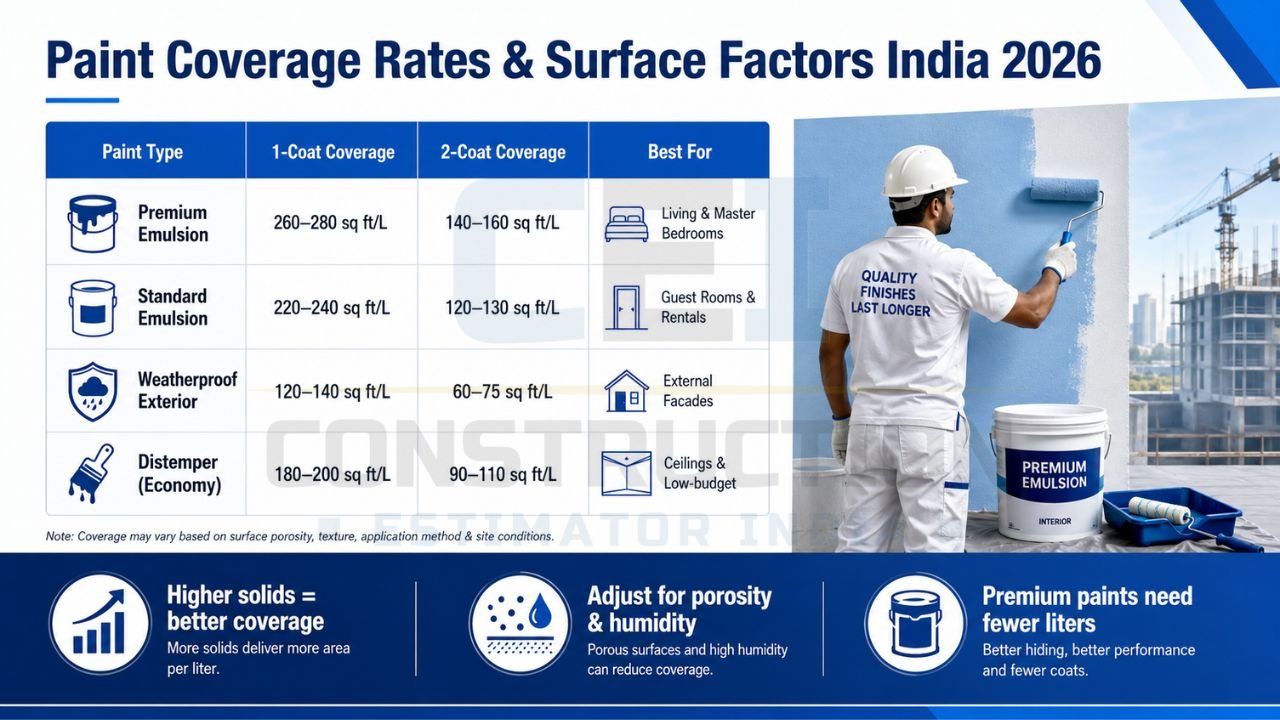
| Paint Type | 1-Coat Coverage (sq. ft./L) | 2-Coat Coverage (sq. ft./L) | Best For |
|---|---|---|---|
| Premium Emulsion | 260–280 | 140–160 | Living & Master Bedrooms |
| Standard Emulsion | 220–240 | 120–130 | Guest Rooms & Rentals |
| Weatherproof Exterior | 120–140 | 60–75 | External Facades |
| Distemper (Economy) | 180–200 | 90–110 | Ceilings & Low-budget |
For technical specifications, always review the Asian Paints 2026 paint coverage rates for buildings or the latest 2026 paint coverage guidelines by Berger and Nerolac for buildings.
Exterior vs. Interior: Handling Different Building Substrates
Different surfaces “drink” paint at different rates. This is a core component of professional interior painting estimation services.
- Fresh Sand-Faced Plaster: This is a “paint sponge.” New cement plaster is highly porous and can consume 25% more paint if not primed correctly.
- POP and Level 5 Putty: Common in luxury high-rises in Noida. These surfaces are smoother and provide the highest coverage per liter.
- Gypsum Board (Drywall): Drywall paper and joint compound have different absorption rates. We recommend a “High-Build” primer to ensure a uniform finish.
Specialized Calculations: Ceilings, Columns, and Pipes
A complete building calculation includes more than just walls.
- Ceilings: Since ceilings face no physical contact, distemper is often used. Formula: Room Length x Room Width. Add 10% for wastage due to roller splatter.
- Steel Columns & Beams: We calculate the perimeter of the I-beam or SHS section and multiply by the length. For complex trusses, factor in a 20% wastage for overspray.
- Piping Systems: For fire hydrant or plumbing lines, use the π x Diameter x Length formula.
For accurate paint quantity calculation or full BOQ for your building painting project in India, WhatsApp or call us today at +91 8630676890.
The 2026 Dark Pigment Factor: When 2 Coats Aren’t Enough
The 2026 trend toward “Desert Terracotta” and “Deep Navy” has a significant impact on quantity. These organic pigments have lower “hiding power.”
- The 3rd Coat Rule: If you are opting for a deep accent wall, budget for at least 3 coats to avoid “streaking.” This increases material purchase by exactly 50% for that specific area.
- BOQ Tip: We include a 5–10% wastage buffer in every BOQ to account for deep-base saturation and roller losses.
India-Specific Adjustments: Humidity, Monsoon, and Vastu
At Construction Estimator India, based in Meerut, we know that the North Indian climate dictates technical choices.
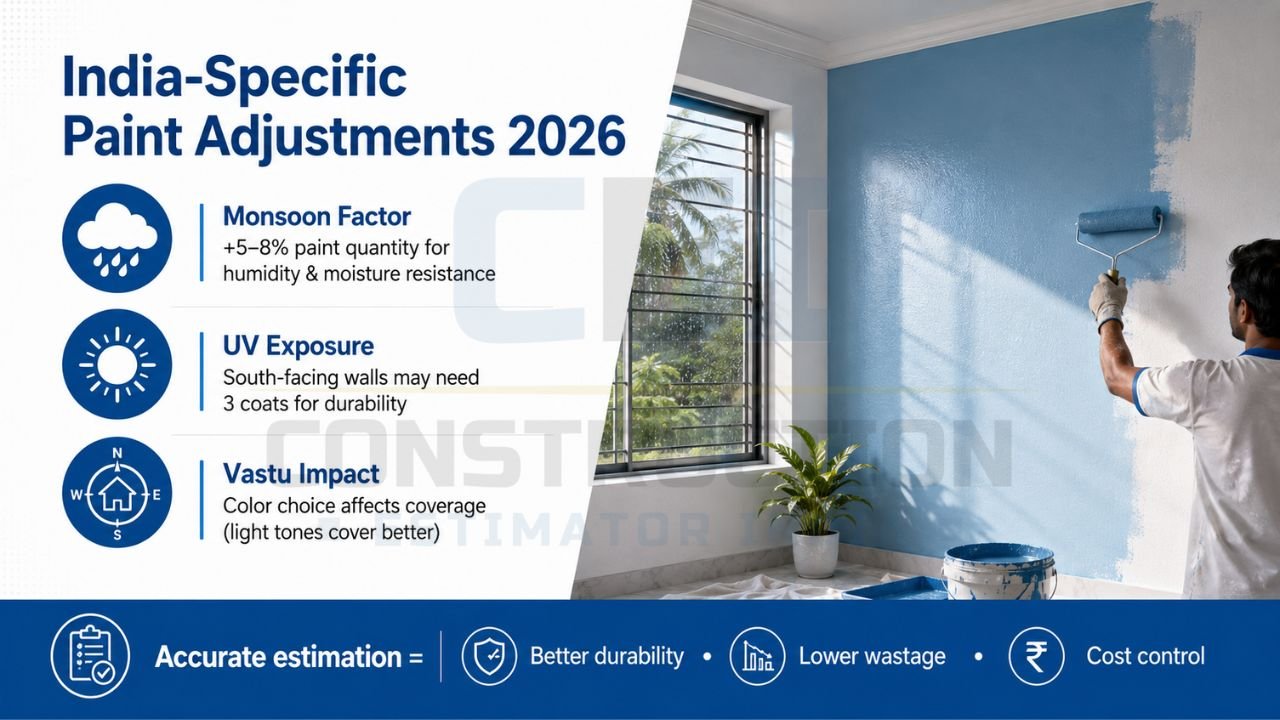
- The Monsoon Multiplier: During the Indian monsoon, high humidity can lead to “sliding.” We recommend increasing your estimate by 5-8% to account for thicker applications needed for moisture resistance.
- The UV Factor: South-facing rooms with intense direct sunlight often require a third coat of cool-toned pigments to achieve full depth and resist fading.
- Vastu Harmony: Vastu dictates color choice, which in turn dictates quantity. Light blues for the North-East cover better than the deep oranges sometimes used in the South-East.
Consult the CPWD guidelines for paint quantity calculation for buildings or the official 2026 paint coverage standards for buildings in India for technical benchmarks used in high-end projects.
Common Calculation Mistakes That Drain Your Budget
- Ignoring the Primer: Skipping primer makes walls “suck in” expensive finish paint. Primer coverage is higher (180–200 sq. ft. / L) and much cheaper.
- Flat Wastage Assumptions: Using a 5% wastage for a complex industrial building. 15–20% is more realistic for large-scale spray applications.
- Inaccurate Opening Deductions: Forgetting to subtract large wardrobe areas or glass partitions can lead to overbuying 10-15% of material.
- Neglecting Surface Profile: Sandblasted steel or rough-cast plaster drinks significantly more paint than smooth surfaces.
Worked Example: Calculating Paint for a G+2 Residential Building
Let’s look at a real-world scenario for a 2,500 sq. ft. built-up area project:
- Gross Wall Area: 8,200 sq. ft.
- Total Deductions (Doors/Windows): 1,100 sq. ft.
- Net Interior Wall Area: 7,100 sq. ft.
- Ceiling Area: 2,100 sq. ft.
- Exterior Area: 3,800 sq. ft.
The Calculation:
- Interior Paint: 7,100 / 150 (Avg coverage) = 47.3 Litres x 2 Coats = 95 Litres.
- Ceiling Paint: 2,100 / 100 (Distemper coverage) = 21 Litres x 2 Coats = 42 Litres.
- Exterior Paint: 3,800 / 65 (Weatherproof coverage) = 58.5 Litres x 2 Coats = 117 Litres.
Total Material for BOQ: Add 10% wastage buffer to each category.
Conclusion and Expert BOQ Assistance
Mastering how to calculate paint quantity for building is the difference between a project that is “on-budget” and one that is “in-crisis.” In 2026, where “Precision Engineering” meets “Budget Optimization,” you cannot afford to guess. By calculating net areas, adjusting for surface profile, and accounting for the brutal Indian monsoon, you protect your structural investment for decades.
At Construction Estimator India, we don’t just provide numbers; we provide a financial shield for your project. Whether you are a contractor in Meerut or a developer in Bangalore, our goal is to ensure your BOQ is a reflection of reality, not a wishlist.
For accurate paint quantity calculation or full BOQ for your building painting project in India, WhatsApp or call us today at +91 8630676890.
FAQ: Real Answers for Indian Homeowners and Contractors
- How do I calculate paint quantity for a building with multi-storey height?
Calculate floor-by-floor and then add a “height factor” for the exterior (approx 5%) to account for increased wind and overspray during application at height. - Is one coat of primer enough for a new building?
For most interior walls, yes. However, new POP ceilings or exterior walls in heavy monsoon zones often require two thin coats of primer to ensure absolute adhesion. - Does the color of the paint change the quantity needed?
Yes. Bright colors (Yellows/Reds) and deep colors (Navy/Forest Green) have poor hiding power and often require a 3rd coat, increasing quantity by 50% over neutral tones. - How much paint is needed for a standard 12×10 room?
A standard room has approx 440 sq. ft. of wall area. With deductions, you typically need 3–4 liters of premium emulsion for two coats. - Can I use a 2-in-1 paint and primer to save time?
In the Indian climate, we don’t recommend it for new masonry. Cement plaster is too “thirsty”; a dedicated primer is cheaper and more effective for the initial seal. - How do I calculate paint for exterior textures?
Measure the flat surface area and multiply by a factor of 1.2 to 1.5, as the peaks and valleys of the texture significantly increase the actual surface to be covered. - How often should a building be repainted in India?
For interiors, 5–7 years is standard. For exteriors facing North Indian heat or coastal humidity, a high-quality repainting every 7–10 years is recommended. - Why is my paint quantity different from the contractor’s estimate?
Contractors often use “Thumb Rules” (e.g., 3.5x Carpet Area). Professional estimation uses actual wall dimensions and net areas, which is usually 15% more accurate.