The civil construction industry in India is booming. From government infrastructure projects to private residential complexes, the demand for skilled and registered civil contractors has never been higher. If you’ve been working on construction sites as an engineer, supervisor, or sub-contractor — and you’re thinking it’s time to start your own contracting business — 2026 is a great year to make that move.
But here’s where most aspiring contractors get stuck: the process feels overwhelming. Which license do you apply for? Which registrations do you need? How much money do you actually need to start? How do you win your first tender?
This guide answers all of that. We’ve put together a complete, practical, step-by-step guide on how to become a civil contractor in India in 2026 — covering eligibility, license classes, registration process, required documents, capital requirements, and how to get your first projects.
Whether you’re a freshly graduated civil engineer, an experienced site engineer ready to branch out, or an entrepreneur who wants to enter the construction business — this guide is for you.
And if you want free guidance on how to start your civil contracting business — including realistic startup cost estimates and BOQ support for your first tender — WhatsApp us at +91 8630676890 right now. Construction Estimator India works with contractors at every stage.
Who Can Become a Civil Contractor in India? Qualifications & Eligibility?
The good news is that civil contracting in India does not require a single national mandatory qualification — eligibility varies by the class of license you’re applying for and the issuing authority (state government, CPWD, PWD, railways, etc.).
That said, here’s the general eligibility picture:
Educational Qualifications:
- Degree in Civil Engineering (B.E./B.Tech): Preferred for Class A and higher-level contracts. Required for most government department registrations above a threshold contract value.
- Diploma in Civil Engineering: Qualifies you for Class B and Class C registrations in most states.
- ITI Certificate in civil trades (Mason, Bar Bender, Carpenter): Can qualify for small contractor (Class D/E) registration in some states.
- No formal qualification: Some state PWDs allow experienced individuals to register for small-value contracts if they have 5–10 years of demonstrated site experience, but this path is increasingly limited.
Experience Requirements:
- Most registering authorities expect 3–5 years of relevant construction experience for Class B/C.
- Class A registration typically requires 5–10 years of experience and documented project completion certificates.
Age: Generally 21 years and above. No upper age limit for most authorities.
Financial Standing: You must demonstrate financial capacity through bank statements, ITR, or a solvency certificate. The required amount varies by license class (covered in the capital section below).
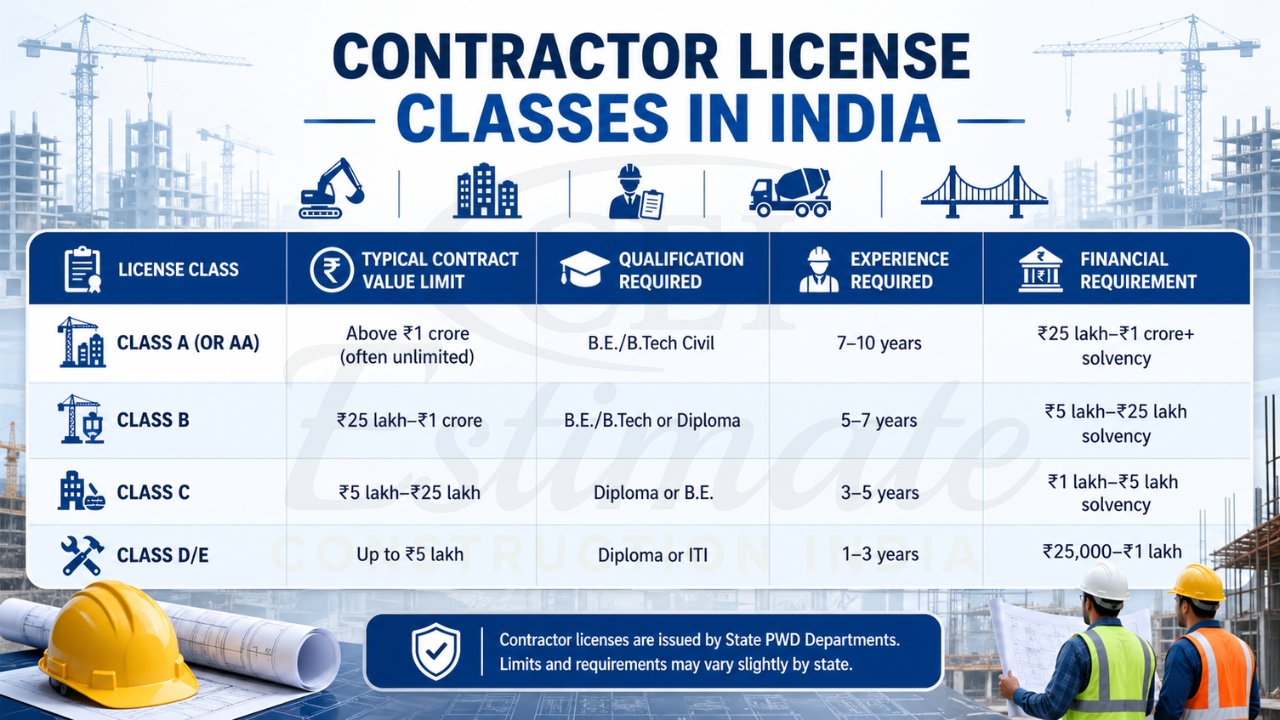
Different Classes of Civil Contractor License in India – Class A, B, C, D Comparison
Civil contractor licenses in India are issued by different authorities — Central PWD (CPWD), State PWDs, Railways, NHAI, MES, Municipal Corporations, and State Development Authorities. Each has its own class system, but the most common framework used across states is the Class A / B / C / D structure.
Here’s a comparison to help you choose:
| License Class | Typical Contract Value Limit | Qualification Required | Experience Required | Financial Requirement (Approx.) |
| Class A (or AA) | Above ₹1 crore (often unlimited) | B.E./B.Tech Civil | 7–10 years | ₹25 lakh – ₹1 crore+ solvency |
| Class B | ₹25 lakh – ₹1 crore | B.E./B.Tech or Diploma | 5–7 years | ₹5 lakh – ₹25 lakh solvency |
| Class C | ₹5 lakh – ₹25 lakh | Diploma or B.E. | 3–5 years | ₹1 lakh – ₹5 lakh solvency |
| Class D / E | Up to ₹5 lakh | Diploma or ITI | 1–3 years | ₹25,000 – ₹1 lakh |
Important notes:
- Exact limits vary by state and issuing authority. UP PWD, Rajasthan PWD, CPWD, Delhi PWD, and Uttarakhand PWD each have slightly different slabs.
- Many states now have an online portal for contractor registration — e.g., UP’s e-procurement portal, Rajasthan’s SPPP portal.
- Government tenders usually require the relevant class registration. Private projects don’t require a class license but do require GST registration and other statutory compliances.
Our recommendation: Start with Class C if you’re a diploma holder or newly graduated engineer. Apply for Class B once you’ve completed 2–3 projects and have project completion certificates. This phased approach is practical and widely followed.
Step-by-Step Process to Become a Civil Contractor in India
Here is a clear, actionable roadmap for how to become a civil contractor in India in 2026:
Step 1: Finalise Your Business Structure
Decide whether you’ll operate as a:
- Sole Proprietorship — simplest, full control, personal liability. Best for starting out.
- Partnership Firm — suitable if starting with a co-founder.
- Private Limited Company (Pvt Ltd) — better for larger projects, limited liability, more credibility with big clients and government departments.
- LLP (Limited Liability Partnership) — good middle ground.
For most new contractors, sole proprietorship or a Pvt Ltd is the practical choice. Starting as sole proprietorship keeps costs and paperwork low, then converting to Pvt Ltd as you grow is a common path.
Step 2: Register Your Business
- GST Registration — mandatory if your annual turnover exceeds ₹20 lakh (₹10 lakh for special category states), but recommended from day one for professional credibility and to claim input tax credit. Construction services attract 12% or 18% GST depending on project type.
- PAN Card in business name — essential for all financial and tax transactions.
- Current Account — open a dedicated business bank account.
- Udyam Registration (MSME) — highly recommended. Free, online, provides benefits like easier bank loans, government tender preference, and protection against delayed payments.
Step 3: Apply for Contractor Registration / License
Identify which authorities you want to register with. Typically:
- State PWD (for state government works)
- CPWD (for central government projects)
- Railways / NHAI / MES (for specialised government infrastructure)
- Municipal Corporation / Development Authority (for local civic works)
- Private sector (no license needed, but GST and business registration are essential)
For each authority, the process typically involves:
- Submitting an online/offline application form
- Attaching required documents (detailed in the next section)
- Paying the registration fee (₹500 – ₹10,000 depending on class and authority)
- Appearing for an interview or site assessment (required by some authorities for Class A)
- Receiving your registration certificate (valid for 1–5 years, renewable)
Step 4: Get Labour and Statutory Registrations
- EPFO Registration — required when you have 20 or more employees
- ESIC Registration — required when you have 10 or more employees
- Labour License under Contract Labour Act — required if you employ contract labour on projects
- Building and Other Construction Workers (BOCW) Registration — required in most states for construction employers
Step 5: Build Your Technical Team
You cannot run a serious contracting business alone. Build your core team:
- At least one qualified civil engineer (if you’re not one yourself)
- An experienced site supervisor or foreman
- A reliable accountant or CA
- Trusted sub-contractors for specialised trades (electrical, plumbing, shuttering)
Step 6: Set Up Your Equipment and Infrastructure
Start lean. For Class C/B projects, you don’t need to own heavy equipment on day one — hire it as needed. Focus on:
- Basic surveying tools (level, total station if needed)
- Safety equipment (helmets, harnesses, boards)
- Basic power tools and site management supplies
- A reliable vehicle for site visits
Step 7: Prepare Your Tender and Estimation Capability
This is where most new contractors struggle and lose money. You need to be able to prepare accurate BOQ (Bill of Quantities) and cost estimates to bid competitively without undercutting yourself into losses.
This is exactly where Construction Estimator India helps — see Section 10 below.
Required Documents and Registrations for Civil Contractor License in India
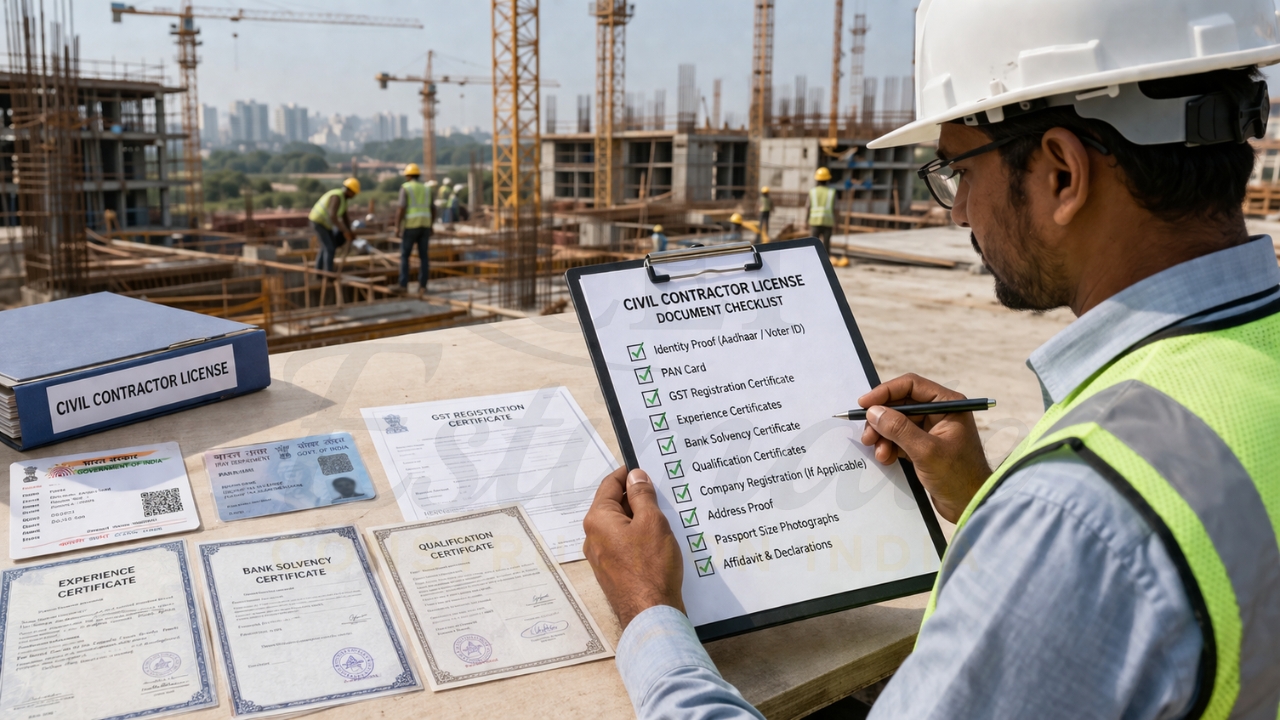
Here’s a comprehensive checklist of documents typically required for contractor registration:
Personal Documents:
- PAN Card (personal + business)
- Aadhaar Card
- Passport-size photographs
- Educational qualification certificates (degree/diploma)
- Experience certificates / project completion certificates
Business Documents:
- Business registration certificate (proprietorship / firm / company)
- GST Registration Certificate
- Udyam (MSME) Registration Certificate
- Current account bank statement (last 6–12 months)
- Solvency Certificate from bank (amount required varies by class)
- Income Tax Returns (last 2–3 years)
- Partnership deed / MOA-AOA (if applicable)
Technical Documents:
- List of completed projects with value, nature, and client name
- Performance certificates from previous employers or clients
- List of technical staff with their qualifications
- List of equipment owned (if any)
Other:
- Tender fee / registration fee DD or online payment receipt
- Affidavit (as required by the authority)
- Photographs of office premises (for some authorities)
Pro tip: Maintain a neat, organised digital folder with all these documents. Government portals now require scanned uploads — poor quality scans are a common reason for application rejection.
How Much Capital Do You Need to Start a Civil Contracting Business?
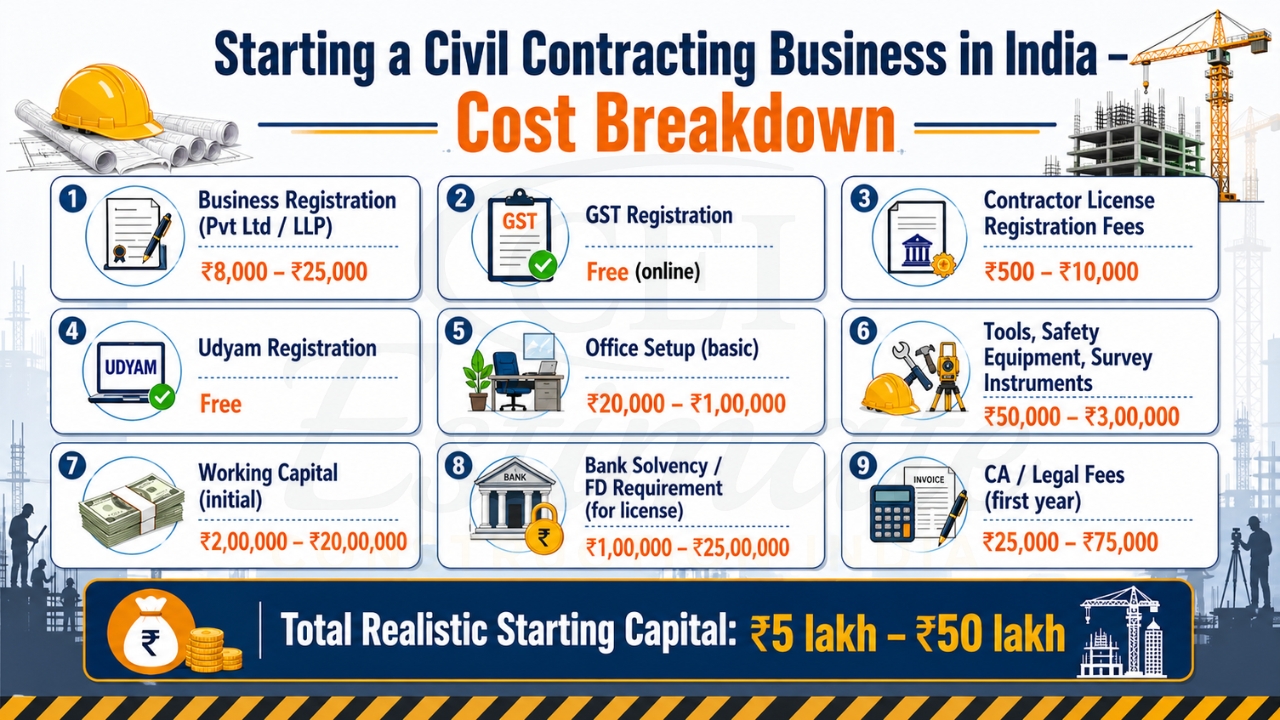
One of the most common questions — and fears — for aspiring contractors. Let’s give you realistic numbers for 2026:
| Item | Estimated Cost |
| Business Registration (Pvt Ltd / LLP) | ₹8,000 – ₹25,000 |
| GST Registration | Free (online) |
| Contractor License Registration Fees | ₹500 – ₹10,000 |
| Udyam Registration | Free |
| Office Setup (basic) | ₹20,000 – ₹1,00,000 |
| Tools, Safety Equipment, Survey Instruments | ₹50,000 – ₹3,00,000 |
| Working Capital (initial) | ₹2,00,000 – ₹20,00,000 |
| Bank Solvency / FD Requirement (for license) | ₹1,00,000 – ₹25,00,000 |
| CA / Legal Fees (first year) | ₹25,000 – ₹75,000 |
| Total Realistic Starting Capital | ₹5 lakh – ₹50 lakh |
The wide range reflects the difference between starting small (Class C, private residential projects, sole proprietorship) vs. setting up for Class A government tenders from the start.
Practical advice: Most successful contractors in India started with ₹5–₹15 lakh personal capital, took on 1–2 small private projects first, built their portfolio and cash flow, and then applied for higher class government registrations within 2–3 years. Don’t wait until you have ₹50 lakh — start lean and grow deliberately.
Working capital is your biggest challenge. Government projects often have payment cycles of 45–90 days after bill submission. You’ll need funds to pay labour and buy materials before you receive client payment. Plan for this from day one.
How to Get Your First Construction Projects and Tenders?
Getting that first project is the hardest part for any new contractor. Here’s how to do it systematically:
- Start with private residential projects Approach individual homeowners, plot owners, or small developers directly. These projects don’t require government registration, have faster payment cycles, and let you build your portfolio and client testimonials quickly.
- Register on government e-procurement portals Once you have your contractor registration, register on:
- Central Government: Government e-Marketplace (GeM), CPWD portal
- State portals: UP e-Procurement, Rajasthan SPPP, Uttarakhand e-Tender portal, Delhi e-Procurement
- Set up email alerts for tenders matching your class and trade
- Network actively
- Join your local Builders’ Association, Contractors’ Association, or CII chapter
- Attend government pre-bid meetings (these are goldmines for understanding what’s needed and meeting officials)
- Connect with architects, structural engineers, and project management consultants who regularly need contractors
- Approach sub-contracting first Sub-contracting for established Class A contractors is an excellent way to get experience, build cash flow, and earn project completion certificates — which you’ll need for upgrading your own license later.
- Bid competitively — but accurately Never bid without a proper BOQ analysis. Underquoting to win your first project is one of the most common traps new contractors fall into — and it leads to financial losses that can sink your business before it starts.
This is where Construction Estimator India’s BOQ and tender estimation support becomes invaluable — helping you bid at the right price to win profitably, not just to win.
Common Mistakes New Civil Contractors Make and How to Avoid Them
Learn from the mistakes of those who went before you:
- Starting without proper registrations: Operating without GST, labour license, or EPF registration exposes you to heavy penalties. Set up your compliance stack before taking on projects.
- Underquoting tenders: The biggest killer of new contracting businesses. Always prepare a detailed BOQ, add realistic overheads (10–15%) and profit margin (8–15%) before submitting a bid.
- No written agreements: Always have a signed contract with every client — including scope of work, payment milestones, material specifications, and dispute resolution clauses.
- Ignoring cash flow: Profitability on paper means nothing if you can’t pay your labour next week. Maintain a cash flow plan for every project.
- Doing everything yourself: Many new contractors try to do everything — site management, procurement, billing, client management — and burn out. Build a small team early.
- Skipping site safety compliance: BOCW cess, safety helmets, scaffolding standards — non-compliance on government projects leads to immediate blacklisting. On private projects, it exposes you to accident liability.
- Not maintaining project documentation: Measurement books, material inspection reports, site photographs — these protect you in disputes and are required for future license upgrades.
How Construction Estimator India Helps New Civil Contractors?
Starting a civil contracting business is hard enough. Figuring out accurate cost estimates and BOQs while also handling registrations, clients, and site management is even harder — especially in your first two to three years.
At Construction Estimator India, we work directly with new and growing civil contractors to give them the one thing that separates profitable contractors from struggling ones: accurate cost estimation.
Here’s how we help you:
- WhatsApp us at +91 8630676890 — tell us about your background (engineer, supervisor, experience level), the type of projects you want to target, and your location.
- Free consultation — we’ll advise you on realistic startup costs for your specific goals and which registration to prioritise first.
- Tender BOQ Preparation — before you submit any government or private tender, we prepare a detailed, material-wise Bill of Quantities with current 2026 market rates. You bid with confidence, not guesswork.
- Bid Analysis Support — we’ll help you analyse the client’s tender BOQ, identify rate variations, and structure your bid to be competitive yet profitable.
- Ongoing Estimation Partnership — as your business grows, we become your back-office estimation team. You focus on winning projects and managing sites; we handle the numbers.
Why contractors trust us:
- We work with contractors across Delhi NCR, UP, Uttarakhand, Rajasthan, and North India
- Our rates are updated with current 2026 material and labour market prices
- Fast turnaround — BOQ support within 48–72 hours typically
- We’re independent — we work for you, not for any client or material supplier
📲 Start Your Civil Contracting Journey — Get Free Guidance Today
You don’t have to figure this out alone.
WhatsApp Construction Estimator India at +91 8630676890 Tell us: Your background | Target project type | Location | Current stage (just planning / already registered) We’ll give you free advice on your next steps and show you how accurate BOQ support can help you win your first profitable project.
Whether you’re just starting to explore civil contracting or you’ve already registered and need help with your first tender — we’re here to help.
FAQ: How to Become a Civil Contractor in India 2026
- What qualifications are needed to become a civil contractor in India? For small contracts (Class C/D), a diploma in civil engineering is typically sufficient. For Class B, a diploma or B.E./B.Tech is required. For Class A (large government projects), a B.E./B.Tech with 7–10 years of experience is typically needed. Some state PWDs allow experienced individuals without formal degrees to register for small-value contracts.
- Is a license mandatory to become a civil contractor in India? For government projects, a PWD/CPWD contractor registration is mandatory. For private construction projects, a formal contractor license is not always required, but GST registration, PAN, and other statutory compliances are essential. Operating without these exposes you to penalties.
- How do I get a civil contractor license in India? Apply to the relevant authority (State PWD, CPWD, Municipal Corporation) with your educational certificates, experience certificates, financial documents (solvency certificate, bank statements), GST registration, and PAN. Most states now have online portals. Pay the registration fee and wait for approval — typically 2–8 weeks.
- What is the difference between Class A, B, C, and D contractor license in India? The class determines the maximum contract value you can bid for. Class D is for very small contracts (up to ₹5 lakh). Class C covers ₹5–25 lakh. Class B covers ₹25 lakh to ₹1 crore. Class A covers contracts above ₹1 crore, often unlimited. Exact limits vary by state and issuing authority.
- How much does it cost to register as a civil contractor in India? Registration fees vary by authority and class — typically ₹500–₹10,000 for the license itself. Total startup costs including business registration, GST, tools, and working capital range from ₹5 lakh to ₹50 lakh depending on the scale you’re targeting.
- How long is a civil contractor license valid in India? Most contractor registrations are valid for 1–5 years and are renewable. CPWD registrations are typically valid for 3 years. State PWD registrations vary — check with your specific state authority.
- Can I become a civil contractor without a civil engineering degree? Yes, in many states — especially for Class C and D registrations. A diploma in civil engineering and demonstrated experience is accepted. Some states allow registration based purely on experience (5–10 years) for small contract values, though this path is becoming less common as requirements are tightening.
- How do I get my first civil construction project or tender? Start with private residential projects through word-of-mouth and networking. Register on government e-procurement portals for tender alerts. Approach architects and developers for sub-contracting opportunities. Build your portfolio with 2–3 small projects before targeting government tenders. Always prepare accurate BOQs before bidding.
- What is GST rate for civil construction services in India? Civil construction services attract 12% GST for affordable housing and government projects, and 18% GST for commercial construction and other works. You must be GST-registered to raise invoices for any project exceeding the threshold, and to participate in most government tenders.
- What is Udyam Registration and should civil contractors register for it? Udyam Registration is India’s official MSME registration (free, online at udyamregistration.gov.in). Civil contractors strongly benefit from it — it provides easier access to business loans, government tender preferences (especially for small businesses), and legal protection against delayed client payments under the MSMED Act.
- What is the BOCW cess and does it apply to civil contractors? The Building and Other Construction Workers (BOCW) cess is a levy of 1% of the cost of construction payable by the employer/contractor on most construction projects above ₹10 lakh. It is used to fund welfare schemes for construction workers. Non-payment attracts penalties. Make sure you factor this into your project pricing.
- How can Construction Estimator India help me as a new civil contractor? We provide free guidance on realistic startup costs and registration priorities for your specific situation. For active projects, we prepare detailed BOQs and tender cost estimates using current 2026 market rates — helping you bid competitively and profitably. WhatsApp us at +91 8630676890 to get started.
Conclusion
Becoming a civil contractor in India in 2026 is absolutely achievable — whether you’re a fresh civil engineer, an experienced site supervisor, or an entrepreneur with construction exposure. The key is to follow the right steps: choose the correct license class for your current stage, complete all required registrations, build your technical team, and — critically — ensure you can estimate and bid accurately before taking on any project.
To recap the essential steps: structure your business → register for GST and Udyam → apply for contractor registration with the right authority → complete labour and statutory compliances → build your team → and develop your estimation and tendering capability.
The most common reason new contractors fail isn’t lack of skill — it’s inaccurate cost estimation. Bidding too low loses money; bidding too high loses the contract. Getting this right from your very first tender sets the foundation for a profitable, sustainable contracting business.
📲 Ready to start? WhatsApp Construction Estimator India at +91 8630676890 today. Share your background, target projects, and location — and we’ll give you free personalised guidance on how to become a civil contractor in India, plus BOQ support for your first tender.