If you’ve spent any time on an Indian construction site, you know the drill. It’s 11:00 PM, you’re staring at a massive spreadsheet for a government tender, and you just realized that one broken formula in cell C45 has thrown off your entire Bill of Quantities (BOQ). As we head into 2026, the stakes for Indian contractors have never been higher. With the nation targeting a $5 trillion economy, the infrastructure boom is massive, but so are the challenges.
👉 Still Using Excel? Upgrade to Smart Estimating Software Today!
Despite the growth, over 70% of small Indian contractors still rely on manual Excel templates for their estimation. I’ve been there—I spent years as a quantity surveyor thinking Excel was my best friend. But in an era of material price volatility, strict RERA regulations, and complex GST compliance, that “best friend” is increasingly becoming a liability. The industry is shifting from traditional manual methods to robust digital backbones. Today, we’re going to have an honest talk about whether you should stick with your spreadsheets, upgrade to professional estimating software, or dive into a full ERP system for your construction projects in India 2026.
Limitations of Using Excel for Construction Estimation
Excel is like the Swiss Army knife of the construction world. It’s free (mostly), everyone knows how to use it, and it feels safe. However, as your firm grows, these “comforts” turn into major bottlenecks.
The Hidden Cost of Human Error
One of the most dangerous aspects of Excel is how easy it is to make a mistake. A single typo or a deleted formula can lead to cost overruns of up to 30%. In a high-stakes bidding environment, an error in your BOQ can mean the difference between a profitable project and one that drains your company’s reserves. Spreadsheets are highly susceptible to human error and are incredibly time-consuming, often taking several days to produce a single BOQ.
Version Control Nightmares
Have you ever had “Final_Estimate_v2_Corrected_REALLYFINAL.xlsx” on your desktop? When multiple team members—architects, site engineers, and procurement officers—are all editing different versions of a file, disaster is inevitable. Excel lacks a “single source of truth.” In 2026, where real-time tracking is essential for survival, waiting for an email update to see your project’s financial health is no longer an option.
Lack of Integration with Real-Time Data
Excel is static. It doesn’t know that the price of TMT bars in Mumbai just jumped by 15% this morning. Because it lacks built-in price libraries or live market feeds, you have to manually update every rate. This manual tracking leads to profit erosion of up to 25% for many Indian builders and contractors. Furthermore, Excel doesn’t talk to your accounting software (like Tally) or your site logs easily, creating silos of data that prevent a clear view of your project’s health.
👉 Stop Guesswork – Start Using Data-Driven Estimation Tools!
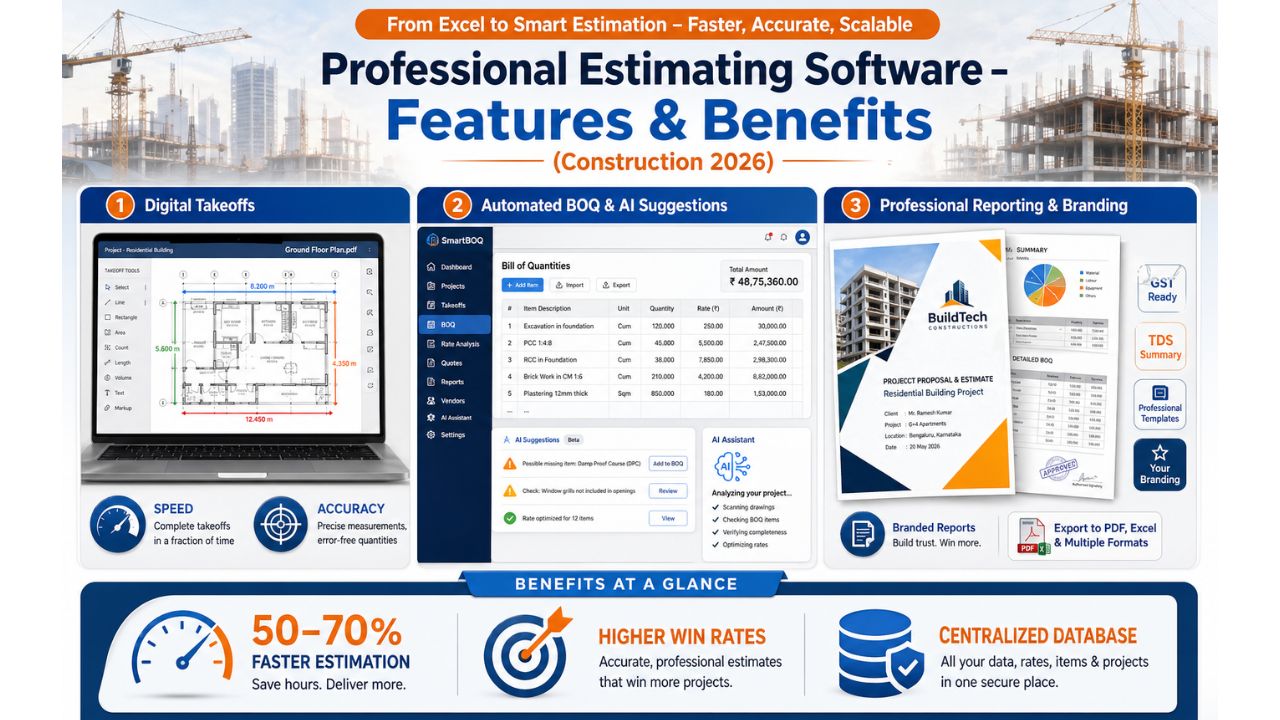
Professional Estimating Software – Features & Benefits
Moving from Excel to professional estimating software is like switching from a bicycle to a turbocharged truck. These tools are specifically designed to handle the unique workflows of construction cost estimation tools India 2026.
Speed and Accuracy with Digital Takeoffs
The biggest game-changer is the ability to perform digital takeoffs. Instead of using a scale and a printout, you can upload a PDF drawing and click your way through measurements. Professional software automatically calculates areas, volumes, and lengths, populating your BOQ in hours rather than days. This speed allows your team to bid on more projects without increasing headcount.
Automated BOQ and AI-Driven Suggestions
Modern tools come pre-loaded with standard Indian items (BOQ/DSR integration) which is critical for government tenders. Some even offer AI suggestions to catch missing items—like reminding you to add shuttering costs if you’ve added a high volume of concrete. This level of “intelligent checking” is something a spreadsheet simply can’t do.
Professional Reporting and Branding
In 2026, your bid’s presentation matters. Professional software generates clean, branded reports with integrated GST and TDS calculations, giving you an edge when presenting to sophisticated clients or government bodies. It shows that your firm is organized, tech-savvy, and ready for large-scale operations.
Benefits at a Glance:
- Reduced Estimation Time: Turnaround times can drop by 50-70%.
- Higher Win Rates: Faster, more accurate bids allow you to be more competitive.
- Centralized Database: All your past rates and project data are in one searchable place.
ERP Software for Construction Companies in India
When your company reaches a certain scale—managing multiple sites across different states—you need more than just an estimator; you need an Enterprise Resource Planning (ERP) system. An ERP integrates every department: from HR and payroll to procurement, site management, and finance.
Selecting the top ERP software for construction companies in India is about creating a “digital nervous system” for your business. For firms seeking global auditing standards, SAP S/4HANA remains a top choice, while AI-driven solutions like Ramco ERP are gaining traction for their predictive capabilities.
Holistic Project Control
Unlike specialized estimating tools, an ERP tracks the entire lifecycle of a project. It handles:
- Procurement & Inventory: Prevents material theft and tracks material price volatility.
- Subcontractor Management: Manages payments, retention, and performance tracking.
- Regulatory Compliance: Automates documentation for GST, RERA, and labor laws, making you “audit-ready” at all times.
The Open-Source Advantage
For growing Indian firms that are budget-conscious, open-source platforms like ERPNext offer a flexible starting point. Meanwhile, real estate developers often prefer specialized options like In4Suite that cater specifically to the Indian property market. The goal of an ERP is to move from reactive management to proactive decision-making through real-time tracking dashboards.
👉 Win More Projects with Accurate Estimates & Smart Systems!
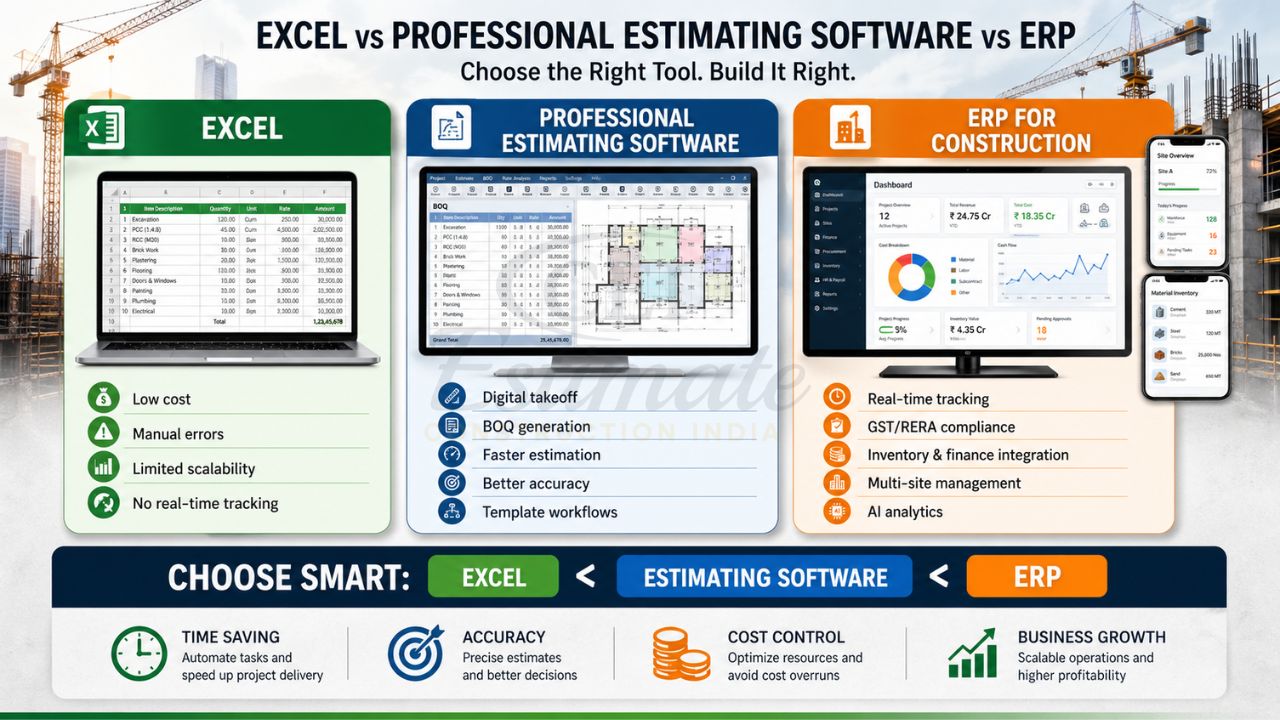
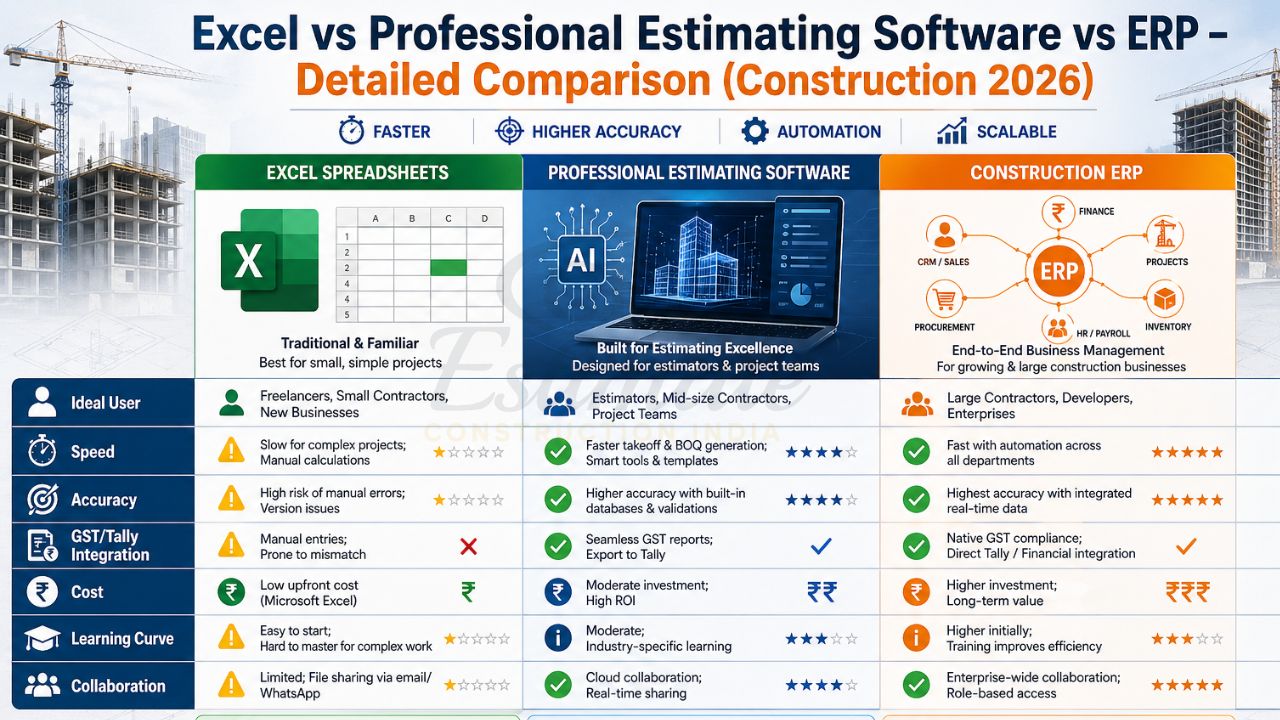
Excel vs Professional Estimating Software vs ERP – Detailed Comparison
Choosing between these three depends on your project volume, team size, and long-term goals. While Excel is the baseline, the transition to more advanced tools usually pays for itself within three to four projects through time saved and reduced errors.
When analyzing excel vs estimating software for construction projects, you have to look at the total cost of ownership, including the “hidden cost” of mistakes made in spreadsheets.
Comparison Table: Construction Management Tools 2026
| Feature | Excel Spreadsheets | Professional Estimating Software | Construction ERP |
|---|---|---|---|
| Ideal User | Small Contractors (1-2 projects/year) | Growing Firms & Specialist Contractors | Large Developers & Multi-Site Firms |
| Speed | Slow & Manual | Fast (Digital Takeoffs) | Moderate (Heavy Data Entry) |
| Accuracy | Low (High Error Risk) | High (Automated Checks) | Very High (System Integration) |
| GST/Tally Integration | Manual / Difficult | Often Included | Seamless & Automated |
| Cost | Low / Free | Moderate Subscription | High (Implementation + Licensing) |
| Learning Curve | Low | Moderate | High |
| Collaboration | Poor | Good | Excellent |
👉 Manage Projects, Costs & Teams in One Powerful Platform!
Top Features in Cost Management Software for Construction
If you are looking to upgrade, you shouldn’t just buy any software. You need features tailored for the unique complexities of the Indian market.
Understanding the top features in cost management software for construction will help you avoid buying “bloatware” that your staff won’t use. Key features for 2026 include:
- Real-Time Dashboards: Capturing site expenses instantly via mobile apps.
- BOQ Forecasting: Automated comparisons between your initial budget and actual spending to prevent profit erosion.
- Predictive AI Analytics: Anticipating budget overruns before they occur based on historical data.
- Mobile Connectivity: Essential for remote site engineers to update progress and material receipt in real-time.
- Statutory Compliance: Built-in modules for GST and TDS to avoid heavy regulatory penalties.
Many Indian firms find that custom ERP solutions are superior to ready-made global tools because they can be tailored to local workflows.
How to Decide: When to Switch from Excel to Professional Tools?
The “switch” shouldn’t be a snap decision. It should be driven by your business’s pain points. Ask yourself these questions:
- Are you bidding on government tenders? If yes, the need for BOQ/DSR integration and strict audit trails makes professional software or an ERP mandatory.
- Is your team growing? Once you have more than 3 people touching an estimate, Excel version control will fail you.
- Are your profits leaking? If you’re consistently seeing 25% profit erosion due to manual tracking, the software will pay for itself in months.
- Is material volatility hurting you? If you can’t update your entire project cost instantly when steel prices change, you are at risk.
Recommendation: For small residential contractors, a hybrid approach works best—use software for digital takeoffs and speed, but export to Excel for final custom client formatting. For firms managing over ₹10-20 Crores in annual project value, moving to a dedicated cost management tool or a “lite” ERP is the only way to scale without losing control.
Frequently Asked Questions (FAQs)
- Is professional estimating software expensive for small Indian contractors?
While there are annual subscription fees, the time saved and the prevention of even one 5% error in a bid usually covers the cost within the first few projects. - Does this software integrate with Tally?
Yes, most top features in cost management software for construction now include seamless Tally integration, which is a must-have for Indian accounting. - Can I use these tools offline on a remote construction site?
Excel is great for offline use, but many modern construction apps now offer “offline-first” mobile modes that sync data as soon as the site engineer reaches a 4G/5G zone. - How long does it take to learn an ERP system?
ERPs have a steeper learning curve than simple estimating tools. Implementation can take 3 to 6 months, but it transforms how your business operates. - Why is Excel still so popular if it has so many flaws?
It has zero licensing costs and total flexibility. For a one-man operation, it’s often “good enough”—but “good enough” doesn’t scale. - What is the best ERP for a medium-sized Indian construction firm?
Options like ERPNext (open-source) or In4Suite (specialized for real estate) are excellent middle-ground choices before moving to heavyweights like SAP. - Can AI really help in construction estimation?
Yes. In 2026, AI is being used to predict material price hikes and identify missing items in complex BOQs, reducing the risk for the contractor. - Is RERA compliance easier with software?
Absolutely. ERPs and cost management tools automate the documentation and financial transparency required by RERA, saving you from legal headaches.
Conclusion
The construction landscape in India 2026 is not for the faint of heart. With massive infrastructure growth comes massive complexity. Relying on Excel for multi-site operations is like trying to manage a modern metro project with a paper map—it’s possible, but why would you take the risk?
Excel remains a valid starting point for very small, low-risk projects. However, the moment you bid on government tenders or manage multiple sub-contractors, Professional Estimating Software becomes your most valuable asset for speed and accuracy. For those looking to build a legacy and manage a large-scale enterprise, a Construction ERP is the only way to ensure transparency, control, and long-term profitability.
My advice? Start by identifying your biggest “profit leak.” If it’s slow bidding, get estimating software. If it’s site-level theft and mismanagement, look for an ERP. Whatever you choose, the time to digitize is now.
Ready to upgrade your workflow? Explore our guides on the latest construction cost estimation tools India 2026 and take the first step toward a more profitable, error-free future.