Namaste, home builders and contractor brothers! I am your friend from the construction world, and today we are going to talk about something that is literally the “glue” holding your dreams together.
Imagine this: Rahul bhai from Agra finally built his dream 2-story house in 2024. He spent lakhs on Italian marble and expensive paint. But by early 2026, he started seeing thin, zig-zag cracks appearing on his exterior walls. He called me, sounding very worried. When I visited the site, I realized the mistake was hidden deep inside—his mason had used a very weak “andaaze se” (estimated) mix of 1:8 or 1:9 for the brickwork to save a few bags of cement.
Yaar, this is the biggest mistake you can make. Choosing the correct mortar mix ratio for brickwork in India is not just a technicality; it is about making sure your walls are pakka strong and crack-free for decades. Whether you choose a 1:4 mortar mix ratio, 1:5 cement sand ratio for brickwork, or a 1:6 mortar ratio for bricks, each has a specific purpose. If you get this wrong, no amount of expensive paint will save your walls from dampness and cracks.
What is Mortar Mix Ratio and Why Does It Matter?
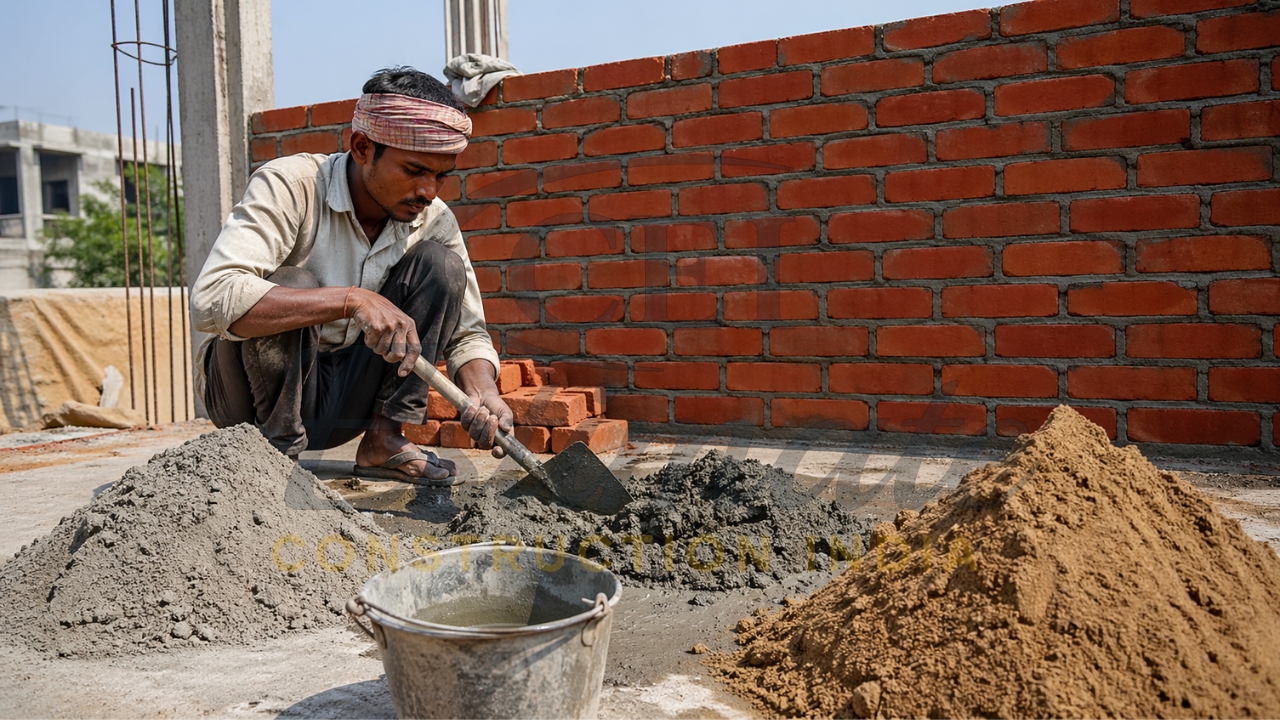
Think of mortar like the dough for a perfect roti. If you add too much water, it becomes sticky; too much flour, and it breaks. In construction, mortar is a mixture of cement (the binder), sand (the filler), and water (the activator).
The brick masonry mortar ratio (like 1:6) simply means for every 1 bag of cement, you are mixing 6 equal parts of sand. The role of cement is to provide strength and bonding, while sand provides bulk and prevents the cement from shrinking too much as it dries.
In India, we follow the IS 2250:1981 code for preparation and use of masonry mortars. Following these standards ensures that your wall doesn’t just stand up today, but remains resilient against the scorching heat of Lucknow or the heavy monsoons of the Delhi NCR region. A balanced cement sand ratio for brick wall construction ensures that the mortar is strong enough to hold the weight but flexible enough to handle minor thermal expansions without cracking.
Detailed Comparison of 1:4, 1:5, and 1:6 Mortar Ratios
Confused about which “masala” (mortar) to use where? Let’s break it down so you can talk to your contractor with confidence.
1. The 1:4 Mortar Mix Ratio: The “Heavyweight Champion”
This is a “rich” mix, meaning it has a high amount of cement.
- Where to use: Best for load bearing wall construction, half-brick (4.5 inch) partition walls, and the plinth level where the load is maximum. It is also recommended for seismic zones (earthquake-prone areas) like parts of North India.
- Strength: Very high compressive strength. It bonds exceptionally well with bricks.
- Pros: Maximum durability; highly resistant to water penetration.
- Cons: Expensive due to higher cement consumption; can develop micro-cracks if not cured properly because high cement generates more heat.
- Real-life Example: If you are building a boundary wall in a rainy area like Meerut, use 1:4 to ensure it doesn’t tilt or weaken over time.
2. The 1:5 Cement Sand Ratio for Brickwork: The “All-Rounder”
This is the most balanced mix for modern Indian homes.
- Where to use: Ideal for standard 9-inch thick external walls of residential buildings. It provides a perfect middle ground between strength and economy.
- Strength: Sufficient for G+2 or G+3 residential structures.
- Pros: Good workability (masons find it easy to spread); lower risk of shrinkage cracks than 1:4.
- Cons: Needs careful measurement; masons often try to dilute it to 1:6 on-site without telling you.
- Real-life Example: For a typical 1000 sq ft villa in a Lucknow colony, 1:5 is your best friend for all main walls.
3. The 1:6 Mortar Ratio for Bricks: The “Budget Professional”
This is a “lean” mix, used where the wall isn’t carrying a heavy structural load.
- Where to use: Excellent for internal wall partitions in framed structures (where columns and beams carry the load).
- Strength: Moderate. It is designed to hold the bricks together rather than support the whole roof.
- Pros: Very economical; significantly reduces your total cement bill.
- Cons: Not suitable for exterior walls facing direct rain or for load-bearing structures.
- Real-life Example: For the wall between your bedroom and bathroom inside a flat in Noida, 1:6 is perfectly fine and saves money.
Comparison Table: Mortar Ratios at a Glance
| Ratio Type | Cement : Sand | Primary Use Case | Strength Category | Cost Factor |
|---|---|---|---|---|
| 1:4 Ratio | 1 Bag : 4 Parts | Load-bearing & 4.5″ walls | High | Premium |
| 1:5 Ratio | 1 Bag : 5 Parts | Exterior 9″ walls | Medium-High | Balanced |
| 1:6 Ratio | 1 Bag : 6 Parts | Internal partition walls | Medium | Economical |
How to Calculate Cement and Sand Quantity for Brickwork?
Arre bhai, don’t let the calculations scare you. It’s actually quite simple if you know the “Dry Volume Factor.” When you mix dry cement and sand with water, the volume shrinks. To account for this and the gaps between bricks, we use a factor of 1.33.
For 1 cubic meter (m³) of brickwork using standard Indian bricks (230 x 115 x 75 mm) and 10mm mortar joints:
- Total volume of mortar required is roughly 0.25 m³ to 0.30 m³ per 1 m³ of brickwork.
- Multiply this by 1.33 to get the dry volume.
Practical Quantity Table (per 1 m³ of Brickwork)
| Ratio | Cement Bags (50kg) | Sand (Cubic Feet / cft) |
|---|---|---|
| 1:4 Mix | ~2.5 to 3.0 Bags | ~12 to 14 cft |
| 1:5 Mix | ~2.0 to 2.4 Bags | ~13 to 15 cft |
| 1:6 Mix | ~1.6 to 1.9 Bags | ~14 to 16 cft |
Thumb Rule for Homeowners:
For a standard 9-inch wall, you will need approximately 0.04 to 0.05 bags of cement per square meter of wall area. If you are doing a 100 sq ft wall, keep roughly 4-5 bags of cement ready for a 1:6 mix.
Remember, even the best mortar ratio won’t perform well if you don’t use the right cement. Check our detailed guide on the best cement for brick work in India to ensure your bond is pakka strong.
Choose Your Construction Services
Connect with verified experts for your project. We provide professional
General Contractors, Sub-contractors, Builders, and Material Suppliers.
Our network also includes specialized 3D Rendering Developers and Interior Experts.
Which Mortar Ratio Should You Choose in 2026?
In 2026, construction costs are rising, but so is our need for durable homes. Don’t just pick one ratio for the whole house. Smart bano!
- For External Walls: Always go with 1:4 or 1:5. These walls face rain, sun, and dust. You need high water resistance here to prevent “seelan” (dampness).
- For Internal Walls: Save your money and use 1:6. Since these walls are protected from the elements, 1:6 is more than enough.
- For Foundation/Plinth: Strictly use 1:4. This is the base of your house; don’t compromise here for a few thousand rupees.
| Construction Element | Recommended Ratio | Why? |
|---|---|---|
| Foundation & Plinth | 1:4 | Max load and moisture resistance |
| Exterior 9″ Walls | 1:5 | Weather protection & strength |
| Interior Partition Walls | 1:6 | Cost-effective for non-load bearing |
| Parapet/Boundary Walls | 1:4 | High exposure to wind and rain |
Step-by-Step: How to Mix and Apply Mortar Properly on Site
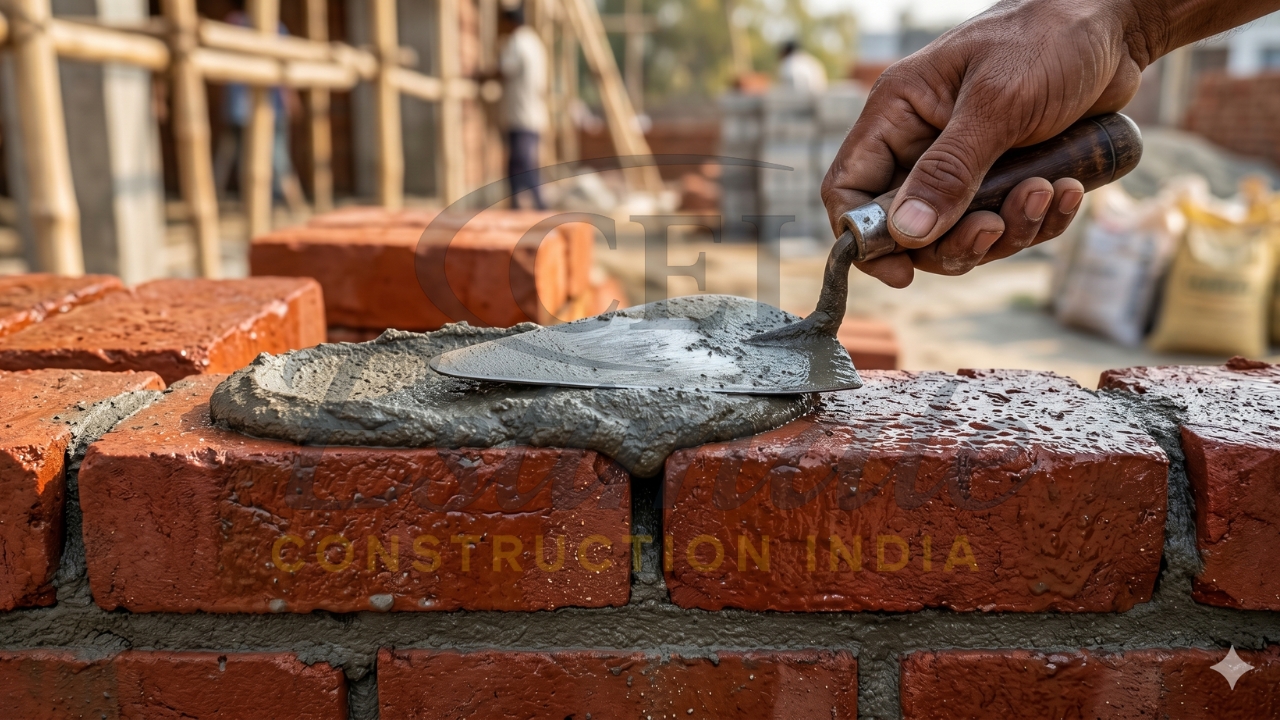
Even a 1:4 mix will fail if your mason mixes it on a pile of dirt. Follow these desi tips for a perfect finish:
- The Platform: Always mix mortar on a clean, non-absorbent platform (like a steel sheet or a finished concrete floor). Mixing on bare earth sucks the water out and adds dirt to your mix.
- Dry Mixing: Mix the cement and sand thoroughly while they are dry until the color is a uniform grey. No streaks of yellow sand should be visible.
- Water is Key: Use clean, drinkable water. Add it slowly. If the mortar is too runny, it will shrink and crack; if it’s too dry, it won’t bond. Aim for a “buttery” consistency.
- The 30-Minute Rule: Only mix as much as you can use in 30-45 minutes. Cement starts setting quickly. Bhai, don’t let the mason “re-temper” old, dry mortar by adding more water—it kills the strength!
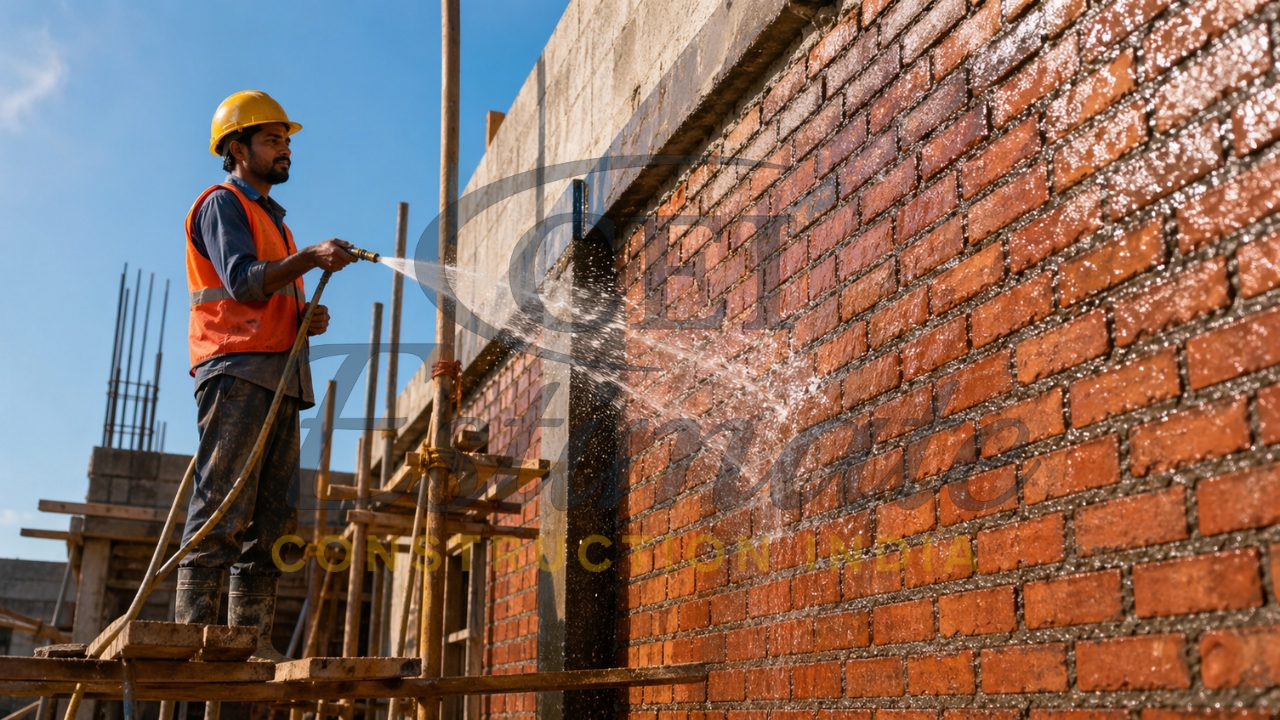
- Curing (The most important part): Once the wall is built, start curing (watering) it after 24 hours. Do this for at least 7 to 10 days. This is where the real strength comes from.
Pro Tips, Additives & Latest Trends in 2026
- Plasticizers: In 2026, more contractors are using liquid plasticizers. A small bottle can make your 1:6 mix as workable and smooth as a 1:4 mix without adding extra cement.
- M-Sand (Manufactured Sand): With river sand becoming expensive and hard to find in places like Delhi NCR, M-Sand is a great alternative. Just ensure it is “washed” and free from dust.
- PPC Cement: For brickwork, Portland Pozzolana Cement (PPC) is generally better than OPC 53 because it has a slower heat of hydration, which means fewer cracks in your mortar joints.
- Ready-Mix Mortar: If you are building in a congested city area, look for dry-mix mortar bags. You just add water. It’s slightly pricier but ensures zero wastage and perfect ratios.
Frequently Asked Questions (FAQs)
- Can I use 1:8 ratio for internal walls to save money?
Arre nahi yaar! 1:8 is too weak. The mortar will eventually turn into dust behind your plaster, and your bricks might even vibrate when you slam a door. Stick to 1:6 minimum. - Is 1:4 always better than 1:6?
Not necessarily. For very thick walls, a very rich 1:4 mix might produce too much heat during setting, leading to more shrinkage cracks. Use the right ratio for the right job. - Why do my mortar joints look white or powdery?
This is often “efflorescence” caused by salts in the sand or water. Always use washed sand and clean water to keep your walls looking fresh. - Should I soak bricks in water before laying them?
Yes, pakka! If the bricks are dry, they will suck the water out of your mortar, making the bond very weak. Soak them until they stop bubbling. - Which sand is best: fine or coarse?
For brickwork, a medium-coarse sand is best. Very fine sand requires more cement to coat the particles, increasing your cost. - Can I mix lime in my mortar?
In the old days, lime was common. It makes the mortar very flexible and “breathable.” However, modern cement-sand mixes are much faster and stronger for today’s fast-paced construction. - How thick should the mortar joint be?
Keep it between 10mm to 12mm. Thicker joints actually weaken the wall because mortar is less strong than the brick itself. - What is the “best” cement for brickwork?
PPC cement is the top choice for masonry in 2026 due to its fine particles and crack resistance.
Conclusion
Building a house is a once-in-a-lifetime journey for most of us. Don’t let a few bags of cement stand between you and a safe, crack-free home. Remember, 1:4 for strength, 1:5 for balance, and 1:6 for economy. Always supervise the mixing on-site—don’t leave it entirely to the laborer’s “andaaza.”
If you found this guide helpful, save it or share it with your contractor. And before you buy your materials, make sure you’re picking the best cement for brick masonry to ensure your mortar ratio works at its full potential.
Happy building, and may your house be budget mein fit aur pakka strong!